Industrial Oven Thermocouple: India’s Complete Buyer and Manufacturer Guide for Kilns, Furnaces & Heat-Treatment Equipment
From automotive component heat-treatment in Pune and Gurugram to ceramic glaze firing in Morbi, from pharmaceutical sterilization ovens in Ahmedabad to semiconductor processing furnaces in Bengaluru — India’s industrial base runs on controlled heat. And controlled heat, at any scale, starts with one thing: a temperature sensor that tells you exactly what’s happening inside the chamber.
An industrial oven thermocouple is the workhorse of this requirement. Unlike laboratory temperature sensors or consumer thermometers, an oven or kiln thermocouple is purpose-built to survive the combination of extreme heat, thermal cycling, oxidizing atmospheres, and mechanical stress that defines industrial oven, kiln, and furnace service — day after day, often for 24-hour continuous operation cycles, for months before replacement.
This is India’s most complete guide to industrial oven thermocouples: how they work, which type fits which oven or kiln, full specifications of Aavad’s industry-standard AKES model, where they’re used across Indian industry, and how to buy the right one — or order a cost-effective like-for-like replacement when yours fails.
What Is an Industrial Oven Thermocouple?
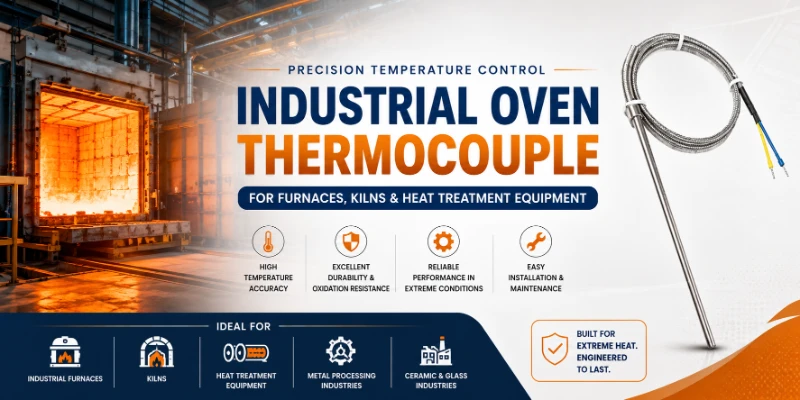
An industrial oven thermocouple is a temperature sensing element — typically a K-type (Chromel/Alumel) mineral-insulated probe housed in a corrosion and high-temperature-resistant sheath — inserted into the hot zone of an industrial oven, kiln, furnace, or heat-treatment chamber to provide continuous temperature measurement for process control.
Unlike surface probes or ambient temperature sensors, an oven thermocouple is:
- Directly exposed to the oven atmosphere — inside the hot zone, not outside the wall
- Designed for continuous high-temperature service — rated for the full operating temperature of the oven with thermal margin, not just a rated maximum
- Mechanically built for thermal cycling — insertion through the oven wall while the probe tip operates at process temperature and the lead wire exits through a cooler transition zone
- Available as a direct OEM replacement for any damaged or drifted thermocouple in an existing oven, regardless of the oven brand or age
Full Specifications: Aavad AKES Industrial Oven Thermocouple
| Parameter | Specification | What It Means for Your Oven |
|---|---|---|
| Type | K (Chromel/Alumel) | Standard for ovens, kilns & furnaces up to 1,200°C |
| Make | Aavad Instrument | ISO 9001:2015 |
| Model | AKES | Standard industrial oven/kiln thermocouple |
| Configuration | Simplex | Single sensing element, 2-wire output |
| Accuracy | ±0.75% | Standard for K-type industrial ovens and kilns |
| Temperature range | 0°C to 1,200°C | Covers 95%+ of all industrial oven, kiln & furnace applications in India |
| Sheath material | Inconel 600 | High-temperature oxidation resistance to ~1,175°C continuous service |
| Insulation | Compacted MgO | Stable electrical isolation under continuous oven temperature cycling |
| Cable length | 3 Metres | Standard; custom lengths available for larger ovens |
| Cable insulation | FG/FG/SS | Fiberglass inner/outer with SS braid — handles the hot intermediate zone between oven wall and junction box |
| OD | 6 mm | Standard for most oven thermowell and direct-insertion fittings |
| Length | 400 mm | Active zone insertion length; custom lengths for deeper kilns available |
Why K-Type and Inconel 600 Are the Correct Default for Industrial Ovens
Why K-Type Is the Standard Oven Thermocouple Type
K-type thermocouples have become the universal standard for oven, kiln, and furnace temperature measurement for four practical reasons:
- Temperature range: -270°C to 1,372°C rated range, with the AKES model specified for 0°C to 1,200°C — covers the operating range of the vast majority of industrial ovens and kilns in India
- Controller compatibility: K-type is the input type that virtually every temperature controller, PID, and data logger sold in India supports as standard — you don’t need a special controller
- Stable, reproducible output: The millivolt output vs. temperature curve for K-type is well-characterized and highly consistent between sensors from a quality manufacturer, supporting tight process control without sensor-specific calibration adjustments
- Cost-effectiveness: K-type Chromel/Alumel is a base-metal thermocouple, significantly less expensive than noble-metal types (R, S, B) while covering all but the most extreme high-temperature applications
Why Inconel 600 Outlasts Stainless Steel in Oven Service
An oven thermocouple’s sheath is continuously exposed to elevated temperature and the oven’s internal atmosphere — typically oxidizing. Over operating hours, stainless steel sheaths oxidize progressively, thinning the sheath wall and eventually compromising the sensor’s electrical integrity. Inconel 600, with its nickel-chromium composition, forms a protective oxide layer at high temperature that resists further oxidation, dramatically extending sheath life compared with SS 310 or SS 316.
For an oven running at 800°C to 1,000°C continuously, the difference between a stainless steel sheath and Inconel 600 can mean the difference between sensor replacement every few months versus once or twice a year — a meaningful maintenance cost difference across a plant with dozens of oven zones.
When to Upgrade Beyond K-Type for Kilns and Furnaces Above 1,200°C
K-type thermocouples with Inconel sheaths are the correct specification for most industrial ovens and kilns. However, as process temperatures approach or exceed 1,200°C continuously, the following upgrades become appropriate:
| Temperature Zone | Recommended Sensor | Reason |
|---|---|---|
| 0°C to 1,200°C | K-type, Inconel 600 sheath (AKES) | Standard — covers the vast majority of industrial ovens and kilns |
| 1,000°C to 1,300°C sustained | N-type thermocouple | Better long-term stability than K-type at sustained high temperatures |
| 1,300°C to 1,480°C | R-type thermocouple | Noble-metal; ceramic protection tube required |
| 1,300°C to 1,600°C | S-type thermocouple | Noble-metal; highest accuracy in this range |
| 600°C to 1,704°C (extreme kilns) | B-type thermocouple | Widest range; for the most extreme kiln applications |
Industrial Oven and Kiln Types Across India: Where This Thermocouple Is Used
Heat-Treatment Furnaces — Automotive and Engineering
Hubs: Pune, Nashik, Aurangabad (Maharashtra) | Gurugram, Manesar, Faridabad (Haryana) | Chennai, Sriperumbudur (Tamil Nadu) | Bengaluru (Karnataka) | Rajkot, Ahmedabad (Gujarat)
Annealing, hardening, tempering, carburizing, and normalizing furnaces all run in the 600°C–1,100°C range that the AKES covers perfectly. With multiple zones per furnace and dozens of furnaces per plant, K-type Inconel thermocouples are often the highest-volume sensor type consumed in automotive heat-treatment facilities.
Ceramic Firing Kilns
Hub: Morbi, Gujarat — India’s #1 ceramic and tile manufacturing cluster
Ceramic floor tile, wall tile, and sanitary ware kilns fire at temperatures typically ranging from 1,050°C to 1,200°C. Zone-by-zone temperature control across tunnel kilns — sometimes 100+ metres long with dozens of temperature control zones — depends on reliable, long-life oven thermocouples. Morbi alone represents one of India’s largest single-cluster demands for industrial kiln thermocouples.
Pharmaceutical Sterilization Ovens and Autoclaves
Hubs: Ahmedabad, Ankleshwar, Vadodara (Gujarat) | Hyderabad, Sangareddy (Telangana) | Aurangabad, Badlapur (Maharashtra) | Baddi, Nalagarh (Himachal Pradesh)
Dry heat sterilization ovens, depyrogenation tunnels, and API drying ovens operate in the 160°C–400°C range — well within the AKES’s rated range. For pharma-grade documentation requirements, NABL-accredited calibration certificates with the thermocouple are a procurement standard.
Food Processing — Baking, Roasting, Drying
Hubs: Ahmedabad, Anand (Gujarat) | Pune, Nashik (Maharashtra) | Ludhiana (Punjab) | Hyderabad (Telangana) | Delhi NCR
Industrial baking ovens, roasting tunnels, grain dryers, and hot-air drying ovens typically operate in the 100°C–350°C range. Consistent zone temperature is directly linked to product consistency — batch colour, moisture content, and texture are all temperature-dependent.
Glass and Refractories Manufacturing
Hubs: Firozabad, Agra (UP) | Bharuch, Surat (Gujarat) | Kolkata (West Bengal) | NashNash (Maharashtra)
Glass melting and annealing furnaces, refractory firing kilns, and glass tempering ovens all operate at temperatures spanning the AKES’s full 0°C to 1,200°C range. Long service life in an oxidizing atmosphere makes Inconel 600 the sheath material of choice.
Paint Curing and Powder Coating Ovens
Hubs: Pune, Nashik (Maharashtra) | Gurugram, Faridabad (Haryana) | Ahmedabad (Gujarat) | Chennai (Tamil Nadu) | Ludhiana (Punjab)
Paint curing and powder coating lines typically operate at 150°C–250°C, with thermocouple sensors monitoring zone-by-zone temperature across the conveyor oven length to ensure even curing coverage on parts.
Textile Dyeing and Heat-Setting Stenters
Hub: Surat, Ahmedabad (Gujarat) | Bhilwara (Rajasthan) | Tiruppur (Tamil Nadu)
Stenter ovens used for heat-setting synthetic fabrics and drying dye-coated textiles run at 150°C–220°C across multiple zones. Consistent temperature across the width and length of the stenter directly affects fabric quality and shrinkage control.
Electronics, PCB, and Semiconductor Equipment
Hubs: Bengaluru (Karnataka) | Pune, Nashik (Maharashtra) | Noida, Greater Noida (UP) | Hyderabad (Telangana) | Chennai (Tamil Nadu)
Reflow soldering ovens, burn-in test chambers, and semiconductor processing furnaces use thermocouples for precise zone-by-zone temperature control at temperatures from 100°C to 400°C.
Like-for-Like Replacement: How to Replace a Failed Oven Thermocouple Without Downtime
One of the most common scenarios Aavad Instrument handles is a production team calling with a simple request: their oven thermocouple has failed, production is stopped, and they need a replacement — ideally today.
Aavad specifically manufactures and stocks industrial oven thermocouples as cost-effective like-for-like replacements for existing sensors in any brand of industrial oven, kiln, or furnace. If your existing thermocouple has failed:
- Photograph or note the following from the failed sensor: Type marking (usually K, J, etc.), sheath OD (usually 4mm, 6mm, or 8mm), insertion length below the connection fitting or connector, cable length, cable type, and termination style (head, connector, or bare leads)
- Call or WhatsApp Aavad’s team at +91 90996 22823 with these details
- Receive a matched specification replacement — typically configurable from standard stock within short lead times
- Receive with NABL calibration certificate if required for your quality system
India-Wide Coverage: Where Aavad Supplies Industrial Oven Thermocouples
Aavad Instrument supplies PAN India with fast despatch from Ahmedabad, Gujarat:
Gujarat: Ahmedabad, Vadodara, Surat, Rajkot, Morbi (ceramics), Ankleshwar, Vapi, Bharuch, Dahej, Jamnagar, Gandhinagar, Mehsana, Porbandar, Bhavnagar
Maharashtra: Pune, Nashik, Mumbai, Aurangabad, Nagpur, Kolhapur, Raigad, Badlapur
Delhi NCR: Noida, Greater Noida, Faridabad, Gurgaon, Manesar, Ghaziabad
Haryana: Gurugram, Faridabad, Panipat, Bahadurgarh, Sonipat, Manesar
Tamil Nadu: Chennai, Coimbatore, Tiruppur, Salem, Hosur, Ennore, Sriperumbudur
Karnataka: Bengaluru, Mysuru, Hubballi, Belagavi, Ballari/Hospet, Tumakuru
Telangana & Andhra Pradesh: Hyderabad, Sangareddy, Visakhapatnam, Vijayawada, Kakinada
Rajasthan: Jaipur, Bhilwara, Kota, Jodhpur, Alwar, Bhiwadi, Neemrana, Chittorgarh
Uttar Pradesh: Noida, Greater Noida, Agra, Firozabad, Lucknow, Kanpur, Varanasi
Madhya Pradesh: Indore, Bhopal, Pithampur, Dewas, Ratlam
Odisha: Bhubaneswar, Rourkela, Angul, Talcher, Sambalpur
West Bengal: Kolkata, Durgapur, Haldia, Asansol, Howrah
Punjab: Ludhiana, Amritsar, Jalandhar, Mohali, Batala
Himachal Pradesh: Baddi, Nalagarh, Parwanoo, Solan
Jharkhand: Jamshedpur, Bokaro, Ranchi, Dhanbad
Chhattisgarh: Raipur, Bhilai, Korba, Bilaspur
Kerala: Kochi, Thrissur, Kozhikode, Kottayam, Thiruvananthapuram
Why Aavad Instrument Is India’s #1 Industrial Oven Thermocouple Manufacturer
Aavad Instrument Pvt. Ltd., Chandkheda, Ahmedabad, Gujarat:
- ISO 9001:2015 certified manufacturing facility
- In-house NABL-accredited calibration laboratory — certificates available with every sensor
- 15+ years manufacturing thermocouples for ovens, kilns, furnaces, and process industry
- 38 million+ successful installations across India and 12+ countries
- 2,900+ customers including BHEL, ONGC, HAL, BARC, NALCO, Indian Railways, Indian Oil, Bharat Petroleum, NPCIL, L&T, Torrent Pharma, Piramal Glass, Aditya Birla Group, Atul Ltd., Sintex, PepsiCo, Kohler, Saint-Gobain, Cera, MIDHANI, RVUN
- Supply to both OEM machine manufacturers and end-users needing replacement sensors
- Custom configurations — insertion length, OD, cable length, thermocouple type — via Build Your Products
- Fast despatch PAN India with same-day processing for standard stock configurations
Frequently Asked Questions
Q1. What type of thermocouple is used in industrial ovens, kilns, and furnaces?
K-type (Chromel/Alumel) thermocouples are by far the most common type used in industrial ovens, kilns, and furnaces across India and globally. They cover 0°C to 1,200°C, are compatible with virtually all industrial temperature controllers, and are available in a wide range of sheath materials including Inconel 600 for high-temperature service. For temperatures above 1,200°C, N-type (up to 1,300°C), R-type or S-type (up to 1,600°C), or B-type (up to 1,704°C) thermocouples with ceramic protection tubes are the appropriate specification.
Q2. Why is Inconel 600 used as the sheath material for industrial oven thermocouples?
Inconel 600 is a nickel-chromium alloy with excellent oxidation resistance at sustained high temperatures — significantly better than stainless steel at temperatures above approximately 800°C. For ovens and kilns running continuously near or above 1,000°C, Inconel 600 sheaths last significantly longer than stainless alternatives, reducing sensor replacement frequency and maintenance costs.
Q3. How do I replace a failed thermocouple in my industrial oven?
Note or photograph the key parameters of your existing thermocouple: type (K, J, etc.), sheath OD, insertion length, cable length, cable type, and connection style. Contact Aavad Instrument with these details at +91 90996 22823 or hrg@aavadinstrument.com — Aavad specifically supplies cost-effective like-for-like oven thermocouple replacements for any brand of industrial oven, kiln, or furnace.
Q4. What is compacted MgO insulation and why does it matter in an oven thermocouple?
Compacted Magnesium Oxide (MgO) powder is packed around the thermocouple sensing wires inside the metal sheath. It maintains electrical isolation between the wires and the sheath at high operating temperatures, prevents the wire conductors from contacting each other, and physically supports the wires along the probe length to resist vibration-induced breakage. It is the standard insulation material for mineral-insulated thermocouples in oven, kiln, and furnace service.
Q5. Can one thermocouple be used across different types of industrial ovens?
The AKES model covers 0°C to 1,200°C, making it compatible with the vast majority of industrial oven, kiln, and furnace applications. However, the insertion length, cable length, and connection style may need to vary between different oven designs. Aavad manufactures the AKES in custom dimensions to match your specific oven’s mounting geometry.
Q6. Does Aavad supply oven thermocouples with NABL calibration certificates?
Yes. NABL-accredited calibration certificates are available from Aavad’s in-house calibration laboratory, providing traceable documentation for ISO quality systems, GMP-regulated pharmaceutical manufacturing, and any application where calibration evidence is required for audit or regulatory purposes.
Q7. What is the FG/FG/SS cable on the AKES oven thermocouple?
FG/FG/SS refers to Fiberglass-Fiberglass-Stainless Steel braid cable construction. The fiberglass inner and outer insulation handles the elevated ambient temperatures that are common in the cable path near an industrial oven — where a standard PVC cable would soften and degrade — while the stainless steel braid provides EMI shielding and mechanical protection against abrasion and handling stress.
Q8. Does Aavad supply industrial oven thermocouples across all Indian states?
Yes — Aavad Instrument supplies PAN India with fast despatch from the Ahmedabad manufacturing facility, with active deployments across all major Indian industrial states including Gujarat, Maharashtra, Rajasthan, Tamil Nadu, Karnataka, Telangana, Andhra Pradesh, Uttar Pradesh, Delhi NCR, Haryana, Punjab, Odisha, West Bengal, Madhya Pradesh, Chhattisgarh, Jharkhand, Himachal Pradesh, and Kerala.
Buy Industrial Oven Thermocouples from India’s #1 Manufacturer
View the product page for complete specifications, or contact Aavad Instrument for a like-for-like replacement quote or a custom order.
📞 +91 90996 22823 | ✉ hrg@aavadinstrument.com | ISO 9001:2015 | NABL Accredited | Ahmedabad, Gujarat | PAN India Supply