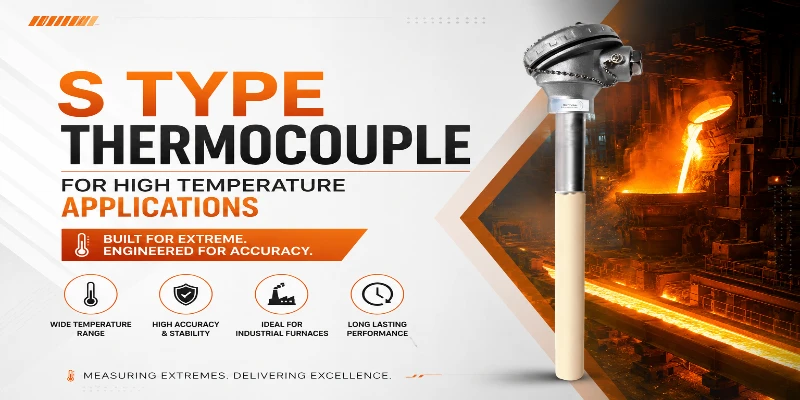
S Type Thermocouple: Why It’s the Gold Standard for Temperature Measurement Above 1,200°C in Glass, Pharma & Calibration Industries
In the hierarchy of thermocouple types, the S Type occupies a unique position. It is not simply a “high-temperature thermocouple” — it is the reference-grade instrument that national metrology institutes and NABL-accredited calibration laboratories use to calibrate other temperature sensors. It is the sensor that pharma and biotech manufacturers specify for critical processes where regulatory documentation demands traceable, verifiable measurement. And it is the workhorse of glass melting furnace crown and combustion zone temperature control across India’s glass industry. This is not a coincidence — it reflects the S type’s specific combination of accuracy, stability, and international calibration support that no base-metal thermocouple can match.
This guide covers the complete Aavad ASWS-D S Type Thermocouple specification, why its ceramic protection system with double Ker-710 protection is essential for sustained high-temperature service, why the S type is called the “gold standard” of thermocouple measurement, and where it’s used across every major Indian industry that operates above 1,200°C.
What Is an S Type Thermocouple?
A Type S thermocouple uses:
- Positive leg: 90% Platinum + 10% Rhodium (Pt.Rh 10%)
- Negative leg: Pure Platinum (Pt)
This specific composition places S type in the noble metal thermocouple family — built from precious metals that retain thermoelectric stability at temperatures where all base-metal alloys fail. The 10% rhodium addition to the positive leg improves mechanical stability at high temperature (pure platinum is too soft above ~1,000°C) while maintaining the excellent thermoelectric accuracy that makes platinum-based thermocouples the reference standard for high-temperature measurement.
Type S can be used in oxidizing or inert atmospheres continuously at temperatures up to 1,600°C, and for brief periods up to 1,700°C. This is confirmed in the live product specification.
Why S Type Is Called the “Gold Standard” of Thermocouple Measurement
The ITS-90 Reference Standard
The International Temperature Scale of 1990 (ITS-90) — the basis for all traceable temperature measurement worldwide — defines the silver point (961.78°C) and the gold point (1,064.18°C) as fixed points using platinum resistance thermometers and platinum-based thermocouple references respectively. S type thermocouples have historically been the instrument of choice for interpolating the ITS-90 scale in the range from approximately 630°C to 1,064°C, making them literally the instrument on which international temperature standards are built at these temperatures.
When a NABL-accredited calibration laboratory calibrates any high-temperature instrument, the traceability chain — from your instrument’s certificate back to national and ultimately international standards — runs through platinum-based thermocouple references. This is why S type is the reference-grade specification.
Wide Third-Party Calibration Support
More calibration data, inter-laboratory comparison data, and certified reference material values exist for S type thermocouples than for any other noble metal type. For industries where third-party verification, NABL audit, or export market documentation requirements apply, S type’s universally recognized calibration foundation is an operational advantage.
Accuracy at High Temperatures
When correctly calibrated, S type thermocouples provide very high accuracy across their operating range — particularly important for applications like pharmaceutical validation, where the measurement uncertainty must be documented and minimized to support process validation.
Full Specifications: Aavad ASWS-D / ASIS S Type Thermocouple
| Parameter | Specification | Engineering Significance |
|---|---|---|
| Type | S (Pt.Rh 10%/Pt) | 10% Rhodium/Platinum noble metal pair |
| Make | Aavad Instrument | ISO 9001:2015 |
| Model | ASIS / ASWS-D | Standard S Type ceramic assembly |
| Datasheet | ASIA_24X750 | Available for download |
| Element | Pt.Rh (10%)/Pt | Noble metal: 0.45mm element diameter |
| Element diameter | 0.45 mm | Standard noble metal wire gauge |
| Calibration standard | ANSI MC 96.1 | International accuracy compliance |
| Configuration | Simplex | Single element, 2-wire output |
| Insulation | Twin hole ceramic Ker-710 | 99.7% alumina — highest purity standard |
| Hot junction | Un-grounded | Electrically isolated — no furnace ground interference |
| Terminal block | Ceramic with nickel-plated brass terminals | High-temperature terminal construction |
| Head | Die-cast aluminum weatherproof ANSI Blue, threaded cover & chain | IP-67 rated |
| Protection class | IP-67 | Sealed against dust and water ingress |
| Cable entry | 1/2″ (F) NPT | Standard cable entry |
| Holding tube MOC | SS 310 | High-temperature stainless transition tube |
| Holding tube diameter | 30 mm | Outer metallic assembly diameter |
| Holding tube length | 150 mm | Metallic section length |
| No. of protection | Double protection | Both outer and inner Ker-710 ceramic tubes |
| Outer ceramic | 24 × 18 mm ID, Ker-710 (alumina 99.7%), 600 mm long | Primary large-bore outer protection |
| Inner ceramic | 15 × 10 mm ID, Ker-710 (alumina 99.7%), 600 mm long | Secondary inner protection |
| Exposed ceramic length | 450 mm | Active ceramic zone inside furnace atmosphere |
| Joint construction | High-temperature alumina compound bonding | Structural integrity at furnace temperatures |
| Range | Up to 1,600°C | Continuous; brief operation to 1,700°C |
ASWS-D vs ASIS: Understanding the Two S Type Models
A key clarification for buyers: Aavad lists two S type configurations:
- ASIS (or ASWS-D with datasheet ASIA_24X750): The double-protection configuration with 24×18mm outer and 15×10mm inner Ker-710 ceramic, 600mm ceramic length, 450mm exposed, rated to 1,600°C — the premium S type assembly for sustained high-temperature service up to 1,600°C
- ASWS (the High Temperature Thermocouple ASWS listed separately as model ASWS with datasheet ASWS_24X1750): A different, larger assembly configuration with 1,500mm+ total ceramic length and 1″ 300#RF flange, also rated up to 1,500°C — designed for deep insertion in large-bore process connections
Confirm which configuration suits your furnace connection geometry and insertion depth requirement with Aavad’s engineering team.
Double Ker-710 Ceramic Protection: Why S Type Needs Both Tubes
The 99.7% purity Ker-710 alumina specification for both inner and outer protection tubes is non-negotiable for sustained S type service. The S type’s pure platinum negative leg is specifically sensitive to silica contamination — silica vapor from the glass melt, combustion products, or lower-purity refractories — which forms platinum silicide compounds that permanently shift the thermoelectric calibration.
Double Ker-710 protection provides:
- Outer tube (24×18mm, 600mm): Intercepts silica vapor, alkali vapors, and combustion products from reaching the noble metal element
- Inner tube (15×10mm, 600mm): Secondary barrier ensuring the platinum wires see only the clean ceramic atmosphere of the inner tube rather than the potentially contaminated outer ceramic surface
- Alumina compound bonding at the SS 310/ceramic joint: Maintains gas-seal integrity at the critical transition point where atmospheric bypass would otherwise allow furnace gases to bypass the ceramic protection system
Why S Type Is the Dominant Noble Metal Type in Biotech & Pharmaceutical Industries
India’s pharmaceutical and biotech sectors specify S type thermocouples for specific high-temperature applications for reasons that differ from glass and steel plants: it is not about raw temperature range (pharma sterilization operates at 160°C–400°C, well below S type’s ceiling), but about calibration traceability and measurement authority.
When a pharmaceutical manufacturer validates a depyrogenation tunnel, an autoclave, or a sterilization oven, the validation protocol requires that every temperature sensor used is calibrated against a traceable reference standard with documented uncertainty. S type thermocouples, as the international temperature reference standard instruments, provide the calibration traceability chain that GMP validation protocols require — and which base-metal thermocouples cannot provide at the same level of documentation authority.
Pharma and biotech manufacturing hubs in India:
- Ahmedabad, Ankleshwar, Vadodara, Vapi (Gujarat)
- Aurangabad, Pune, Badlapur (Maharashtra)
- Hyderabad, Sangareddy (Telangana)
- Baddi, Nalagarh (Himachal Pradesh)
- Noida, Greater Noida (UP)
Industries and Applications Across India
Glass Manufacturing
All India glass clusters (Firozabad/UP, Bharuch/Gujarat, Nashik/Maharashtra, Kolkata/WB, Hyderabad/Telangana) — crown, combustion zone, refiner, and forehearth temperature monitoring. S type is the dominant noble metal specification for glass plants globally.
Ceramics and Tiles — Morbi, Gujarat
Peak firing zone monitoring in tunnel kilns where temperatures approach 1,100°C–1,200°C. S type is the appropriate specification when kiln temperatures approach the upper range of what base-metal thermocouples reliably handle.
Pharmaceutical, Biotech, and Life Sciences
Validation reference measurements, calibration transfer standards, and process monitoring in high-temperature pharmaceutical processing equipment.
Steel and Metals — Soaking Pits, EAF, Ladles
Where sustained high-temperature stability and calibration traceability matter more than initial sensor cost — particularly at high-audit steel plants and those supplying automotive or aerospace customers with strict process documentation requirements.
Calibration Laboratories and National Metrology
NABL-accredited calibration labs across India | CSIR labs | BARC | ISRO | NPL (National Physical Laboratory, New Delhi) — reference-grade temperature measurement for instrument calibration.
Power Generation — High-Temperature Combustion Zones
Superheater, reheater, and high-temperature combustion zone monitoring at India’s thermal power stations.
India-Wide Coverage
Aavad Instrument supplies S Type Thermocouples PAN India from Ahmedabad:
Gujarat: Ahmedabad, Vadodara, Surat, Rajkot, Morbi, Bharuch, Vapi, Jamnagar, Ankleshwar, Dahej, Hazira, Gandhinagar, Porbandar
Maharashtra: Nashik, Pune, Mumbai, Aurangabad, Nagpur, Raigad
UP: Firozabad, Agra, Noida, Kanpur, Lucknow, Renukoot
WB: Kolkata, Howrah, Durgapur, Asansol, Bardhaman
Rajasthan: Jaipur, Chittorgarh, Kota, Alwar, Bhilwara
Tamil Nadu: Chennai, Coimbatore, Mettur, Ennore, Hosur, Tuticorin
Karnataka: Bengaluru, Ballari/Hospet, Belagavi, Mysuru, Mangaluru
Telangana & AP: Hyderabad, Ramagundam, Visakhapatnam, Nalgonda
Odisha, Jharkhand, CG, MP, Delhi NCR, Haryana, Punjab, Kerala, HP, Uttarakhand: PAN India
Aavad Instrument: India’s #1 S Type Thermocouple Manufacturer
Aavad Instrument Pvt. Ltd., Chandkheda, Ahmedabad:
- ISO 9001:2015 certified | NABL-accredited calibration laboratory
- 15+ years | 38M+ installations | 2,900+ customers | 12+ countries
- Trusted by Saint-Gobain, Piramal Glass, Torrent Pharma, BHEL, ONGC, BARC, NALCO, L&T, MIDHANI
Frequently Asked Questions
Q1. Why is the S Type thermocouple called the “gold standard” of temperature measurement?
The S type thermocouple (Pt.Rh 10%/Pt) is the noble metal thermocouple type upon which international temperature calibration standards (including ITS-90) are based in the range from approximately 630°C to 1,064°C. This makes it literally the reference instrument for traceable high-temperature measurement — the thermocouple type from which all other thermocouple calibrations are ultimately traced.
Q2. What is the maximum continuous operating temperature of Aavad’s S Type Thermocouple (ASIS/ASWS-D)?
Continuous operation up to 1,600°C, with brief operation possible up to 1,700°C in appropriate conditions. This is specified directly in the product description.
Q3. Why does S type need double Ker-710 ceramic protection?
The pure platinum negative leg of an S type thermocouple is vulnerable to silica contamination and alkali vapor attack from glass furnace and kiln atmospheres. Double Ker-710 (99.7% alumina) protection intercepts these contaminants at both the outer and inner ceramic level before they can reach and permanently alter the calibration of the noble metal sensing element.
Q4. What is the difference between Aavad’s S type ASIS and the High Temperature Thermocouple ASWS?
The ASIS/ASWS-D (double protection, 24×18mm outer ceramic, 600mm ceramic, 450mm exposed, rated 1,600°C, 1/2″ NPT cable entry) is the standard double-protection S type assembly. The ASWS High Temperature Thermocouple (2″ 300#RF flange, 1,500mm+ total ceramic length, 1,500°C rating) is a larger assembly for deep insertion in large-bore furnace process connections. Confirm your furnace connection geometry and insertion requirements with Aavad’s team.
Q5. Why does the pharmaceutical industry specify S type thermocouples?
Pharmaceutical GMP validation protocols require temperature sensors with documented calibration traceability to national and international standards. S type thermocouples, as the reference-grade noble metal thermocouple type in the ITS-90 temperature scale, provide the calibration authority and traceability documentation that validation protocols require — and that base-metal thermocouple calibrations cannot provide at the same level.
Q6. Can S type thermocouples be used in reducing atmospheres?
No. S type noble metal thermocouples must only be used in oxidizing or inert atmospheres. Reducing atmospheres contaminate and permanently degrade platinum and platinum-rhodium elements. Confirm your furnace atmosphere before specifying.
Q7. Is NABL calibration available for S Type thermocouples?
Yes. Aavad’s in-house NABL-accredited calibration laboratory issues traceable calibration certificates for S type thermocouples, providing the documentation required for ISO quality systems, GMP validation, and regulatory audit requirements.
Buy S Type Thermocouples from India’s #1 Manufacturer
View the product page and download datasheet ASIA_24X750 or contact Aavad Instrument for a quote.
📞 +91 90996 22823 | ✉ hrg@aavadinstrument.com | ISO 9001:2015 | NABL Accredited | Ahmedabad, Gujarat | PAN India Supply