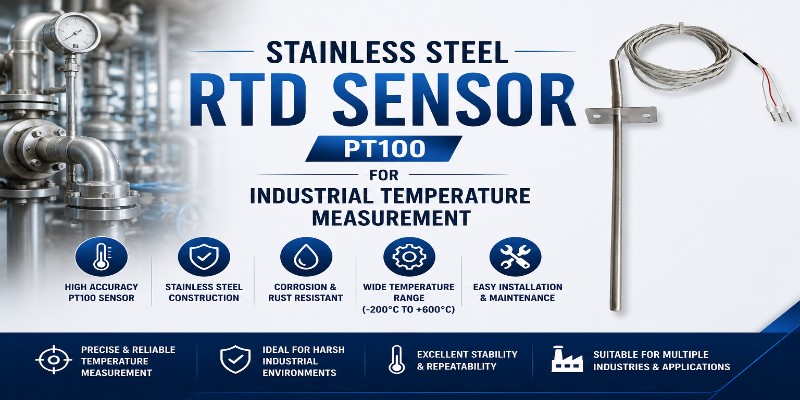
Stainless Steel RTD Sensor: What Is the Best General-Purpose PT100 Probe for Process Industries?
Across India’s process manufacturing base — from the chemical and petrochemical corridor running through Ankleshwar, Vapi, and Dahej in Gujarat, to the refineries of Jamnagar and Vizag, the thermal power stations of Korba and Ramagundam, the food and dairy processing plants of Anand and Ludhiana, and the pharmaceutical and HVAC installations found in nearly every industrial city in the country — one sensor shows up more often than any other single instrument on the P&ID: a general-purpose Stainless Steel RTD Sensor. It’s the workhorse of industrial temperature measurement, and the reason is straightforward — it is accurate, stable, corrosion-resistant, and simple to specify for almost any liquid, gas, or surface measurement point.
What Is a Stainless Steel RTD Sensor?
A Stainless Steel RTD Sensor is a PT100 resistance temperature detector housed in a stainless steel sheath, designed for direct immersion or insertion into process piping, tanks, vessels, and equipment across a wide range of industries. Unlike specialty sensors built for one specific mounting method — bayonet, weld pad, or clamp-on — this is the standard, general-duty wire-type RTD probe most engineers reach for first when specifying a new temperature measurement point.
Its defining characteristics for general industrial duty:
- PT100 element with Class A accuracy: tight tolerance for reliable process monitoring and control-loop feedback
- SS 316 sheath construction: excellent mechanical strength and corrosion resistance across chemical, food, and moisture-heavy environments
- 300 mm sensor length: suited to standard immersion depths in pipes, tanks, and vessels
- 3-wire configuration: lead-resistance compensation for accurate readings over standard cable runs
Full Specifications: Aavad APES-6X300 Stainless Steel RTD Sensor
| Parameter | Specification | Engineering Significance |
|---|---|---|
| Type | PT-100 | Standardised 100 Ohms at 0°C; IEC 60751 resistance curve |
| Make | Aavad Instrument | ISO 9001:2015 |
| Model | APES-6X300 | Standard general-purpose wire-type RTD probe |
| Datasheet | APES_6X300 | Available for download from product page |
| Configuration | Simplex | Single measuring element |
| Total no. of wires | 3-wire | Lead-resistance compensation for accurate readings |
| Accuracy | Class A | ±(0.15 + 0.002 |
| Temperature range | -50°C to 400°C | Covers the large majority of industrial process temperatures in one probe |
| Material of construction | SS 316 | Corrosion-resistant, durable across chemical and food-grade environments |
| Insulation | Compacted MgO | Fast response and stable insulation resistance under thermal cycling |
| Cable length | 5 metres | Standard; custom lengths available |
| Cable type | TF/TF | Teflon-insulated, moisture- and heat-resistant |
| Sensor OD | 6 mm | Standard fit for most process ports and thermowells |
| Sensor length | 300 mm | Suited to standard pipe, tank, and vessel immersion depths |
Why a General-Purpose PT100 RTD Belongs in Almost Every Process
1. Class A Accuracy for Control-Loop Confidence
Process control loops — whether feeding a PID controller, SCADA system, or PLC — are only as good as the temperature signal driving them. Class A accuracy gives process engineers a tighter, more dependable input for closed-loop temperature control compared to Class B sensors.
2. SS 316 for Cross-Industry Corrosion Resistance
SS 316 is the standard material choice precisely because it performs reliably across such a wide range of environments — mildly corrosive chemical process fluids, food-grade liquids, moist HVAC air streams, and general industrial atmospheres — without requiring a different material spec for every application.
3. -50°C to 400°C Covers Most Applications in One Probe
Very few industrial process points fall outside this range, which is why a single standard product like the APES-6X300 can serve as the default specification across chemical plants, refineries, power stations, food processing, and HVAC systems alike — simplifying spares inventory and sensor standardization across a plant.
4. Simple Wire-Type Construction for Straightforward Installation
As a wire-type sensor rather than a head-mounted or transmitter-integrated design, it installs directly into a thermowell, compression fitting, or process port with a simple cable connection to a controller or transmitter — no additional housing or wiring complexity.
Stainless Steel RTD Sensor vs. Other RTD Mounting Styles
| Sensor Type | Mounting | Best Use Case |
|---|---|---|
| Stainless Steel RTD Sensor (Wire Type) | Direct insertion via thermowell or compression fitting | General-purpose liquid, gas, and surface measurement across most industries |
| Weld Pad RTD Sensor | Permanently welded to a surface | Pipe/vessel skin temperature where penetration isn’t possible |
| 3 Wire RTD Sensor | Direct insertion, standard 3-wire lead compensation | Similar general-purpose duty; confirm wiring compatibility with existing instrumentation |
| Plastic Machinery RTD Sensor | Bayonet/threaded, machine-specific | Extruder and injection molding barrel zones |
If your application needs permanent surface mounting without penetrating the pipe, the Weld Pad RTD Sensor is the better fit. For direct immersion in liquid, gas, or general process points, the standard wire-type Stainless Steel RTD Sensor remains the default choice.
Industries and Applications Across India
Chemical & Petrochemical Plants
Chemical process hubs: Ankleshwar, Vapi, Dahej, Nandesari, Panoli (Gujarat) | Panipat (Haryana) | Vizag (Andhra Pradesh) | Mangaluru (Karnataka)
General-purpose PT100 RTDs monitor reactor jackets, pipelines, and storage tanks across chemical and petrochemical processing lines where reliable Class A accuracy supports both process control and batch quality documentation.
Oil & Gas and Refineries
Refinery clusters: Jamnagar, Vadodara (Gujarat) | Mumbai (Maharashtra) | Vizag (Andhra Pradesh) | Chennai (Tamil Nadu) | Panipat (Haryana) | Kochi (Kerala)
Process piping, storage tank, and separator temperature monitoring throughout upstream, midstream, and downstream oil & gas operations.
Power Plants & Energy Systems
Thermal power hubs: Korba, Sipat (Chhattisgarh) | Ramagundam (Telangana) | Vindhyachal, Singrauli (UP/MP) | Mundra, Kawas (Gujarat) | Chandrapur (Maharashtra)
Feedwater, cooling water, and auxiliary system temperature monitoring across thermal and combined-cycle power generation.
HVAC and Refrigeration Systems
Chilled water supply/return, cooling coil, and air handling unit temperature monitoring in commercial and industrial HVAC systems across every major Indian city.
Food, Beverage & Pharmaceutical Processing
Dairy and food processing hubs: Anand, Mehsana (Gujarat) | Ludhiana (Punjab) | Pune (Maharashtra) | Delhi NCR
Pharmaceutical manufacturing hubs: Ahmedabad, Vadodara, Ankleshwar (Gujarat) | Baddi (Himachal Pradesh) | Hyderabad, Pune
Pasteurization, sterilization, and process temperature monitoring where SS 316 construction meets the corrosion and hygiene demands of food-grade and pharma-grade environments.
Machinery, Plant & Equipment Temperature Sensing
General industrial machinery, compressors, and plant utility systems across manufacturing facilities nationwide use the standard wire-type RTD as the default sensor for equipment temperature monitoring.
Tanks, Pipelines & Vessels
Storage tank and pipeline temperature monitoring across chemical, oil & gas, and bulk liquid handling facilities, typically installed via a thermowell for process isolation.
Laboratory and Calibration Applications
Research institutions and NABL-accredited calibration labs across cities like Bengaluru, Mumbai, Hyderabad, Pune, Chennai, and Delhi use Class A PT100 RTDs as reference-grade sensors for calibration and validation work.
Stainless Steel RTD Sensor vs. 3 Wire RTD Sensor: Key Distinction
Buyers sometimes compare the Stainless Steel RTD Sensor (APES-6X300) with the 3 Wire RTD Sensor listed separately in Aavad’s catalog. Both use the same 3-wire PT100 lead configuration — the key differences typically come down to:
| Feature | Stainless Steel RTD Sensor (APES-6X300) | 3 Wire RTD Sensor |
|---|---|---|
| Sensor length | 300 mm (standard) | Application-dependent, may vary by model |
| Positioning | Marketed as general-purpose SS-sheathed probe | Marketed by wiring configuration for instrumentation compatibility |
| Best for | Buyers specifying by material and length | Buyers specifying by wiring/lead configuration for existing systems |
Both are legitimate general-purpose options — the right choice comes down to matching sensor length and lead configuration to your specific thermowell or process port. Aavad’s Build Your Products service can also produce a custom length or configuration if neither standard model fits exactly.
India-Wide Coverage
Aavad Instrument supplies Stainless Steel RTD Sensors PAN India from Ahmedabad, Gujarat:
Gujarat: Ahmedabad, Vadodara, Surat, Jamnagar, Ankleshwar, Vapi, Dahej, Rajkot, Anand, Mehsana
Maharashtra: Mumbai, Pune, Nagpur, Nashik, Chandrapur
Andhra Pradesh & Telangana: Visakhapatnam, Ramagundam, Hyderabad
Haryana & Delhi NCR: Panipat, Faridabad, Gurugram, Delhi, Noida
Tamil Nadu: Chennai, Coimbatore, Madurai
Karnataka: Bengaluru, Mangaluru, Mysuru
Kerala: Kochi, Thiruvananthapuram
Punjab: Ludhiana, Jalandhar, Amritsar
Chhattisgarh & Madhya Pradesh: Korba, Sipat, Bhopal, Indore
Himachal Pradesh: Baddi, Nalagarh
Rajasthan, West Bengal, Uttar Pradesh, Bihar, and all other states: PAN India delivery available
Aavad Instrument: India’s Trusted Stainless Steel RTD Sensor Manufacturer
Aavad Instrument Pvt. Ltd., Chandkheda, Ahmedabad, Gujarat:
- ISO 9001:2015 certified | NABL-accredited calibration laboratory
- 15+ years | 38M+ installations | 2,900+ customers | 12+ countries
- Trusted by BHEL, ONGC, Indian Oil, Bharat Petroleum, NPCIL, L&T, HAL, BARC, NALCO, Aditya Birla Group, Torrent Pharma, PepsiCo, Kohler, Cera, Saint-Gobain
Frequently Asked Questions
Q1. What is a stainless steel RTD sensor used for?
A stainless steel RTD sensor is a general-purpose PT100 temperature probe used across chemical, oil & gas, power, HVAC, food, pharmaceutical, and general industrial applications for accurate, stable temperature measurement in liquids, gases, and on surfaces.
Q2. What temperature range does Aavad’s stainless steel RTD sensor cover?
The standard APES-6X300 model covers -50°C to 400°C using a PT100 element with Class A accuracy, suitable for the large majority of industrial process temperature points.
Q3. Why is SS 316 used for RTD sensor construction?
SS 316 offers strong corrosion and chemical resistance across a wide range of environments — from mildly corrosive process fluids to food-grade and pharmaceutical applications — making it the standard material for general-purpose RTD probes.
Q4. What does Class A accuracy mean and why does it matter?
Class A is a tighter accuracy tolerance (per IEC 60751) than Class B, giving process control loops and monitoring systems a more precise, dependable temperature signal — particularly important for closed-loop PID control and quality-critical processes.
Q5. Can the stainless steel RTD sensor be customized?
Yes. Aavad manufactures both standard and fully custom stainless steel RTD sensors — including custom sensor length, cable length, and accuracy class — through the Build Your Products service to match specific thermowell or process port requirements.
Q6. What is the difference between a wire-type RTD and other RTD mounting styles?
A wire-type RTD like the APES-6X300 installs via direct insertion into a thermowell or compression fitting and connects via cable to a controller or transmitter — as opposed to weld pad RTDs (permanently welded to a surface) or bayonet RTDs (spring-loaded, quarter-turn mount for machinery).
Q7. Which industries commonly use general-purpose stainless steel RTD sensors?
Chemical and petrochemical plants, oil & gas and refineries, power plants and energy systems, HVAC and refrigeration, food and beverage processing, pharmaceutical manufacturing, general machinery temperature sensing, and laboratory/calibration applications.
Q8. Does Aavad supply stainless steel RTD sensors across India?
Yes — PAN India from Ahmedabad, with active supply into chemical, refinery, power, food, pharma, and HVAC hubs across Gujarat, Maharashtra, Andhra Pradesh, Telangana, Haryana, Tamil Nadu, Karnataka, Kerala, Punjab, Chhattisgarh, Madhya Pradesh, Himachal Pradesh, and all other Indian states.
Buy Stainless Steel RTD Sensors from India’s Trusted Manufacturer
View the product page and download datasheet APES-6X300 or contact Aavad Instrument for general-purpose process temperature sensor requirements.
📞 +91 90996 22823 | ✉ hrg@aavadinstrument.com | ISO 9001:2015 | NABL Accredited | Ahmedabad, Gujarat | PAN India Supply