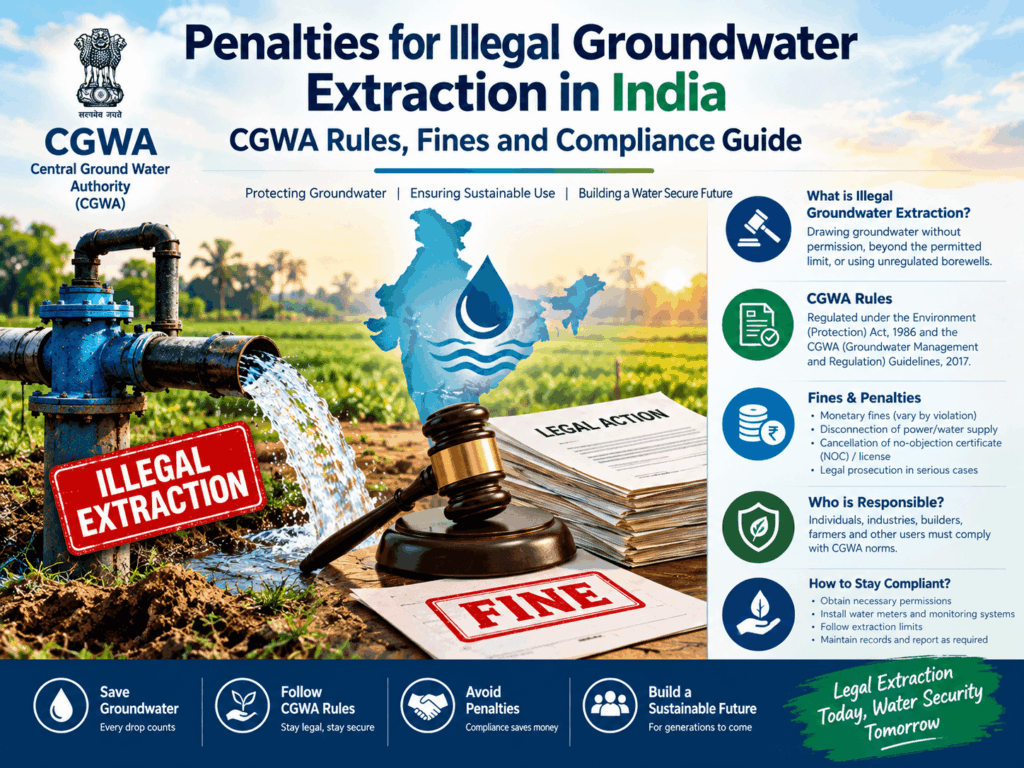
Penalties for Illegal Groundwater Extraction in India: CGWA Rules, Fines and Compliance Guide
Introduction
Groundwater is an essential resource for industries, hotels, hospitals, commercial establishments and infrastructure projects across India. However, excessive or unauthorized groundwater extraction can contribute to falling water tables, environmental damage and regulatory action.
The Central Ground Water Authority (CGWA) regulates groundwater extraction for specified industries, infrastructure projects, mining projects and other users within its jurisdiction. State groundwater authorities also regulate extraction where applicable. Depending on the location and type of use, an appropriate No Objection Certificate (NOC) may be required before groundwater can be extracted. – CGWB
Businesses that extract groundwater without the required approval, exceed their permitted extraction limits or violate NOC conditions may face environmental compensation, penalties and other enforcement measures.
In this guide, we explain the potential penalties for illegal groundwater extraction in India, who needs an NOC, how businesses can maintain compliance and what monitoring systems can help them meet applicable requirements.
1. What is illegal groundwater extraction?
Illegal groundwater extraction generally refers to withdrawing groundwater in violation of applicable laws, permissions or regulatory conditions.
Examples include:
-
Extracting groundwater for industrial or commercial use without a required valid NOC.
-
Continuing to extract groundwater after an NOC expires.
-
Withdrawing more water than the quantity permitted under an approved NOC.
-
Violating applicable groundwater monitoring, metering or reporting conditions.
-
Failing to comply with regulatory directions or other mandatory NOC conditions.
The precise requirements depend on the type of establishment, the location, the applicable authority and any relevant exemptions. Not every groundwater user is subject to identical NOC requirements.
2. What are the penalties for illegal groundwater extraction in India?
Businesses found extracting groundwater illegally may face financial and regulatory consequences. These measures can apply individually or together, depending on the circumstances and the authority’s decision.
– Environmental compensation charges
Authorities may calculate environmental compensation for groundwater extracted without a valid NOC or beyond the permitted quantity. The assessment can take account of the quantity and duration of unauthorized extraction and applicable regulatory rates. – PressReleasePage
Violations of NOC conditions may attract penalties under the applicable regulatory framework. These may be separate from environmental compensation for unauthorized extraction.
– Sealing of unauthorized borewells
Enforcement authorities may take action against unauthorized groundwater abstraction structures, including sealing wells, where legally authorized and applicable. – Groundwater Extraction
– Cancellation or non-renewal of NOC
Non-compliance may lead to cancellation or non-renewal of groundwater permission, subject to the applicable rules and regulatory process.
– Further legal or enforcement action
Authorities may issue directions or initiate other proceedings under applicable environmental and groundwater regulations. The consequences depend on the specific violation and legal provisions in force.
Important: There is no single fixed fine that can safely be quoted for every illegal groundwater extraction case. The applicable amount depends on the regulatory framework, extraction volume, duration, sector and other relevant factors.
3. How much environmental compensation can a business face?
Environmental compensation is an important enforcement mechanism used for unauthorized groundwater extraction.
The applicable CGWA guidelines dated 24 September 2020 provide a framework for calculating environmental compensation and penalties. The actual assessment depends on the relevant provisions and the facts of the case. – भारत का राजपत
The following factors may affect the assessment:
-
Groundwater extraction quantity: How much water has been withdrawn.
-
Duration of violation: How long unauthorized extraction continued.
-
Type of establishment: Industrial, infrastructure, mining or other applicable category.
-
Location and groundwater status: The assessment category and relevant regulatory restrictions.
-
Nature of non-compliance: Whether the violation involves missing permission, excess extraction or failure to follow NOC conditions.
For this reason, businesses should not rely on a generic online fine estimate. They should check the applicable guidelines and any official notice or assessment issued by the competent authority.
A current enforcement indicator
According to the Ministry of Jal Shakti’s Press Information Bureau release dated 9 March 2026, the CGWA had imposed approximately ₹2,017.97 crore in environmental compensation and ₹121.06 crore in penalties across 10,049 cases, as of 15 February 2026.
These figures represent aggregate enforcement across multiple cases. They are not the penalty applicable to an individual company.
4. Which businesses may need a CGWA NOC?
The requirement depends on the applicable authority, groundwater use, location and any exemptions.
| Establishment | Compliance consideration |
|---|---|
| Manufacturing industries | Check NOC requirements for industrial groundwater extraction. |
| Hotels and resorts | Assess groundwater permissions for commercial operations and applicable conditions. |
| Hospitals and healthcare facilities | Verify the applicable groundwater extraction and regulatory requirements. |
| Textile and chemical industries | Check extraction limits, monitoring requirements and applicable permissions. |
| Infrastructure projects | Review the requirements applicable to the project and its groundwater use. |
| Mining projects | Verify the relevant groundwater abstraction approval and monitoring conditions. |
| Residential apartments and group housing | Check requirements applicable to the building and local groundwater authority. |
CGWA and state authorities regulate groundwater under their respective jurisdictions. Some users and purposes may be exempt from obtaining an NOC, so the applicable rules should be verified before assuming that permission is either mandatory or unnecessary.
5. How can businesses avoid groundwater extraction penalties?
Businesses can reduce compliance risks by following a systematic groundwater management process.
Step 1: Obtain the required NOC
– Identify the competent groundwater authority and obtain the necessary approval before extracting groundwater where required.
Step 2: Install a suitable water flow meter
– Use an appropriate water flow meter to measure groundwater consumption and maintain reliable extraction records. Follow the meter type and technical conditions specified in the applicable NOC.
Step 3: Implement telemetry monitoring where required
– Telemetry can transmit groundwater extraction data to a remote monitoring platform, helping businesses track consumption and maintain records in line with applicable requirements.
Step 4: Monitor groundwater levels where applicable
– A suitable piezometer can help monitor groundwater levels and support groundwater management and reporting requirements when specified by the authority.
Step 5: Maintain calibration and compliance records
– Follow the applicable calibration, maintenance, data submission and reporting conditions. Track the NOC’s validity and begin renewal procedures in time.
CGWA guidance identifies water flow metering and compliance monitoring as important measures. The Ministry has also highlighted telemetry-enabled flow meters as a means of improving real-time groundwater extraction monitoring. Exact installation and reporting requirements should be checked against the current NOC.
6. Why are digital water flow meters and telemetry systems important?
A digital water flow meter measures the quantity of water passing through a pipeline. A telemetry system can communicate the recorded data to a remote platform for monitoring and reporting.
For industrial and commercial groundwater users, these systems can help with:
-
Monitoring daily, monthly and cumulative water consumption.
-
Identifying unusual consumption patterns.
-
Maintaining digital records for internal review.
-
Supporting applicable groundwater reporting requirements.
-
Improving visibility into water usage across facilities.
-
Supporting timely action when consumption approaches an approved limit.
A flow meter or telemetry system alone does not establish legal compliance. The equipment must be suitable for the application, correctly installed and operated in accordance with the relevant NOC and regulatory requirements.
7. How can AAVAD support groundwater monitoring and compliance?
- Tamperproof Digital and electromagnetic water flow meters
Suitable flow measurement solutions can help industrial and commercial users monitor water consumption and maintain usage records. - Telemetry systems
Remote monitoring solutions can support the collection and transmission of flow data, subject to system compatibility and the relevant authority’s requirements. - Piezometers and groundwater level monitoring
Groundwater level monitoring instruments can help users assess changes in water levels where required by their project or approval conditions.
AAVAD Instrument Pvt. Ltd. offers instrumentation solutions for industrial water measurement, monitoring and automation applications. Businesses can evaluate appropriate flow meters, telemetry systems and groundwater level monitoring instruments according to their technical and compliance requirements.
Request product information or application support:
-
Company: Aavad Instrument Pvt. Ltd.
-
Mobile: +91-90996 22823
-
Email: hrg@aavadinstrument.com
-
Website: www.aavadinstrument.com
Frequently asked questions (FAQs)
1. What is the penalty for illegal groundwater extraction in India?
– The consequences may include environmental compensation, additional penalties for non-compliance and other enforcement action. The amount depends on the applicable guidelines, quantity and duration of extraction, and the circumstances of the case.
2. Is a CGWA NOC mandatory for every borewell?
– No. NOC requirements depend on the type and purpose of groundwater use, the location, the applicable authority and any exemptions. Businesses should verify the current requirements for their specific premises.
3. Can a hotel face penalties for extracting groundwater without permission?
– Yes, if the hotel is required to obtain groundwater approval and extracts water without a valid NOC or violates its conditions. The applicable authority determines the consequences.
4. What happens if a groundwater NOC expires?
– Continued groundwater extraction after expiry can be treated as illegal where a valid NOC is required. The user should check renewal requirements and avoid unauthorized extraction.
5. Is a digital water flow meter mandatory for CGWA compliance?
– Flow metering may be a mandatory condition under the applicable NOC. The user should check the specific approval for the required meter, installation, monitoring and data submission conditions.
6. Why is telemetry used with a digital water flow meter?
– Telemetry can transmit water consumption data remotely, making it easier to monitor extraction and maintain digital records. Whether a particular telemetry configuration is acceptable depends on the applicable requirements.
7. Is a piezometer required for groundwater extraction?
– A piezometer is used to monitor groundwater levels. Whether it is required depends on the applicable approval conditions and project-specific requirements.
8. Which authority regulates groundwater extraction in India?
– The Central Ground Water Authority regulates groundwater extraction within its jurisdiction, while state groundwater authorities regulate it in accordance with their applicable provisions.
9. How can I check whether my company needs a CGWA NOC?
– Review your groundwater use, location, applicable exemptions and the requirements of the relevant authority. Consult the official CGWA website for current guidance and application information.
10. Can installing a flow meter prevent penalties?
– A suitable flow meter can help with measurement and recordkeeping, but it does not replace a required NOC or guarantee compliance. Businesses must satisfy all applicable approval and reporting conditions.
Illegal groundwater extraction can expose businesses to environmental compensation, additional penalties and regulatory action. Obtaining the required approvals, staying within permitted extraction limits, monitoring consumption and maintaining accurate records are important steps toward responsible groundwater management.
For industries, hotels, hospitals and commercial establishments, digital water flow meters, telemetry systems and piezometers can support groundwater monitoring when selected and installed in accordance with applicable requirements.
Protecting groundwater is both an environmental responsibility and an important part of sustainable industrial operations.
Publishing note: This article is an informational guide, not legal advice. Before publishing, verify the latest applicable CGWA or state-authority rules and any amendments. Avoid presenting an illustrative penalty as a guaranteed amount for every violation.
⚠️ CGWA Penalty Provisions for Non-Compliance of NOC Conditions (2026–27)