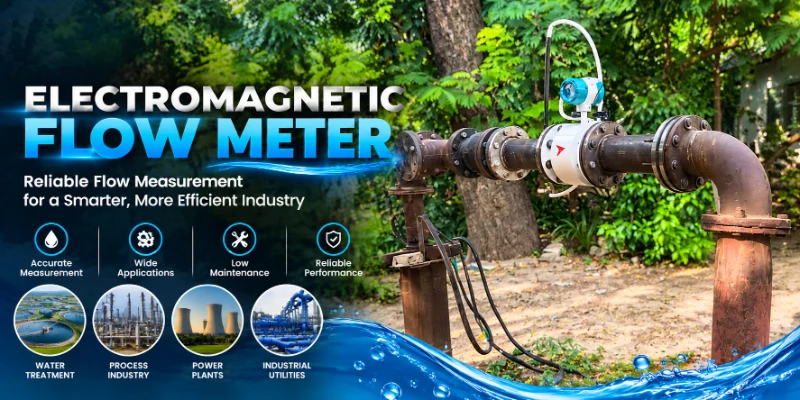
A good supplier of electromagnetic flow meters in Tamil Nadu will ask about your liquid and its conductivity before quoting, then back the meter with calibration certificates and clear specifications. Aavad Instrument Pvt.Ltd. offers Made in India magmeters from DN15 to DN500 with ±0.5% of reading accuracy for textile ETP, STP and utility water lines.
Why it Matters in Tamil Nadu
The importance of knowing the quantity of water and effluent in the piping system is paramount when considering a few key states. In Tiruppur, dyeing units, Erode and Karur with spinning mills, Cuddalore belt with chemical plants and Hosur/Chennai with automotive factories all have a need to know the amount of water/effluent they are passing along their pipework.
It’s often a case of knowing what you’re dealing with. The effluent from a dyehouse will consist of fibres, salts and heat. Effluent from Thoothukudi will have high levels of chlorides present. A main line from municipal services near Thanjavur will require consistent totalisation and generally remote reading. Meters that perform well in one area may struggle in another due to the specifications of the application.
Instead of asking who can quote the lowest price, ask who can help you select the right meter for your application.
Electromagnetic Flow Meters Explained How They Work
An electromagnetic flow meter (also known as a magnetic or magmeter) uses Faraday’s Law of Electromagnetic Induction to measure flow. The flow tube has a series of coils which create a magnetic field. As the conductive liquid flows through the flowtube a voltage will be induced. This voltage is directly proportional to the flow velocity. The electrodes pick up the voltage and this will be converted by the transmitter to a flow rate and totalised volume.
As the flowtube is full bore there will be no pressure drop. It has no moving parts so no wearing down of a rotor. It can also flow in both directions which is helpful on pumped lines and distribution networks.
Why Conductivity Decides Everything
A magmeter can only measure liquids that can carry the signal. AAVAD’s catalogue shows that you need a minimum conductivity of more than 10µS/cm. This covers most waters, most wastewaters, a lot of chemical solutions and brines. It does not cover oils, solvents or very pure waters like DM water.
Before you shortlist any meter, measure your liquid’s conductivity.
Where are these meters used across Tamil Nadu?
Chennai and Tiruvallur
The automotive, engineering, pharmaceutical, chemical and power sector. These meters are commonly used in raw water, cooling water lines, boiler make up, STP/ETP inlet and outlet and reuse lines. In the pharma/chemical sector it is important to consider what lining and electrode will be used based on what actual liquid is being used.
Coimbatore and Tiruppur
Coimbatore has many textile, pumping and food processing units whereas Tiruppur is a knitwear, dyeing and bleaching hub. These meters are commonly used in: Process water to dyeing lines, ETP inlet and outlet, Treated effluent, RO feed and reject.
Dye house effluent is usually conductive due to dissolved salts but the fibre type, solids, temperature and chemical residue will affect the lining, electrode and cleaning requirements. Please send through an effluent analysis.
Erode, Karur, Salem and Namakkal
The spinning, weaving, home textiles and municipal sectors are prevalent in this area. The meters are used for tracking process water, discharge, treated water and distribution. Municipal schemes are concerned about consistent readings and remote data requirements. Textile units are focused on effluent lines and tracking water usage.
Hosur and Madurai
Hosur has many automotive component, EV and electronic industries. Madurai also has food processing, textiles and municipal. The AAVAD catalog states that our meters are used in the food and beverage industry. If you require any hygienic or food grade features please mention this at the start and request confirmation.
Cuddalore and Thoothukudi
Cuddalore has a SIPCOT area with chemical and pharmaceutical plants. Thoothukudi has salt, fertiliser, port and metal processing. These are some of the harshest applications within the state. Our catalog states that we have PTFE & PFA linings and Hastelloy C electrodes for harsh media. However, brine high in Chlorides, acids and alkalis will need confirmation in writing.
Tiruchirappalli, Thanjavur, Karaikudi and Theni Belt
Tiruchirappalli has heavy engineering and manufacturing. Thanjavur, Karaikudi and the Theni belt are all reliant on municipal water, sewage treatment and agro processing. Typical points are raw water, treated water, STP inlet and outlet. Forward and reverse totals and remote data are as important as accuracy.
How to Select the Right Flow Meter
Velocity and Accuracy
Velocity affects accuracy. AAVAD’s catalogue gives a working range of 0.3 to 10 m/s. Here are the flow limits for selected sizes:
| Line size | Minimum (m³/h) | Maximum (m³/h) |
|---|---|---|
| DN 25 | 0.53 | 17.66 |
| DN 50 | 2.12 | 70.65 |
| DN 100 | 8.48 | 282 |
| DN 200 | 33.92 | 1,130 |
| DN 300 | 76.34 | 2,543 |
| DN 500 | 212.06 | 7,065 |
A quick example: 50 m³/h through a DN100 line moves at about 1.8 m/s, which is comfortable. The same flow through a DN300 line moves at only about 0.2 m/s, below the stated minimum. A smaller meter with reducers is usually the better answer. The full table for DN15 to DN500 is in the electromagnetic flow meter catalogue (PDF).
Lining and Electrode
- Hard rubber or neoprene: water and mild wastewater. The catalogue lists 70°C for rubber.
- PTFE or PFA: chemical resistance and higher temperature. The catalogue lists 120°C for PTFE.
- SS316L electrodes: water and many wastewater duties.
- Hastelloy C electrodes: more aggressive media.
Installation
AAVAD’s installation guide covers what decides whether a good meter reads well:
- Keep the tube completely full, even at no flow.
- On vertical runs, send the flow upward where possible.
- Leave about 10 D of straight pipe on both sides, and more if the flow swirls.
- Place valves at least 5 D downstream.
- On partially filled lines or free outlets, install the meter in a U-section.
- Earth the meter properly. Plants with VFD-driven pumps are prone to electrical interference.
Aavad Instrument Pvt.Ltd. Electromagnetic Flow Meter Options
Aavad Instrument Pvt. Ltd. is an ISO 9001:2015-certified instrumentation manufacturer. Its published specifications:
| Parameter | Published specification |
|---|---|
| Line size | 15 NB to 500 NB, customisable |
| Accuracy | ±0.5% of reading |
| Conductivity | > 10 µS/cm |
| Lining | Hard rubber, neoprene, PTFE, PFA |
| Electrodes | SS316L, Hastelloy C, other on request |
| Outputs | 4–20 mA, pulse, relay (optional) |
| Communication | RS-485 Modbus RTU, HART (optional) |
| Transmitter | Integral, remote, LED display |
| Connection | ANSI 150 flanged |
| Documents | NABL-accredited calibration certificate and 1-year warranty certificate (listed on product pages) |
Which model suits which job:
- General industrial and effluent duty: the Digital Electromagnetic Flow Meter, Made in India, listed with isolated 4–20 mA, RS-485, pulse and HART outputs, a backlit 16×4 LCD and a 9-digit totaliser.
- Utility water with a telemetry option: the AMAG-I electromagnetic flow meter product specifications page.
- Groundwater reporting: the digital water flow meter with CGWA telemetry, which adds a cloud dashboard, historical logging and SMS or email alerts. Check the exact requirement with the authority that applies to your site.
- Multi-site monitoring: the digital water flow meter with telemetry.
To compare every variant, browse the full electromagnetic flow meter range.
Information to Share When Requesting a Quotation
- Liquid and application (for example, ETP outlet, cooling water, treated water)
- Measured or expected conductivity
- Solids, fibres, chemicals or gas content
- Line size, pipe material and flange requirement
- Minimum, normal and maximum flow
- Operating pressure and temperature, including peaks
- Transmitter type: integral, remote or LED display
- Outputs and communication needed
- Telemetry or CGWA requirement
- Power supply and site conditions
- Calibration certificate and documentation needs
- Delivery location and commissioning expectations
Frequently Asked Questions
What is an electromagnetic flow meter used for?
It measures conductive liquids and slurries in full pipes. Typical uses include water, wastewater, effluent treatment, cooling water and compatible chemicals. The full-bore design means no pressure loss.
How do I choose an electromagnetic flow meter supplier in Tamil Nadu?
Pick a supplier who asks about your liquid and conductivity before quoting. Request written specifications covering lining, electrode, calibration and warranty. Get delivery and commissioning arrangements confirmed in writing too.
Can electromagnetic flow meters be used in textile ETP applications?
Frequently, since textile effluent is usually conductive. Solids, fibres, temperature and chemical content then decide the lining and electrode. Share an effluent analysis with your enquiry.
Are they suitable for STP and wastewater measurement?
Generally yes, at inlets, outlets and treated-water points, provided the pipe runs full and conductivity is adequate. If the line is partially filled or discharges freely, install the meter in a U-section.
Can an electromagnetic flow meter measure DM water?
Usually not. DM water often falls below the minimum conductivity of about 10 µS/cm. Measure it first, and consider another technology if it is lower.
What information is needed to select the correct meter?
You need the liquid, conductivity, line size, flow range, pressure, temperature, installation layout, outputs and power supply. The checklist above covers all of these.
What affects the price of an electromagnetic flow meter?
Line size, lining, electrode, flange and housing materials, transmitter, outputs, communication and telemetry all play a part. Calibration certificates, quantity and delivery add to it. Compare quotes on identical specifications.
How do I get product details or a quote from AAVAD Instrument?
Use the “Get a Quote” form on any AAVAD product page and include the details from the checklist above. You can also download the AAVAD flow meter catalogue first to check the specifications.
Choosing the Right Electromagnetic Flow Meter for Your Plant
Once you know your liquid, its conductivity, the line size and the flow range, you can compare them against the published specifications. Review the product pages above, or send your process details through the quote form on the website so AAVAD’s team can confirm suitability before you order.