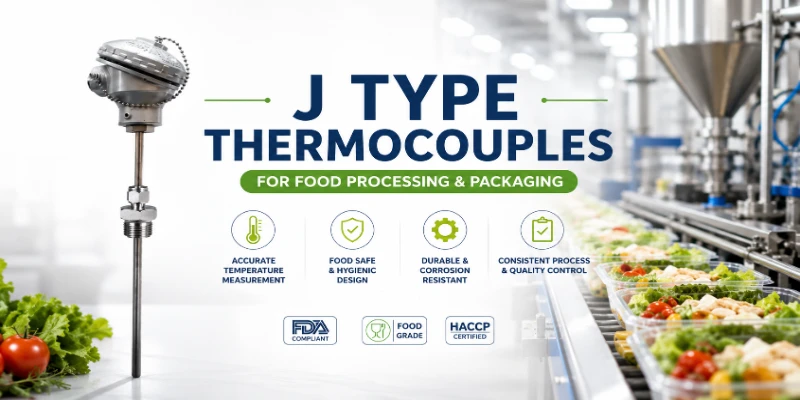
J Type Thermocouples in Food Processing and Packaging Industries
Whether it’s a baking oven, a retort sterilizer, or a heat-sealing line for packaged snacks, food processing and packaging equipment runs on precise, repeatable temperature control. Get it wrong, and the result isn’t just an off-spec batch — it can be a food safety issue or a packaging seal failure that compromises shelf life. This is why J Type thermocouples are widely used across food processing and packaging lines for accurate, dependable temperature monitoring.
This guide explains why J Type thermocouples suit food and packaging applications, where they’re used, and what to check before specifying one.
Why Temperature Accuracy Matters in Food Processing & Packaging
- Cooking and baking — under-temperature processing risks food safety; over-temperature affects texture, color, and yield
- Pasteurization and sterilization — precise temperature and hold time directly determine microbial safety
- Heat sealing and packaging — seal strength and barrier integrity depend on consistent sealing jaw or bar temperature
- Cold chain and storage transitions — accurate monitoring during heating/cooling phases protects product quality
- Regulatory and quality documentation — food manufacturers increasingly need traceable temperature records for HACCP and quality audits
Why J Type Thermocouples Suit Food & Packaging Applications
1. Right-Sized for the Temperature Range
Most food cooking, baking, and packaging-sealing processes operate well below 400°C — squarely within a J Type thermocouple’s practical working range, making it an appropriately matched, cost-effective sensor choice rather than over-specifying with a high-temperature sensor type.
2. Good Sensitivity for Process-Critical Monitoring
J Type thermocouples provide good sensitivity and stable signal output, supporting accurate, repeatable readings for ovens, fryers, retorts, and sealing equipment where small temperature deviations can affect product quality or safety.
3. Cost-Effective Across Multiple Monitoring Points
Food processing lines often need multiple temperature measurement points — across oven zones, multiple sealing stations, or several stages of a continuous cooking line. J Type thermocouples keep per-point instrumentation costs manageable at this scale.
4. Reliable in Industrial Kitchen & Packaging Environments
Built with SS 316 sheaths and IP-67-rated, die-cast aluminum connection heads, J Type thermocouples used in food and packaging settings are designed to handle the washdown, steam, and humidity typical of food processing floors.
5. Stable, Repeatable Output Supports Quality Documentation
The stable voltage output from Iron-Constantan construction provides the kind of consistent readings that support HACCP monitoring logs and quality assurance documentation across batch and continuous processes.
Where J Type Thermocouples Are Used in Food & Packaging Operations
| Equipment/Process | Application |
|---|---|
| Baking ovens | Zone-by-zone oven chamber temperature monitoring |
| Frying and cooking equipment | Oil/process temperature control for consistent product quality |
| Retort sterilizers & pasteurizers | Process temperature verification for food safety compliance |
| Heat sealing machines | Sealing jaw/bar temperature monitoring for pouch, sachet & film packaging |
| Shrink wrap & tunnel sealers | Tunnel zone temperature control |
| Dryers and dehydration equipment | Process air or product temperature monitoring |
| Extrusion-based snack processing | Barrel and die temperature monitoring (similar to plastics extrusion use) |
Buyer’s Checklist for Food & Packaging Thermocouples
- Confirm your process temperature range — most cooking, baking, and sealing operations fall well within J Type’s working range.
- Check sheath material suitability — SS 316 is broadly suitable for food-environment exposure to steam, washdown, and general industrial cleaning.
- Verify the connection head protection rating — IP-67 is recommended for food processing areas with frequent washdown.
- Match insertion length and process connection to your specific oven, sealer, or vessel design.
- Confirm response time needs — fast-cycling sealing equipment may benefit from quicker-responding sensor configurations; discuss your cycle time with your supplier.
- Ask about calibration support — NABL-traceable calibration certificates help support HACCP and ISO quality documentation.
Aavad Instrument’s J Type Thermocouple for Food & Packaging Applications
Aavad Instrument Pvt. Ltd., based in Ahmedabad, Gujarat, manufactures the J-Type Thermocouple (Model AJIS), suitable for food processing and heat-treatment equipment among its general-purpose industrial applications. Key specifications:
- Temperature range: 0°C to 600°C
- Construction: Iron-Constantan (J type) sensing element
- Sheath material: SS 316
- Insulation: Compacted MgO
- Configuration: Simplex, 2-wire
- Process connection: BSP, 1/2″ (M), adjustable
- Protection head: Die-cast aluminum with threaded cap & safety chain, IP-67 rated
- Cable entry: 1/2″ NPT, single entry
- Terminal block: Nickel-plated ceramic
- Standard dimensions: 6 mm OD, 650 mm length (custom lengths available)
Manufactured under an ISO 9001:2015 quality system with calibration support from Aavad’s in-house NABL-accredited laboratory, this thermocouple is part of the broader Head Type Thermocouple Manufacturer range, with clients including Pepsico, Kohler, and Cera in the consumer and process manufacturing space.
Frequently Asked Questions
Q1. Can J Type thermocouples be used safely around food processing equipment? Yes — when built with food-environment-appropriate materials like SS 316 sheaths and IP-67-rated connection heads, J Type thermocouples are widely used for external process temperature monitoring on food processing and packaging equipment. Always confirm hygienic design and material compatibility requirements specific to your facility and any direct food-contact considerations with your quality team.
Q2. What’s the typical temperature range needed for food packaging seal monitoring? Heat sealing for most flexible packaging films and pouches typically operates in the range of roughly 100°C to 220°C, depending on the film material — well within a J Type thermocouple’s working range.
Q3. Why choose J Type over K Type for food processing equipment? J Type thermocouples are well matched to the lower-to-medium temperatures typical of cooking, baking, and sealing processes, making them a more cost-effective choice than higher-range sensor types designed for furnace or kiln-level temperatures.
Q4. How does calibration support HACCP compliance? NABL-traceable calibration certificates provide documented evidence that your temperature sensors are measuring accurately — supporting HACCP critical control point verification and overall food safety quality documentation.
Q5. Can these thermocouples handle washdown and steam exposure on a food processing floor? IP-67-rated, die-cast aluminum connection heads are designed to resist dust ingress and temporary water exposure, making them suitable for the washdown and humid conditions common in food processing environments.
Get the Right Thermocouple for Your Food or Packaging Line
Aavad Instrument’s engineering team can help you specify the correct J Type thermocouple configuration for your oven, sealer, or processing equipment. Request a quote or view the J-Type Thermocouple product page for full specifications.