Description
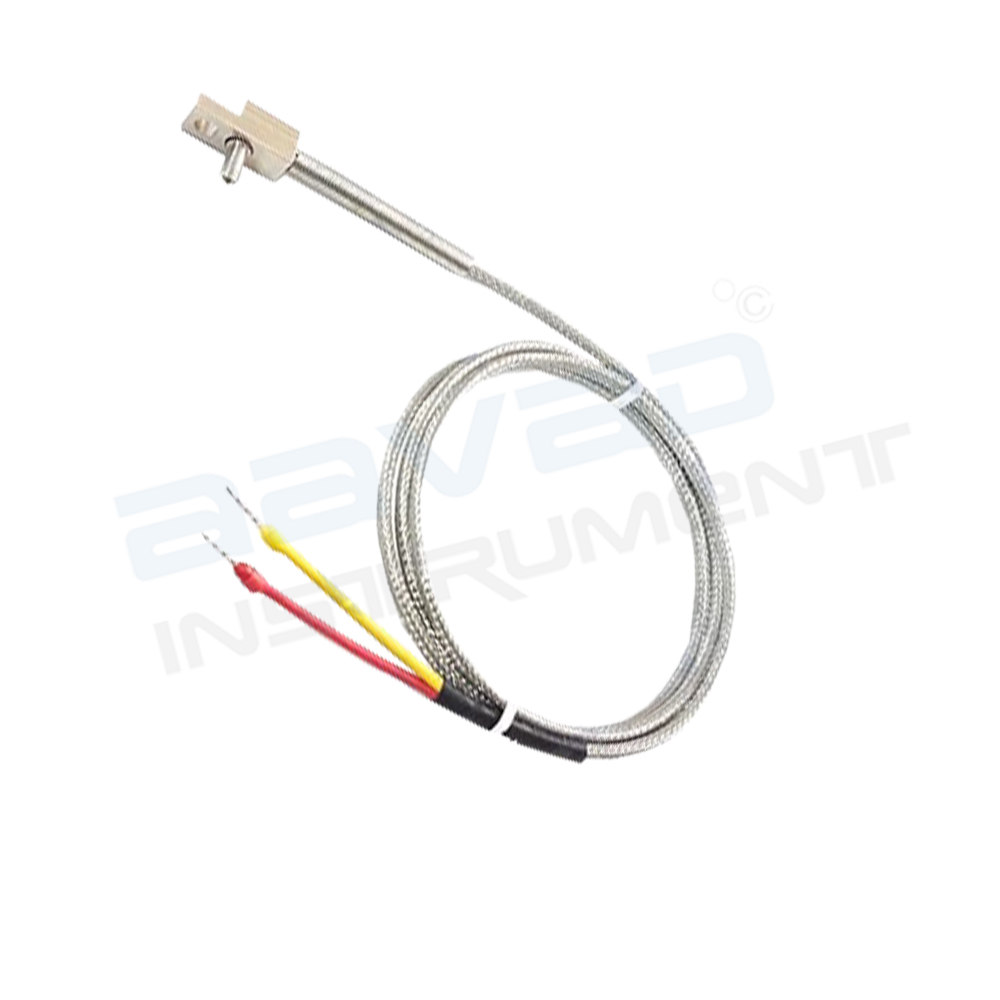
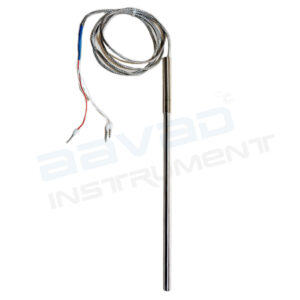
Manifold Thermocouple (Model AKES-4×15) is a compact K-Type temperature sensor designed for applications where installation space is limited and conventional threaded or bayonet-mounted sensors cannot be used. Its 4 mm diameter sheath and 15 mm sensing tip make it the smallest thermocouple in Aavad’s wire-type range, allowing accurate temperature measurement in small drilled holes and confined assemblies.
Unlike threaded or bayonet thermocouples, this model uses a direct push-fit design that allows the sensing tip to be inserted directly into a compatible mounting hole. This simplifies installation in equipment where there is insufficient space for threaded bosses or bayonet locking mechanisms.
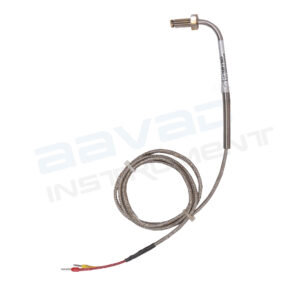
The thermocouple features an L-shaped body, which routes the cable away from the heat source at a right angle. This configuration helps reduce cable exposure to radiant heat, improves cable management, and is particularly useful in compact machinery where straight cable exits are impractical.
Key Features
-
Compact, low-profile design for confined installations
-
Direct-fit metal sensing tip for improved thermal response
-
Fast and accurate temperature measurement
-
Rugged construction for industrial environments
-
Reliable performance under vibration and thermal cycling
-
Available in different thermocouple types (K, J, etc.)
-
Custom probe lengths and mounting options available
-
Easy installation and replacement
Applications
-
Engine manifolds and exhaust components
-
Hydraulic and pneumatic systems
-
Industrial machinery and equipment housings
-
Heaters, hot plates, and metal blocks
-
Plastic processing and molding machines
-
Automotive and diesel engine applications
-
General-purpose industrial temperature monitoring
Datasheet
FAQs
1. What is a Manifold Thermocouple?
A Manifold Thermocouple is a compact industrial temperature sensor designed to measure temperatures in engine manifolds, exhaust manifolds, metal blocks, heated components, and other confined spaces where larger temperature sensors cannot be installed. Its compact construction provides accurate temperature measurement while occupying minimal installation space.
2. What is the advantage of a Push-Fit Thermocouple?
A push-fit thermocouple can be installed directly into a compatible drilled hole without requiring threaded process connections or bayonet fittings. This simplifies installation, reduces assembly time, and makes it ideal for compact equipment, OEM machinery, prototype testing, and applications with limited installation space.
3. Why does this Thermocouple have an L-Shaped Body?
The L-shaped body routes the extension cable away from the heat source, helping reduce cable exposure to high temperatures while improving cable management in confined installations. This design also minimizes cable bending and mechanical stress, contributing to longer sensor service life.
4. Where are Manifold Thermocouples commonly used?
Manifold Thermocouples are widely used in engine testing, exhaust manifold monitoring, automotive testing, diesel generators, industrial engines, OEM machinery, metal processing equipment, laboratory testing, research and development, and industrial automation systems where compact and reliable temperature measurement is required.
5. Can Manifold Thermocouples be customized?
Yes. Manifold Thermocouples can be customized with different thermocouple types (K, J, T, N), sheath diameters, insertion lengths, cable lengths, sheath materials such as SS316, SS310, or Inconel, insulation types, and termination options to meet specific OEM and industrial application requirements.
6. Why Choose Aavad Instrument Manifold Thermocouples?
Aavad Instrument Pvt. Ltd. Manifold Thermocouples are designed for accurate and reliable temperature measurement in compact and demanding industrial applications. Manufactured with premium K-Type sensing elements, durable stainless steel protective sheaths, precision L-shaped push-fit construction, and heat-resistant cables, our thermocouples provide fast response, long service life, and dependable performance. We also offer customized sheath diameters, insertion lengths, cable assemblies, insulation materials, and termination options to suit engine, OEM, laboratory, and industrial process applications.