Description
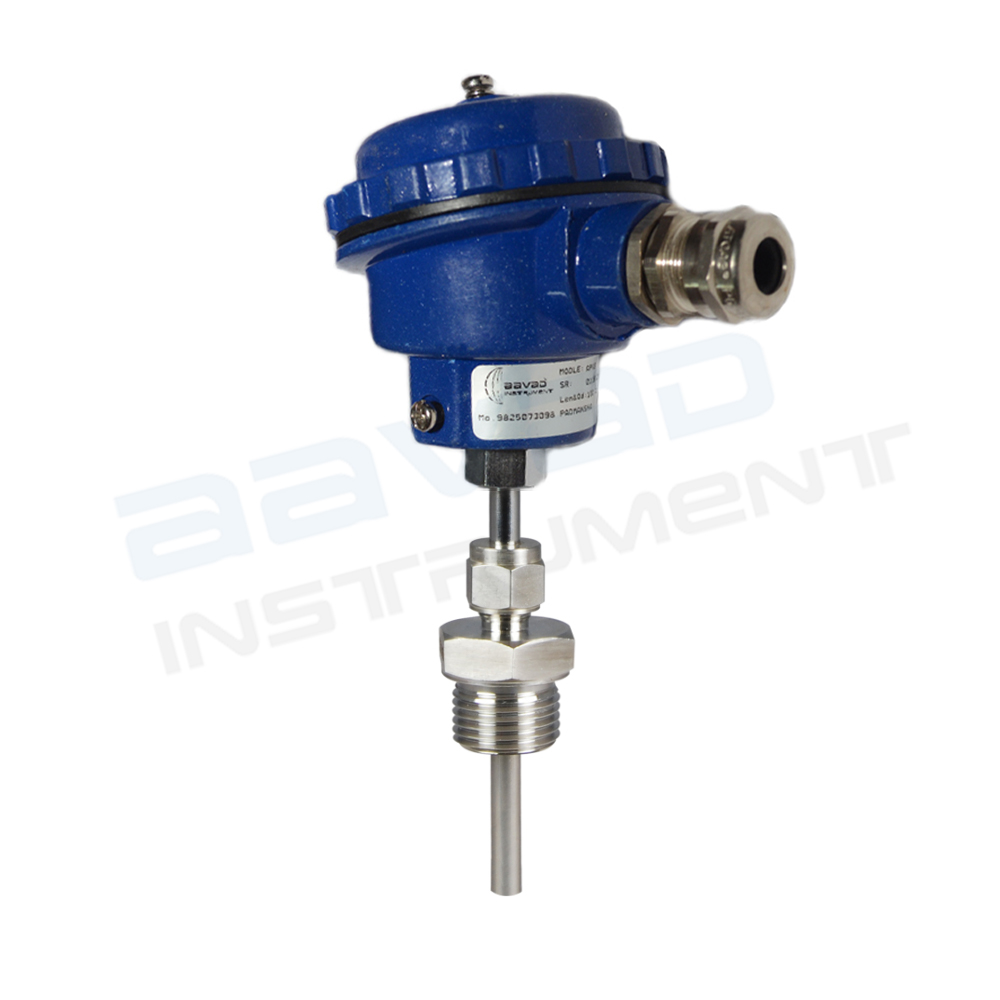
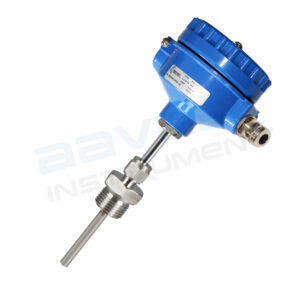
PT1000 RTD Temperature Sensor (Model APWS-6×150) is a precision PT1000 platinum resistance temperature detector (RTD) designed for accurate temperature measurement in industrial automation, HVAC, OEM machinery, and process control applications. Unlike a standard PT100, the PT1000 sensing element provides a nominal resistance of 1000 Ω at 0°C, offering improved signal stability where lead-wire resistance can influence measurement accuracy. Manufactured with a 3-wire simplex PT1000 element, SS316 stainless steel sheath, adjustable 1/2-inch BSP process connection, compacted MgO mineral insulation, and a rugged IP65 die-cast aluminium terminal head, this industrial temperature sensor delivers dependable performance across an operating range of -50°C to +400°C.
The higher base resistance of a PT1000 RTD makes it particularly suitable for applications involving longer cable runs and instrumentation designed for PT1000 inputs, while the adjustable 1/2-inch BSP fitting allows flexible insertion-depth adjustment during installation. The corrosion-resistant SS316 construction ensures durability in demanding industrial environments, and the sensor integrates seamlessly with compatible temperature transmitters, PLCs, DCS, SCADA systems, controllers, and building automation systems supporting PT1000 inputs. Manufactured by Aavad Instrument, this PT1000 temperature sensor is widely used in HVAC systems, industrial automation, laboratories, manufacturing plants, utilities, and process industries requiring stable and accurate resistance-based temperature measurement.
Key Features
-
High-Resistance Pt1000 Element Core Provides a robust 1000 $Omega$ baseline at 0°C, rendering long field-wire resistance errors practically negligible.
-
Optimized for 2-Wire & Long Cable Loops The ideal technical choice for extended control room cable runs and retrofits into existing 2-wire legacy terminal infrastructure.
-
Sliding Adjustable 1/2″ BSP Fitting Equipped with a compression connector that lets technicians fine-tune and lock the probe insertion depth during installation.
-
Durable Marine-Grade SS316 Sheath Heavy-walled stainless steel body shields the internal sensor from scaling, high-temperature oxidation, and chemical corrosion.
-
Compacted Mineral MgO Insulation Densely packed internal insulation protects the internal platinum filaments from mechanical wear and plant vibration.
-
Wide -50°C to 400°C Thermal Envelope Delivers highly accurate, linear temperature tracking across both deep sub-zero and mid-range thermal applications.
-
Weatherproof IP65 Aluminum Enclosure Rugged die-cast aluminum terminal head protects electrical terminations from ambient plant dust and low-pressure water sprays.
-
Versatile 3-Wire Simplex Footprint Configured as a 3-wire simplex layout to give you maximum flexibility across both modern 3-wire PLC cards and legacy 2-wire display loops.
Applications
-
Long-Distance Industrial Automation Loops Reliable temperature tracking where sensors are located far away from centralized PLC control cabinets.
-
Commercial HVAC and Building Automation Continuous temperature monitoring across expansive air handling systems, cooling towers, and multi-floor facility ventilation networks.
-
Retrofit Processing Infrastructure Direct drop-in replacement sensor for upgrading legacy industrial plants that utilize 2-wire terminal instrumentation blocks.
-
Remote Utility Manifolds and Storage Tanks Stable monitoring of liquid and gas storage temperatures across spread-out facility perimeters without signal booster blocks.
Datasheet
FAQs
1. What is a PT1000 Sensor and how is it different from a PT100 Sensor?
A PT1000 Sensor is a platinum Resistance Temperature Detector (RTD) with a nominal resistance of 1000 Ω at 0°C, compared to 100 Ω for a PT100 sensor. Aavad’s Model APWS-6×150 is a 3-wire simplex PT1000 RTD Sensor with an operating temperature range of -50°C to +400°C, featuring an SS316 stainless steel sheath and compacted Magnesium Oxide (MgO) insulation for accurate and reliable industrial temperature measurement.
2. Why choose a PT1000 Sensor over a PT100 Sensor for 2-wire installations?
Because a PT1000 RTD has ten times the resistance of a PT100 sensor at 0°C, the effect of lead-wire resistance on the temperature measurement is significantly reduced. This makes PT1000 Sensors an excellent choice for 2-wire installations and long cable runs, where wiring resistance could otherwise introduce measurement errors.
3. What is the Process Connection and Protection Rating of Aavad’s PT1000 Sensor?
The sensor is supplied with a 1/2" BSP (Male) adjustable process connection, a die-cast aluminum protection head featuring a threaded cap and retaining chain rated IP65, a ¾" ET cable entry with cable gland, and a nickel-plated ceramic terminal block for secure and dependable industrial installation.
4. Is Aavad’s PT1000 Sensor NABL Traceable?
Yes. Aavad’s PT1000 Sensor is available with NABL traceable calibration, meaning its calibration can be traced to National Accreditation Board for Testing and Calibration Laboratories (NABL) reference standards. This provides audit-ready calibration documentation for industries requiring verified measurement accuracy and regulatory compliance.
5. What applications is the PT1000 RTD Sensor best suited for?
PT1000 RTD Sensors are widely used in HVAC systems, building automation, industrial process control, OEM equipment, precision instrumentation, laboratory applications, and industrial automation, particularly in installations with long cable runs where reduced lead-wire resistance errors improve measurement accuracy.