Description
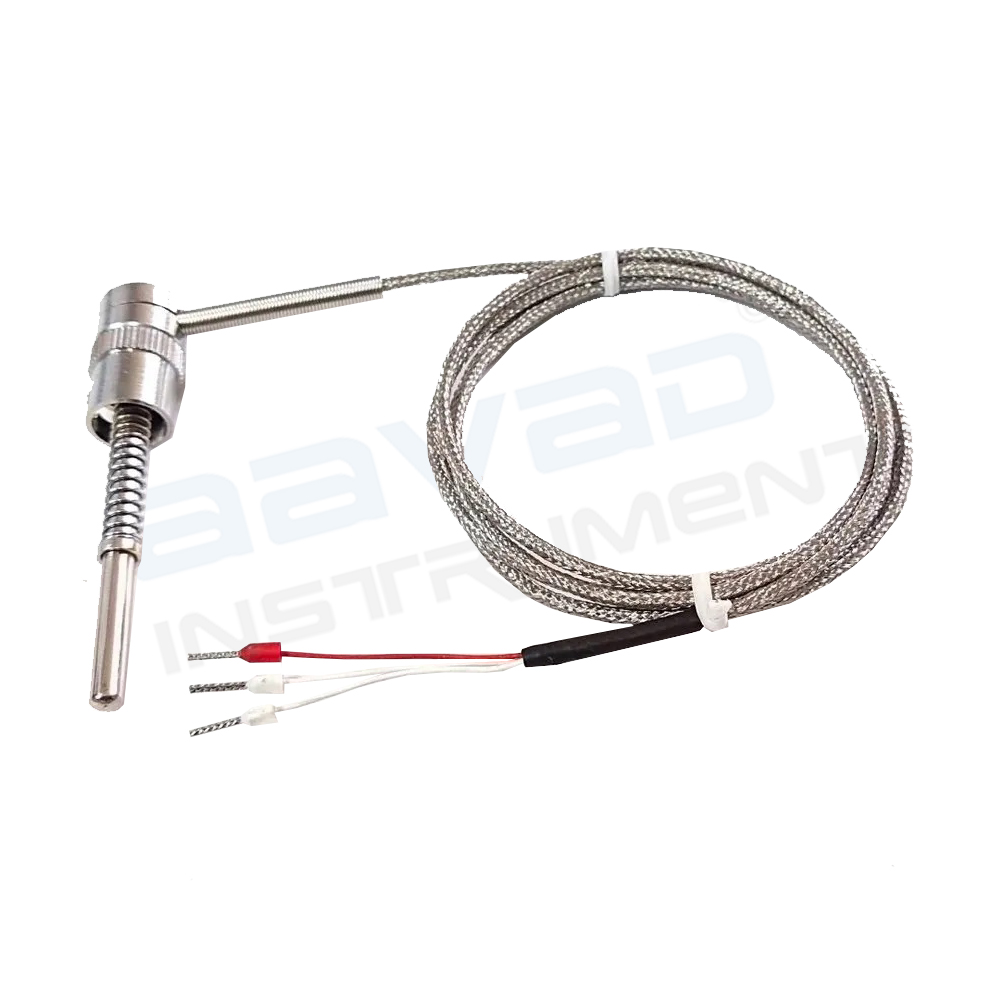
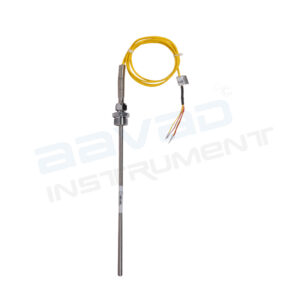
Spring Loaded Bayonet RTD Sensor (Model APES-5×50) is a PT100 Class A temperature sensor designed for precise and repeatable temperature measurement in industrial heating systems, plastic processing machinery, kilns, industrial ovens, and other equipment where stable sensor contact is essential. It combines the accuracy of a PT100 RTD element with a spring-loaded rotating bayonet mechanism, making it suitable for applications exposed to vibration, thermal expansion, or frequent maintenance.
Unlike fixed bayonet RTD sensors, this model features a rotating 1-pin bayonet assembly that allows the cable to be positioned after installation without twisting. The spring-loaded mechanism continuously applies pressure to the sensing tip, helping maintain reliable thermal contact even as equipment expands and contracts during heating and cooling cycles.
The sensor incorporates a Class A PT100 element for highly accurate temperature measurement over a -50°C to 250°C operating range. Its SS316 stainless steel sensing probe offers excellent corrosion resistance and long service life, while the Teflon/Teflon/Stainless Steel braided cable provides protection against heat, abrasion, oils, and mechanical damage. A 1/4″ BSP adapter adds installation flexibility for equipment requiring threaded support in addition to the bayonet mounting.
Key Features
-
High-Accuracy Class A PT100 Sensing Element Provides exceptional thermal measurement precision and linear resistance output across -50°C to 250°C.
-
14.10mm OD 1-Pin Rotating Bayonet Cap Allows full 360-degree rotation post-installation to prevent cable strain and simplify tight-space mounting.
-
1/4″ BSP Threaded Adapter Included Supplied with a matching 1/4″ BSP male thread bayonet adapter stud for straightforward installation into pre-tapped equipment ports.
-
Vibration-Resistant Spring Loading Heavy-duty compression spring continuously pushes the 50mm sensing tip against the bottom of the thermowell, eliminating air gaps and dampening severe machine vibration.
-
Triple-Layered Teflon/Teflon/SS Lead Cable 2-meter armored lead wire combines chemical-resistant dual Teflon insulation with an outer stainless steel wire braid shield.
-
Optimal 50mm Immersion Depth Mid-range 50mm tip length provides ideal thermal penetration into standard-depth kiln and turbine sensor wells.
Applications
-
Kilns & Heat Treating Furnaces Precise temperature monitoring in ceramic kilns, continuous annealing lines, and baking ovens.
-
Gas Turbine Exhaust Monitoring Thermal tracking along turbine exhaust manifolds, bypass ducts, and heat recovery units.
-
Diesel Engine Exhaust Systems Continuous exhaust gas temperature (EGT) monitoring on power generation diesels and marine propulsion engines.
-
Industrial Process Heaters & Blowers Temperature feedback for high-output air heaters, drying tunnels, and heat exchangers requiring RTD accuracy.
-
Vibration-Intense Machinery Skids High-precision temperature monitoring on heavy rotating equipment subject to continuous vibration and thermal cycling.
Datasheet
FAQs
1. What is a Spring Loaded Bayonet RTD Sensor?
A Spring Loaded Bayonet RTD Sensor is a PT100 Resistance Temperature Detector (RTD) that uses a spring-loaded bayonet mounting mechanism to maintain consistent contact with the measurement surface. This design delivers accurate, stable, and repeatable temperature readings in industrial machinery requiring precise temperature control.
2. Why use a PT100 RTD instead of a Thermocouple?
PT100 RTD sensors provide higher measurement accuracy, better repeatability, and excellent long-term stability within moderate temperature ranges. Compared to thermocouples, they are preferred for applications where precise and consistent temperature measurement is critical for process control and product quality.
3. What is the advantage of a Spring-Loaded Mechanism?
The spring-loaded mechanism maintains constant pressure between the sensing tip and the mounting surface, helping compensate for vibration, thermal expansion, and minor dimensional changes. This ensures reliable thermal contact, improves measurement consistency, and enhances long-term sensor performance.
4. Why choose a Rotating Bayonet RTD?
A rotating bayonet RTD allows the cable to be oriented in the desired direction after installation without twisting. This simplifies installation, improves cable routing, reduces mechanical stress on the cable, and helps extend the service life of the sensor.