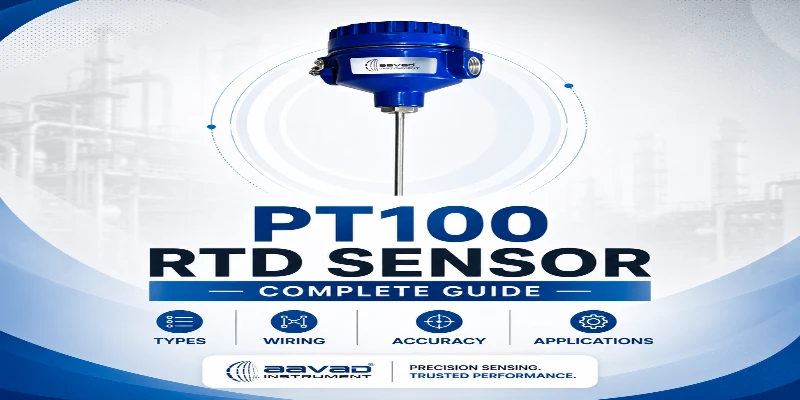
PT100 RTD Sensor: The Complete Guide for Industrial Engineer
Introduction
When accurate temperature measurement is critical, engineers across industries trust the PT100 RTD sensor. From pharmaceutical reactors and food processing plants to chemical manufacturing facilities and power stations, PT100 sensors are among the most widely used temperature sensors in industrial automation.
Their popularity comes from their excellent accuracy, long-term stability, repeatability, and compatibility with modern PLC, SCADA, and DCS systems.
In this complete guide, we’ll explain:
✔ What a PT100 RTD sensor is
✔ How PT100 sensors work
✔ 2-wire vs 3-wire vs 4-wire PT100 wiring
✔ Class A vs Class B RTD accuracy
✔ Simplex vs Duplex RTD sensors
✔ Industrial applications of PT100 RTD sensors
✔ How to choose the right PT100 sensor
What is a PT100 RTD Sensor?
A PT100 RTD (Resistance Temperature Detector) is a temperature sensor that measures temperature by detecting changes in electrical resistance.
The term:
- PT = Platinum
- 100 = 100 Ohms resistance at 0°C
As temperature increases, the resistance of platinum increases in a predictable manner.
This predictable relationship allows highly accurate temperature measurement.
How Does a PT100 RTD Sensor Work?
The sensing element inside a PT100 sensor is made of pure platinum.
At:
| Temperature | Resistance |
|---|---|
| 0°C | 100 Ω |
| 100°C | 138.5 Ω |
| 200°C | 175.8 Ω |
The RTD transmitter or temperature controller measures this resistance change and converts it into a temperature reading.
Because platinum has a very stable resistance-temperature relationship, PT100 sensors provide highly reliable measurements.
Why PT100 RTD Sensors Are Widely Used
Compared with thermocouples, PT100 sensors offer:
Higher Accuracy
Excellent measurement precision.
Better Stability
Minimal drift over time.
Superior Repeatability
Consistent readings throughout sensor life.
Excellent Linearity
Predictable temperature response.
Long Service Life
Suitable for continuous industrial operation.
PT100 Temperature Range
Standard PT100 sensors typically operate between:
-200°C to +650°C
Common industrial range:
-50°C to +400°C
This makes PT100 RTDs suitable for most industrial temperature monitoring applications.
PT100 Wiring Types Explained
One of the most common questions engineers ask is:
What is the difference between 2-wire, 3-wire, and 4-wire PT100 sensors?
2-Wire PT100 Sensor
How It Works
Uses two conductors connected to the sensing element.
Advantages
✔ Low cost
✔ Simple installation
Limitations
✖ Lead wire resistance causes measurement error
Typical Applications
- Short cable runs
- Basic temperature monitoring
3-Wire PT100 Sensor
How It Works
Uses three wires to compensate for lead resistance.
Advantages
✔ Improved accuracy
✔ Most widely used industrial configuration
✔ Cost-effective
Typical Applications
- Chemical plants
- Food processing industries
- Pharmaceutical facilities
- Utility systems
3-wire PT100 sensors are the industry standard.
4-Wire PT100 Sensor
How It Works
Uses four wires to eliminate lead resistance effects completely.
Advantages
✔ Highest accuracy
✔ Best laboratory-grade performance
✔ Precision temperature measurement
Typical Applications
- Calibration laboratories
- Research facilities
- High-precision manufacturing
PT100 Accuracy: Class A vs Class B
RTD sensors are manufactured according to IEC 60751 standards.
Class A PT100
Accuracy
±(0.15 + 0.002 × t)°C
Benefits
✔ Higher precision
✔ Better process control
Used In
- Pharmaceuticals
- Biotechnology
- Food processing
- Laboratories
Class B PT100
Accuracy
±(0.30 + 0.005 × t)°C
Benefits
✔ Economical
✔ Suitable for general industrial use
Used In
- Utilities
- Water treatment plants
- HVAC systems
- Manufacturing industries
Simplex vs Duplex PT100 RTD Sensors
Simplex RTD Sensor
Contains one sensing element.
Benefits
✔ Lower cost
✔ Compact design
Applications
- Standard process monitoring
Duplex RTD Sensor
Contains two sensing elements inside one probe.
Benefits
✔ Redundancy
✔ Simultaneous monitoring
✔ Improved reliability
Applications
- Critical process systems
- Power plants
- Pharmaceutical manufacturing
- Petrochemical industries
PT100 Sensor Construction Types
Different industries require different RTD designs.
Head Type RTD
Used for industrial process applications.
Mineral Insulated RTD
High-temperature and vibration-resistant.
Thermowell Mounted RTD
Provides protection against pressure and corrosion.
Surface RTD
Measures surface temperatures.
Sanitary RTD
Used in food and pharmaceutical applications.
Industries Using PT100 RTD Sensors
PT100 RTD sensors are widely used across industries.
Pharmaceutical Industry
Applications:
- Reactors
- Cleanrooms
- Sterilization systems
Chemical Industry
Applications:
- Process vessels
- Pipelines
- Heat exchangers
Food & Beverage Industry
Applications:
- Pasteurization systems
- Brewing processes
- Dairy plants
Power Plants
Applications:
- Boiler monitoring
- Turbine bearings
- Cooling water systems
Water Treatment Plants
Applications:
- Process temperature monitoring
- Utility systems
Textile Industry
Applications:
- Dyeing processes
- Steam systems
PT100 RTD vs Thermocouple
| Feature | PT100 RTD | Thermocouple |
| Accuracy | Higher | Moderate |
| Stability | Excellent | Good |
| Repeatability | Excellent | Good |
| Temperature Range | Up to 650°C | Up to 1800°C |
| Cost | Moderate | Lower |
| Industrial Use | Precision Measurement | High Temperature |
Choose PT100 When:
✔ Accuracy is critical
✔ Stable measurements are required
✔ Long-term reliability is important
How to Select the Right PT100 RTD Sensor
Before selecting a PT100 sensor, consider:
Temperature Range
Operating temperature requirements.
Sensor Accuracy
Class A or Class B.
Process Connection
Threaded, flanged, or sanitary.
Environmental Conditions
Corrosion, vibration, pressure.
Wiring Configuration
2-wire, 3-wire, or 4-wire.
Automation Compatibility
PLC, SCADA, DCS, or transmitter integration.
Why Choose Aavad Instrument Pvt. Ltd.?
AAVAD Instrument Pvt. Ltd. is a trusted manufacturer and supplier of industrial temperature sensors in India.
Our PT100 RTD Solutions Include:
✔ Thermowell RTD Assemblies
✔ Duplex RTD Sensors
✔ Class A & Class B RTDs
✔ Customized RTD Solutions
✔ Industrial Automation Compatible Designs
Industries Served
- Pharmaceutical
- Chemical
- Food Processing
- Water Treatment
- Textile
- Power Generation
- Oil & Gas
Frequently Asked Questions
What is the resistance of a PT100 at 0°C?
100 Ohms.
Which PT100 wiring is most commonly used?
3-wire PT100 is the most common industrial configuration.
Which is better: PT100 or Thermocouple?
PT100 is better for accuracy and stability, while thermocouples are preferred for extremely high temperatures.
What is the difference between Class A and Class B PT100?
Class A offers higher accuracy than Class B.
Conclusion
PT100 RTD sensors remain the preferred choice for industrial temperature measurement because of their high accuracy, stability, and reliability.
Whether you need a 3-wire PT100 sensor for a chemical plant, a duplex RTD for a power station, or a sanitary RTD for a pharmaceutical process, selecting the right RTD can significantly improve process control and operational efficiency.
For high-quality PT100 RTD sensors and customized temperature measurement solutions, AAVAD Instrument Pvt. Ltd. provides trusted products and expert technical support across India.
📞 Call: +91 90996 22823
🌐 Website: www.aavadinstrument.com
📧 Email: hrg@aavadinstrument.com