RTD Sensor — Complete Guide, Product Range & Manufacturer in India
Everything you need to know about RTD sensors — how they work, accuracy classes, wire configurations, 8 product variants, 6 industry applications, and how to select the right sensor for your process.
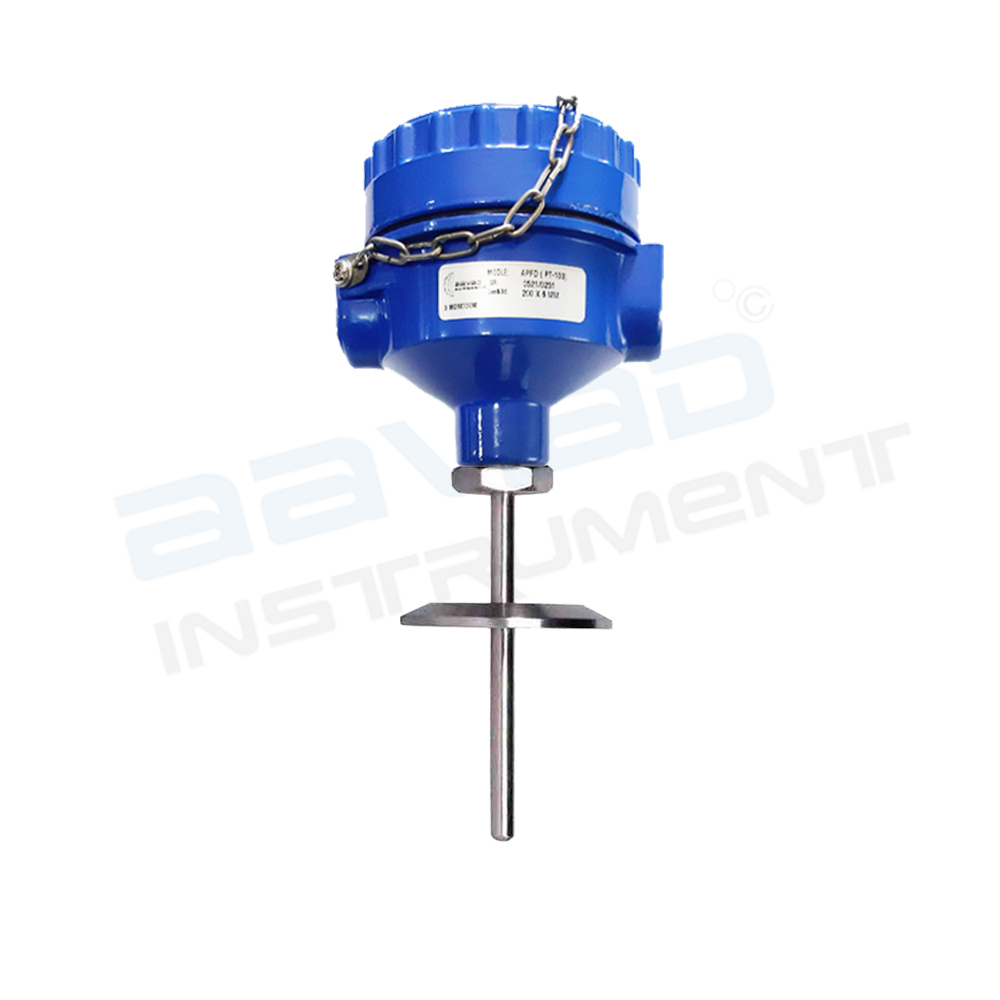
Pt100 RTD Sensor — Manufactured in Ahmedabad, Gujarat
What Is an RTD Sensor?
An RTD (Resistance Temperature Detector) sensor is a precision temperature measurement device that works on a fundamental physical principle — the electrical resistance of a pure metal changes predictably and repeatably as its temperature changes. Unlike thermocouples which generate a voltage, RTDs change resistance, making them more stable and significantly more accurate.
The most common type is the Pt100 — a platinum element with exactly 100Ω resistance at 0°C — standardised globally under IEC 60751 / DIN EN 60751. Aavad Instrument manufactures the complete RTD range from its ISO 9001:2015 certified facility in Ahmedabad, Gujarat, supplying to pharma, power, chemical, food, and oil & gas industries across India.
How Does an RTD Sensor Work?
The sensing element inside an RTD is a coil or thin film of pure platinum wire wound around a ceramic or glass core. When process temperature changes, the platinum resistance changes along a precisely known, highly repeatable curve. A measurement circuit — typically a Wheatstone bridge or a precision transmitter — applies a small known current, measures the resulting voltage (and therefore resistance), and converts it to a temperature reading.
The governing equation for Pt100 above 0°C is the Callendar–Van Dusen equation:
Where: A = 3.9083 × 10⁻³ | B = −5.775 × 10⁻⁷ | R₀ = 100Ω
In practice, the transmitter or PLC performs this calculation automatically. What matters is that Pt100 sensors are accurate to ±0.1°C to ±0.3°C in calibrated conditions — far beyond what a thermocouple can achieve.
Thin Film vs Wire-Wound Elements
| Parameter | Thin Film (PTFC) | Wire-Wound (PRTD) |
|---|---|---|
| Construction | Platinum film on ceramic substrate | Fine platinum wire on ceramic bobbin |
| Accuracy | Class B standard; Class A available | Class A and Class AA available |
| Response Time | Faster (small mass) | Slightly slower |
| Vibration Resistance | Better | More fragile |
| Temperature Range | −50°C to +500°C | −200°C to +850°C |
| Cost | Lower | Higher |
| Best For | Industrial process, HVAC, food | Labs, calibration, extreme ranges |
Wire Configurations: 2-Wire, 3-Wire & 4-Wire
The number of wires connected to the RTD element directly determines measurement accuracy. Lead wire resistance — typically 0.1 to 5Ω depending on cable length and gauge — adds to the measured resistance and introduces temperature error if not compensated.
| Configuration | How It Works | Lead Error | Best For |
|---|---|---|---|
| 2-Wire | Both leads add directly to the measured resistance — no compensation possible | ~0.6°C / Ω total lead resistance | Cable runs <5m, non-critical applications |
| 3-Wire ★ Standard | Third lead allows instrument to measure and subtract one lead resistance (assumes matched leads) | <0.1°C for matched leads up to 100m | 80% of industrial applications — industry standard |
| 4-Wire | Separate current and voltage leads — completely eliminates lead resistance error regardless of cable length | <0.01°C error | NABL calibration labs, pharmaceutical validation, Class AA sensors |
Accuracy Classes — IEC 60751
IEC 60751 defines four accuracy classes for Pt100 sensors. The tolerance formula is ±(base value + multiplier × |T|)°C. Choosing the right class balances accuracy requirements against cost.
| Class | Tolerance Formula | At 0°C | At 100°C | At 300°C | Typical Application |
|---|---|---|---|---|---|
| Class AA | ±(0.10 + 0.0017×|T|) | ±0.10°C | ±0.27°C | ±0.61°C | NABL labs, pharmaceutical GMP validation, reference sensors |
| Class A | ±(0.15 + 0.0020×|T|) | ±0.15°C | ±0.35°C | ±0.75°C | Process control, power generation, food processing |
| Class B | ±(0.30 + 0.0050×|T|) | ±0.30°C | ±0.80°C | ±1.80°C | General industrial monitoring, HVAC, water treatment |
| Class C | ±(0.60 + 0.0100×|T|) | ±0.60°C | ±1.60°C | ±3.60°C | Non-critical monitoring, simple on/off control |
Our RTD Sensor Product Range
Aavad Instrument manufactures 8+ variants of RTD sensors from its Ahmedabad facility. All products are manufactured to IEC 60751 and supplied with NABL calibration certificates.
RTD Sensor (Standard)
General-purpose Pt100 immersion RTD. Available in 2/3/4-wire, Class A & B. SS316 sheath. Custom insertion lengths. Screw-in or direct immersion. Ideal for pharma, food, and chemical applications.
View ProductPT100 Sensor
Precision Pt100 with NABL calibration certificate as standard. Thin film or wire-wound element. Class AA, A, B accuracy. 3mm to 12mm sheath OD. For GMP-validated temperature loops.
View Product3-Wire RTD Sensor
Industry standard 3-wire Pt100. Compensates lead resistance for accurate readings up to 100m cable runs. Suitable for PLC/DCS/SCADA connections. Terminal head or flying leads.
View ProductFlameproof RTD Sensor
Ex-d certified for Zone 1 & Zone 2 hazardous areas. IS/IEC 60079 compliant. Cast aluminium explosion-proof head. For oil refineries, chemical plants, paint factories, gas processing.
View ProductDuplex RTD Sensor
Two independent Pt100 elements in one protection tube. Primary + backup measurement. Cross-verification capability. Essential for power plants, turbines, and critical processes where sensor failure is not acceptable.
View ProductTurbine RTD Sensor
Designed for turbine bearing and winding temperature monitoring. High-vibration rated. Mineral insulated (MI) construction. Temperature range up to 500°C. Used in power plants and compressors.
View ProductRTD Sensor with Thermowell
Spring-loaded Pt100 in SS316 bar-stock thermowell. Sensor replaceable without process shutdown. Available with threaded, flanged, or weld-in thermowell connections. High-pressure rated up to 200 bar.
View ProductBearing Temperature Detector (BTD)
Specially designed for bearing and winding temperature monitoring in motors, generators, and transformers. Compact design, quick response. PT100 or PT1000 element. 2/3/4-wire versions.
View Product6 Steps to Choose the Right RTD Sensor
Follow this selection guide to specify the correct RTD for your application. Our application engineers are available to assist — call or email for free consultation.
Define the temperature range
What are the minimum and maximum process temperatures? Add at least 20% safety margin above the maximum. For >600°C applications, consider a thermocouple instead.
Select the element type
Pt100 for standard industrial use (±0.1–0.3°C accuracy). Pt1000 for cable runs >50m — higher resistance reduces proportional lead error. Ni100/1000 for HVAC where cost is primary concern.
Choose the wire configuration
3-wire for most industrial installations (compensates lead resistance up to 100m). 4-wire for NABL calibration labs, pharmaceutical validation, or any Class AA application. 2-wire only for short runs <5m.
Specify the sheath material
SS304/316 for general use, water, steam, mild chemicals. Inconel 600/625 for temperatures above 600°C or oxidising atmospheres. Hastelloy C276 for strong acids, chloride environments. Titanium for seawater or highly oxidising acids.
Decide on thermowell requirement
In high-pressure pipes (>20 bar), high-velocity flow, or corrosive/abrasive media, a thermowell is essential — it protects the sensor and allows replacement without process shutdown. See our thermowell guide.
Confirm installation details
Specify: insertion length (U), sheath OD, process connection type (1/2″ NPT, BSP, tri-clamp, flange), conduit entry size, and head type (terminal head A/B/C or flying leads). Mention if ATEX/flameproof certification is required.
Technical Specifications
| Parameter | Specification |
|---|---|
| Sensing Element | Platinum (Pt100 per IEC 60751 / Pt1000) |
| Nominal Resistance at 0°C | 100.00 Ω (Pt100) / 1000.00 Ω (Pt1000) |
| Temperature Coefficient α | 0.003851 Ω/Ω/°C (IEC 60751) |
| Accuracy Class | Class AA: ±(0.10+0.0017|t|)°C | Class A: ±(0.15+0.002|t|)°C | Class B: ±(0.30+0.005|t|)°C |
| Temperature Range | −200°C to +850°C (model dependent) |
| Wire Configuration | 2-wire, 3-wire, 4-wire |
| Sheath Material | SS304, SS316, SS316L, Inconel 600/625, Hastelloy C276, Titanium |
| Sheath Diameter | 3mm, 4.5mm, 6mm, 8mm, 10mm, 12mm (custom) |
| Insulation Resistance | >100 MΩ at 100V DC (25°C ambient) |
| Response Time T₆₃% | 2–8 seconds (sheath diameter and media dependent) |
| Process Connection | ½” NPT, BSP, Flanged (ANSI 150#/300#), Tri-clamp, Direct immersion |
| IP Protection | IP65, IP67, IP68 available |
| Transmitter Output | 4–20mA, HART, MODBUS (integrated head-mount option) |
| Calibration Standard | NABL traceable calibration certificate (IEC 60751) — included standard |
| Quality Certification | ISO 9001:2015, NABL accredited lab |
| Hazardous Area | Ex-d IIC (Flameproof) — Zone 1 & Zone 2 per IS/IEC 60079 |
Industry Applications
Aavad RTD sensors are deployed across 8 major industries in India and internationally. Each industry has specific requirements for accuracy, materials, certifications, and installation type.
GMP-validated temperature measurement is non-negotiable in pharma. FDA and WHO GMP require Class A or Class AA Pt100 sensors with NABL calibration certificates for all critical temperature loops.
- Autoclave sterilisation (121°C) — Class A, 4-wire, SS316L
- Lyophilizer (freeze dryer) — Class AA, −50°C to +60°C
- Clean room & cold chain monitoring — wireless RTD options
- Fermentation bioreactors — tri-clamp, electropolished sheath
- API reactor temperature control — multi-point RTD
Power plants demand RTD sensors that survive high temperatures, high pressure, vibration, and continuous duty cycles. Turbine and bearing monitoring is safety-critical.
- Turbine bearing temperature — Duplex RTD, mineral insulated
- Generator winding temperature — BTD sensors
- Boiler feed water — RTD + bar-stock thermowell
- Condenser cooling water — SS316 immersion RTD
- Switchgear busbar temperature — surface-mount RTD
Chemical environments demand corrosion-resistant sheath materials and often ATEX/flameproof certification for Zone 1 hazardous areas where flammable vapours are present.
- Reactor temperature monitoring — Hastelloy C276 sheath
- Distillation column temperature profile — multi-point RTD
- Flameproof RTD for Zone 1 & Zone 2 — Ex-d certified
- HCl / H₂SO₄ environments — PTFE-sheathed or Titanium
- Heat exchanger monitoring — flanged thermowell assembly
Food safety regulations (FSSAI, BIS) require hygienic sensors with cleanable surfaces, suitable for CIP (Clean-In-Place) and SIP (Steam-In-Place) procedures.
- Pasteurisation (72°C / 15 sec) — tri-clamp RTD, SS316L
- Dairy UHT (135°C) — high-pressure tri-clamp assembly
- Cold storage & blast chiller — −40°C rated sensors
- Brewing fermentation — sanitary RTD with thermowell
- Sugar mill — high-temperature evaporator RTD
Offshore and onshore oil & gas installations require ATEX/IECEx-certified RTDs, high-pressure ratings, and robust construction for continuous outdoor operation.
- Wellhead temperature — flameproof RTD, NACE MR0175
- Pipeline temperature monitoring — flanged thermowell
- Fired heater / furnace — MI RTD up to 600°C
- Crude oil storage tank — multipoint RTD assembly
- Gas compressor bearing — duplex vibration-rated RTD
CGWA (Central Ground Water Authority) mandates online monitoring of groundwater temperature for compliance. Aavad RTD sensors are combined with CGWA-compliant EM flowmeters for complete monitoring systems.
- CGWA borewell temperature monitoring — submersible RTD
- Effluent treatment plant (ETP) — IP68 rated SS316
- Reverse osmosis (RO) plant — SS316 immersion RTD
- Cooling tower return water — SS304 with thermowell
Application Case Studies
Real-world applications where Aavad Instrument RTD sensors have been deployed across Indian industries.
Turbine Bearing Protection in 210 MW Thermal Power Plant
A thermal power plant in Gujarat required bearing temperature monitoring for 8 turbine bearings. Standard sensors were failing within 6 months due to vibration and steam ingress. Aavad supplied mineral-insulated Duplex RTD sensors with vibration-damping thermowell assemblies. NABL calibration certificates provided for each sensor for plant commissioning documentation.
GMP Validation of Autoclave Temperature Loops
A pharmaceutical manufacturer in Ahmedabad needed NABL-calibrated Pt100 sensors for FDA audit compliance. 24 temperature loops across 6 autoclaves required Class A sensors with multi-point calibration certificates at 0°C, 100°C, and 121°C. Aavad supplied Class A 4-wire Pt100 sensors with calibration data at 5 temperature points and full traceability documentation.
RTD Sensors for Hazardous Zone Reactor Monitoring
A specialty chemical manufacturer at GIDC Vatva needed temperature sensors for reactors in Zone 1 hazardous areas where flammable solvent vapours are present. Standard sensors could not be used. Aavad supplied Ex-d IIC flameproof RTD sensors with SS316 sheath and explosion-proof cast aluminium terminal heads certified to IS/IEC 60079-1.
Busbar Temperature Monitoring for MV Switchgear Panels
Multiple industrial facilities required busbar overtemperature protection in 11kV and 33kV switchgear panels. Conventional RTDs were too large for panel mounting. Aavad designed compact surface-mount PT100 sensors with spring-loaded clamps for direct busbar contact and IP67 rated lead cables for panel use. Read full switchgear application note →
Tri-Clamp RTD for Dairy Pasteurisation Line
A dairy cooperative in Maharashtra required hygienic temperature sensors for their HTST pasteurisation line. Sensors needed to withstand daily CIP (caustic + acid cycles), SIP (steam sterilisation at 135°C), and FSSAI inspection. Aavad supplied electropolished SS316L tri-clamp RTD sensors with Class A accuracy and Ra ≤0.8μm surface finish.
CGWA Compliance Monitoring — Groundwater Extraction
A textile manufacturing unit in Rajasthan needed CGWA-compliant groundwater monitoring including borewell temperature measurement. Aavad supplied submersible IP68 RTD sensors integrated with CGWA-compliant electromagnetic flowmeters and a telemetry data logger for real-time reporting to the CGWA portal.
Related Technical Articles & Guides
In-depth technical guides by Aavad Instrument’s engineering team — covering RTD selection, applications, and troubleshooting.
RTD Sensor: What It Is, How It Works & 6 Steps to Choose the Right One
Comprehensive beginner-to-engineer guide — working principle, types, accuracy classes, wire configurations, and step-by-step selection process.
Read ArticlePT100 Temperature Sensor: Specifications, Wiring Configurations & Applications
Everything engineers need to know about Pt100 — resistance table, accuracy classes, 2/3/4-wire wiring diagrams, sheath materials, and industrial applications.
Read ArticleRTD Sensors for Switchgear Safety — Busbar & Panel Temperature Monitoring
How surface-mount and spring-clip RTD sensors prevent switchgear fires through early busbar overtemperature detection. Includes installation guide.
Read ArticleThermocouple & RTD Solutions for Power Plants — Selection & Maintenance Guide
A practical guide to selecting between RTD and thermocouple for thermal power plant applications — bearing, winding, boiler, and steam temperature measurement.
Read ArticleFrequently Asked Questions
Pt100 has 100Ω resistance at 0°C; Pt1000 has 1,000Ω. The 10× higher resistance of Pt1000 makes it better for long cable runs — lead resistance error is proportionally smaller. Both follow IEC 60751 and achieve the same accuracy class. Pt100 is the global industrial standard supported by most PLC and DCS input modules. Use Pt1000 when cable length exceeds 50m or in HVAC applications where transmitters are designed for high-resistance inputs.
RTDs are significantly more accurate. A Class A Pt100 achieves ±0.15°C at 0°C versus ±2.2°C for a standard Type K thermocouple. RTDs also drift far less over time (<0.1°C/year vs 1–3°C/year for thermocouples). For processes below 600°C where measurement accuracy matters, RTDs are always preferred. Above 600°C, thermocouples become the practical choice due to their wider temperature range. Read our full RTD vs Thermocouple comparison.
NABL (National Accreditation Board for Testing and Calibration Laboratories) calibration means your sensor has been calibrated against national measurement standards in an accredited laboratory. This provides legal traceability of your measurements — mandatory for ISO 9001:2015, pharmaceutical GMP (FDA/WHO), food safety (FSSAI), and CGWA compliance. Aavad Instrument’s NABL-accredited lab issues calibration certificates for every RTD sensor order, covering multiple temperature points per IEC 60751.
Yes. Aavad Instrument manufactures flameproof RTD sensors certified to IS/IEC 60079-1 (Ex-d IIC) for Zone 1 and Zone 2 hazardous areas. These feature cast aluminium explosion-proof heads with certified cable glands. Suitable for chemical plants, oil refineries, paint factories, and gas processing facilities where flammable gas or dust may be present. PESO certificate available.
Yes. Aavad Instrument supplies integrated head-mount and DIN rail 4-20mA transmitters with HART protocol. These loop-powered transmitters connect directly to your PLC, DCS, or SCADA system. 0.1% accuracy, −40°C to +85°C ambient range. They work alongside our electromagnetic flowmeters and pressure transmitters in complete process measurement loops.
A duplex RTD contains two independent sensing elements in one protection tube. Element 1 provides the primary control signal; Element 2 provides backup measurement or cross-verification. Used wherever sensor failure cannot be tolerated — thermal power plant turbine bearings, critical reactor temperature, pharmaceutical batch validation. Aavad supplies 3+3 or 4+4 wire duplex Pt100 sensors in standard and custom configurations.
Standard Pt100 and Pt1000 sensors are dispatched within 3–5 working days. Custom configurations (special insertion lengths, exotic materials, multi-element, flameproof) are ready in 7–15 working days. NABL calibration certificates are issued with every order — standard certificates take 1–2 days, multi-point certificates up to 3 days. Express dispatch available for shutdown maintenance requirements.
Disconnect the sensor from the transmitter and measure resistance with a calibrated multimeter at known ambient temperature. Compare to the IEC 60751 table: at 25°C, a Pt100 should read ~109.73Ω (±accuracy class tolerance). Open circuit (infinite resistance) = broken element. Short circuit (near 0Ω) = sheath damage or moisture ingress. Resistance in range but unstable = connection fault or moisture ingress. Contact Aavad for recalibration or replacement.
General use (water, steam, mild chemicals): SS316 or SS316L. Temperatures above 600°C or oxidising atmospheres: Inconel 600/625. Strong acids, chloride environments, HCl, H₂SO₄: Hastelloy C276. Seawater or highly oxidising: Titanium. Food/pharma contact: SS316L electropolished, Ra ≤0.8μm. Contact Aavad’s application team for process-specific material recommendations — a material compatibility failure is expensive to fix after installation.
Yes. Aavad Instrument’s NABL-accredited laboratory offers recalibration services for all makes and models of RTD sensors. Submit your sensors by courier or bring them to our Ahmedabad facility. Calibration certificates issued within 2–3 working days. We recommend annual recalibration for Class A sensors in pharmaceutical and food applications, and bi-annual for Class B in general industrial use.