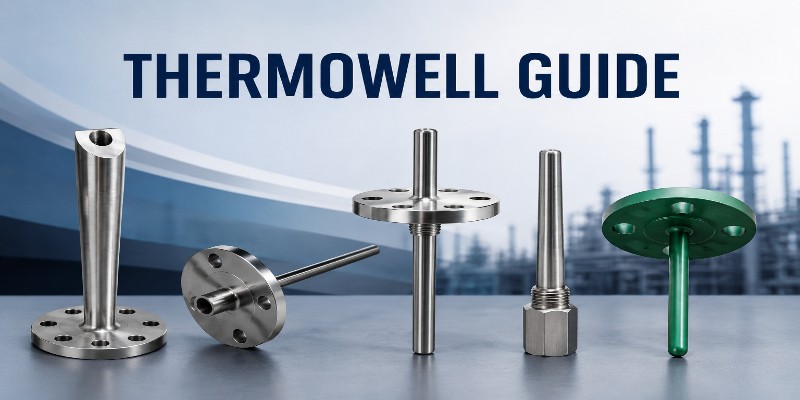
A thermowell is a pressure-tight protective fitting installed between a process and a temperature sensor such as an RTD or thermocouple. It protects the sensor from process pressure, corrosion, velocity and mechanical forces while allowing the sensor to be removed for maintenance without directly exposing the sensing element to the process.
How a Thermowell Works
A thermowell is essentially a closed-end tube. The closed end is inserted into the process stream — a pipe, vessel, or tank — while the open end sits outside the pipe wall or insulation, exposed to ambient air. The temperature sensor slides into this open end and rests against the closed tip.
Heat transfer happens in two steps: the process fluid heats the thermowell wall, and the thermowell wall then heats the sensor. This adds thermal mass to the measurement path, which is the trade-off you accept in exchange for protection. A well-selected thermowell keeps that added lag and error small — usually under one percent for insulated piping at near-ambient conditions — while a poorly selected one can introduce dangerous mechanical failure long before it introduces a measurement problem.
That second point deserves emphasis: the biggest risk with a thermowell is not measurement error — it is flow-induced vibration. A thermowell installed too long, in too thin a diameter, or with the wrong tip geometry for the fluid velocity can be excited by vortex shedding at its own natural frequency. Left uncorrected, this causes fatigue failure at the root, snapping the thermowell off and releasing it into the process — a serious safety and downtime event. Any credible thermowell design must be checked against wake-frequency/vibration criteria (per ASME PTC 19.3 or equivalent) before it’s manufactured, not just sized on tradition or “same as last time.”
Types of Thermowells
Different process conditions call for different thermowell constructions. Below are the main types, matched to the situations they’re built for.
1. Bar Stock Thermowell
Machined from a single solid bar of metal (no welds along the pressure-retaining wall), a bar stock thermowell is the strongest, most leak-proof construction available. Because there’s no weld seam exposed to the process, it’s the default choice for high-pressure, high-velocity, or corrosive-service applications, and for anywhere a weld failure simply isn’t an option — pharma, food-grade, oil & gas, and power generation lines.
2. Drilled Bar Stock Thermowell
A refinement of the bar stock design, a drilled bar stock thermowell is gun-drilled from solid round bar to produce a precise, concentric bore with tight wall-thickness tolerance. That precision matters twice over: it keeps the wake-frequency calculation accurate (uneven walls shift the natural frequency), and it gives better, more even heat transfer to the sensor for a faster, more stable reading. This is generally the highest-integrity option in the bar stock family.
3. Casting Thermowell
A casting thermowell is cast (rather than machined from bar) and is typically used where flanges, unusual bore profiles, or larger custom geometries are needed economically, or where the base metal (like certain alloy or high-nickel castings) is easier to produce as a casting than to machine from solid stock. Casting is a practical route for large-diameter, low-to-moderate pressure applications and for materials that are difficult to machine in bar form.
4. Tapered / Tapered Flanged Thermowell
A tapered flanged thermowell has a stem that narrows from root to tip. That taper reduces mass at the tip, which raises the natural frequency of the well and makes it far more resistant to vortex-induced vibration — exactly what you want in high-velocity gas or liquid lines. The flange gives a bolted, gasketed connection to a mating pipe flange, so it can be removed for maintenance without hot work, and it’s the standard choice on high-velocity steam, gas, and hydrocarbon lines in refineries and power plants.
5. Flanged Thermowell (Straight Bore)
Similar in mounting to the tapered version but with a constant-diameter (straight) bore rather than a taper. Straight flanged wells are simpler and cheaper to manufacture and work well at moderate flow velocities where vibration risk is lower.
6. Threaded Thermowells (Weld-in, Socket Weld, NPT)
Threaded designs connect via NPT or similar threads, either weld-in for a permanent, leak-tight joint or socket-weld/threaded for easier field installation. These suit small-bore piping and lower-pressure utility lines where a full flanged connection isn’t justified by cost or space.
7. Standard Thermowell / Protection Tube
A general-purpose thermowell (protection tube) — a straightforward NPT-to-NPT tube used across general industrial, utility, and lower-severity applications where the extreme designs above aren’t necessary.
8. PTFE Coated Thermowell
For processes that are aggressively corrosive to bare metal — strong acids, chlorides, certain chemical and pharma duties — a PTFE coated thermowell adds a fully fused fluoropolymer lining over the metal or alternative substrate. This gives near-universal chemical resistance at a fraction of the cost of an exotic alloy well, and it’s a common choice in chemical processing, pickling lines, and pharmaceutical manufacturing.
Thermowell Materials: How to Choose
Material selection is driven by three things: the corrosiveness of the process fluid, the operating temperature, and mechanical strength requirements at pressure.
| Material | Typical Use Case |
|---|---|
| SS304 | General-purpose, mild corrosive duty, utility lines |
| SS316 / SS316L | The industry default — good corrosion resistance for most chemical, oil & gas, and process duties |
| SS310 | High-temperature service (furnaces, kilns, high-temp gas streams) |
| Carbon Steel | Non-corrosive, cost-sensitive utility and steam applications |
| Inconel / Hastelloy | Severe corrosion or very high temperature — chemical processing, exotic service |
| PTFE-Lined | Strongly acidic/chemically aggressive fluids where metal alone would corrode |
| Brass | Low-pressure, low-temperature utility and water applications |
As a rule of thumb: if you’re unsure between SS316 and an exotic alloy, check the process fluid’s chloride content and pH first — that single data point resolves most material disputes faster than any general chart.
Thermowell Design & Selection Checklist
Before finalizing a thermowell spec sheet, confirm the following with your instrumentation or process engineer:
- Process connection type — threaded, socket weld, weld-in, or flanged (and flange rating/class if flanged)
- Insertion (U) length — enough to reach representative flow, but not so long it enters a high-vibration risk zone
- Bore diameter and sensor fit — matched to the RTD/thermocouple probe diameter for good thermal contact
- Wake-frequency/vibration calculation — mandatory for any high-velocity gas, steam, or liquid line (ASME PTC 19.3 or equivalent)
- Material compatibility — against the actual process fluid, not just “what we used last time”
- Pressure and temperature rating — matched to the line’s design pressure and maximum process temperature, with margin
- Stem profile — straight, tapered, or stepped, based on velocity and vibration exposure
- Surface finish / internal coating — PTFE lining or polished bore for hygienic/pharma and food-grade applications
Where Thermowells Are Used
Thermowells show up anywhere a temperature sensor needs to survive process conditions it can’t be directly exposed to:
- Oil, gas, and petrochemical refining and pipelines
- Power generation — boilers, steam headers, turbines
- Chemical and pharmaceutical processing
- Food and beverage sanitary processing
- Water and wastewater treatment
- Cement, steel, and heavy process industries
- HVAC and utility steam/water systems
Installation & Maintenance Tips
- Always install thermowells with adequate insertion depth into the flow stream — shallow insertion is one of the most common causes of measurement lag and inaccurate readings.
- Re-torque flanged and threaded connections after initial commissioning; thermal cycling can loosen a joint that tested tight cold.
- Inspect thermowells during turnarounds for wall thinning from erosion/corrosion, especially in high-velocity or particulate-laden service — this is where undetected wake-frequency issues eventually surface as cracked or thinned roots.
- Keep the sensor-to-bore fit snug; a loose fit slows response time and increases measurement error even with a perfectly good thermowell.
- Match replacement thermowells to the original wake-frequency calculation — don’t assume “same size” is “same safe” if line conditions have changed.
Why Choose Aavad Instrument as Your Thermowell Manufacturer
Aavad Instrument is an ISO 9001:2015 certified manufacturer of thermowells and temperature sensing equipment, built for plants that can’t afford a sensor failure or an unplanned shutdown. A few things that matter when you’re comparing thermowell suppliers:
- Full type range — bar stock, drilled bar stock, casting, tapered flanged, straight flanged, threaded, and PTFE-coated wells from a single thermowell manufacturer, so mixed-spec projects don’t need multiple vendors.
- Custom dimensions — thermowells built to your U-length, bore, and connection spec rather than forcing your design around a catalog size.
- NABL-accredited calibration and in-house engineering support for wake-frequency and material selection queries.
- Proven track record — long-standing supply relationships with BHEL, ONGC, NPCIL, Indian Oil, BPCL, L&T, and other major industrial and public-sector accounts.
- Pairs naturally with Aavad’s own RTD and thermocouple sensors and temperature transmitters for a complete, single-vendor temperature measurement loop.
If you’re specifying thermowells for a new project or replacing failed ones on an existing line, get a quote from Aavad’s engineering team — send your process conditions (fluid, pressure, temperature, velocity, and connection type) and they’ll recommend the right type and material rather than just selling you a catalog part number.
Frequently Asked Questions (FAQ)
What is a thermowell?
A thermowell is a protective fitting used to install an RTD, thermocouple or temperature sensor into a process while protecting the sensor from pressure, corrosion, flow and mechanical forces.
It also allows the temperature sensor to be removed for maintenance in suitable installations without directly exposing the sensing element to the process.
What is the difference between a thermowell and a thermocouple?
A thermocouple measures temperature, while a thermowell protects the thermocouple from the process. The thermocouple generates the temperature measurement signal. The thermowell provides the mechanical and environmental protection around the sensor.
What are the different types of thermowells?
Common thermowell constructions include bar stock, drilled bar stock, casting, tapered, flanged, threaded, standard and PTFE-coated thermowells.
The appropriate type depends on process pressure, temperature, flow velocity, corrosion, connection requirements and mechanical design.
What is the best material for a thermowell?
There is no universally best thermowell material. SS316/SS316L is a common choice for many industrial and chemical applications, while SS310, carbon steel, Inconel, Hastelloy or PTFE-lined construction may be selected for specific temperature or corrosion conditions.
Material compatibility should always be checked against the actual process fluid.
Why do thermowells fail?
Thermowells can fail because of flow-induced vibration, fatigue, corrosion, erosion, excessive mechanical loading or unsuitable material selection.
In flowing process lines, wake-frequency and vibration analysis is an important part of thermowell engineering.
What is thermowell wake frequency?
Thermowell wake frequency is associated with the periodic vortex shedding that occurs as fluid flows around the thermowell. If the excitation frequency interacts unfavorably with the thermowell’s natural frequency, vibration and fatigue risk can increase.
Do thermowells require vibration calculations?
Thermowells installed in significant-flow applications should be evaluated for flow-induced vibration and mechanical integrity using the applicable engineering criteria. ASME PTC 19.3 is commonly referenced for thermowell design evaluation where applicable.
What is a tapered thermowell?
A tapered thermowell has a stem that decreases in diameter toward the tip. The geometry can reduce tip mass and improve the mechanical characteristics of the thermowell for certain high-velocity applications.
How is thermowell insertion length determined?
Thermowell insertion or U-length should provide sufficient immersion for representative temperature measurement while considering mechanical loading and vibration. Pipe/vessel geometry, boundary-layer effects, flow conditions and wake-frequency analysis should be considered together.
Can a temperature sensor be replaced without replacing the thermowell?
In a suitable thermowell installation, the RTD or thermocouple can generally be removed and replaced while the thermowell remains installed. Whether this can be done while the process is operating depends on the specific process connection, isolation arrangement and plant safety procedure.
How do I select the right thermowell?
Start with the process fluid, temperature, pressure and flow velocity. Then specify material, insertion length, bore, stem profile, process connection and sensor compatibility. For significant flow velocity, include the required vibration/wake-frequency evaluation.
Have a specific process condition to size a thermowell for? Contact Aavad Instrument’s engineering team with your fluid, pressure, temperature, and connection details for a free recommendation.