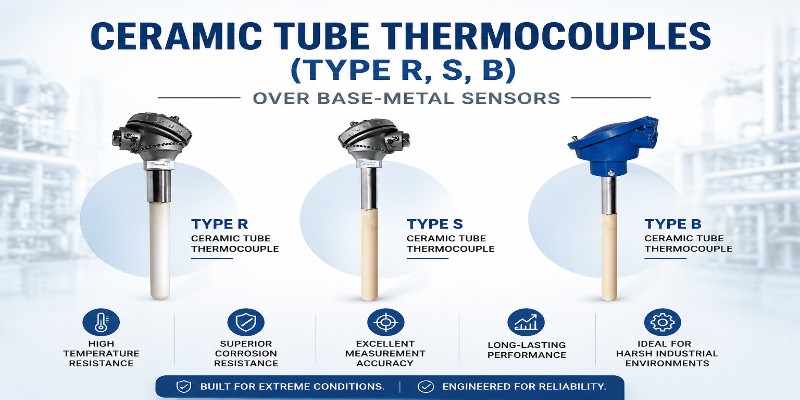
When to Use Ceramic Tube Thermocouples (Type R, S, B) Over Base-Metal Sensors
Most industrial temperature measurement runs comfortably on base-metal thermocouples — Type K, J, T, and N cover the vast majority of applications below 1,200°C reliably and affordably. But push past that ceiling, into glass melting, steel and metal refining, or extreme kiln and furnace zones, and base-metal sensors start to fail — both literally and in terms of accuracy. This is the territory of ceramic tube thermocouples: Type R,Type S, and Type B, the “noble metal” thermocouples built from platinum and rhodium alloys specifically for extreme high-temperature service.
This guide explains exactly when to reach for R, S, or B type ceramic tube thermocouples instead of base-metal sensors, and how to choose between the three.
Base-Metal vs Noble-Metal Thermocouples: The Core Distinction
Thermocouple types fall into two broad families:
- Base-metal thermocouples (J, K, T, N, E) — the most common types, built from economical alloys like Iron-Constantan, Chromel-Alumel, and Copper-Constantan. Reliable, cost-effective, and well suited to the vast majority of industrial applications up to roughly 1,200°C–1,300°C.
- Noble-metal thermocouples (R, S, B) — built from platinum and platinum-rhodium alloys, used specifically for high-temperature applications where base-metal types reach their limits.
The trade-off is straightforward: noble-metal thermocouples cost significantly more than base-metal types, but they unlock temperature ranges and long-term stability that base-metal sensors simply cannot match.
When Base-Metal Sensors Hit Their Limit
Base-metal thermocouples like Type K begin to show practical limitations above roughly 1,000°C–1,200°C, including:
- Accelerated oxidation and drift at sustained high temperatures
- Shorter service life under continuous extreme heat
- Reduced accuracy as the sensor approaches its upper rated limit
When your process temperature regularly approaches or exceeds these limits — or when long-term stability at high temperature is critical to product quality — it’s time to consider a ceramic tube, noble-metal thermocouple instead.
Type R Thermocouple: When to Use It
Type R thermocouples (Platinum vs. 13% Rhodium/Platinum) are usable up to 1,480°C. They are extremely stable, though reducing atmospheres are particularly damaging to their accuracy and lifespan.
Choose Type R when:
- Your process temperature regularly approaches or exceeds the practical limit of Type S, but you don’t need Type B’s full range
- You want improved stability and a marginal increase in usable range compared to Type S
- Your application can be run in an oxidizing or inert atmosphere — Type R’s reducing-atmosphere sensitivity makes it unsuitable for reducing conditions
Type R covers similar applications to Type S, but its improved stability is the reason it’s often used in preference to Type S where both could technically apply.
Type S Thermocouple: When to Use It
Type S thermocouples can be used in oxidizing or inert atmospheres continuously at temperatures up to 1,600°C, and for brief periods up to 1,700°C. For high-temperature work, insulators and sheaths made from high-purity recrystallized alumina are used to support this range.
Choose Type S when:
- You need continuous operation up to 1,600°C with excellent long-term stability and low drift
- Your atmosphere is oxidizing or inert (Type S, like Type R, is sensitive to reducing conditions)
- You need high accuracy for critical high-temperature processes, and the slightly lower stability versus Type R is an acceptable trade-off for your specific application or cost target
Type B Thermocouple: When to Use It
Type B thermocouples are composed of a positive leg (70% Platinum, 30% Rhodium) and a negative leg (94% Platinum, 6% Rhodium). When protected by compacted mineral insulation and an appropriate outer sheath, Type B is usable from 600°C to 1,704°C — the highest practical range among the three noble-metal types.
Choose Type B when:
- Your process temperature exceeds the practical ceiling of Type R or Type S — Type B is the go-to for the most extreme continuous high-temperature applications
- You need excellent stability and long life at elevated temperatures with minimal drift
- Your application demands high resistance to oxidation and corrosion at extreme temperatures
- Note: Type B’s output is very low at temperatures below 600°C, so it’s specifically a high-temperature specialist rather than a general-purpose sensor — it’s not the right choice if your process also needs to measure lower temperature ranges accurately
R, S, and B Type: Side-by-Side Comparison
| Type | Construction | Continuous Range | Brief/Peak Range | Best Suited For |
|---|---|---|---|---|
| Type R | Platinum vs. 13% Rh/Pt | Up to 1,480°C | — | Improved stability over Type S; preferred where both could apply |
| Type S | Platinum vs. Rhodium/Pt | Up to 1,600°C | Up to 1,700°C | Critical high-accuracy continuous high-temperature processes |
| Type B | 70% Pt/30% Rh vs. 94% Pt/6% Rh | 600°C to 1,704°C | — | The most extreme continuous high-temperature applications |
Common Applications for Ceramic Tube (R, S, B) Thermocouples
| Industry/Application | Typical Type Used |
|---|---|
| Glass melting furnaces | Type R or S |
| Steel and metal refining/machining | Type B, K, R, or S (high-temperature monitoring during melt) |
| High-temperature kilns and ceramics firing | Type R or S |
| Power generation (high-temperature combustion zones) | Type S or B |
| Aerospace and materials testing | Type R or S |
| Catalyst regeneration and petrochemical high-heat processes | Type S or B |
Key Considerations Before Choosing a Noble-Metal Thermocouple
- Confirm your actual peak process temperature — including any excursions — and select the type with adequate margin above it.
- Check your process atmosphere. Reducing atmospheres are damaging to Type R and S; confirm whether your environment is oxidizing, inert, or reducing before specifying.
- Factor in the higher cost. Noble-metal thermocouples cost considerably more than base-metal types — make sure the application genuinely needs the extended range and stability before specifying R, S, or B.
- Specify the correct ceramic protection tube and insulation — high-purity alumina insulators and sheaths are standard for supporting these sensors at their rated high-temperature limits.
- Confirm calibration support. NABL-traceable calibration certificates are especially important for high-value noble-metal sensors used in critical high-temperature processes.
Aavad Instrument’s Ceramic Tube Thermocouple Range
Aavad Instrument Pvt. Ltd., based in Ahmedabad, Gujarat, manufactures the full range of noble-metal ceramic tube thermocouples:
- R Type Thermocouple (Model ARWS-S-650) — Platinum vs. 13% Rhodium/Platinum, usable up to 1,480°C, with excellent long-term stability and low drift.
- S Type Thermocouple (Model ASWS-D) — Platinum/Rhodium construction, continuous operation up to 1,600°C and brief operation up to 1,700°C, with high-purity alumina insulation for durability.
- B Type Thermocouple — Platinum-Rhodium construction (70/30 and 94/6 legs), usable from 600°C to 1,704°C, supplied with NABL-accredited calibration certification.
Manufactured under an ISO 9001:2015 quality system with calibration support from Aavad’s in-house NABL-accredited laboratory, these thermocouples are part of the broader Ceramic Tube Thermocouple Manufacturer range, with deployments across high-temperature industrial clients including BHEL, ONGC, and Saint-Gobain.
Frequently Asked Questions
Q1. At what temperature should I switch from a base-metal thermocouple to a noble-metal type? There’s no single fixed threshold, but as process temperatures approach or exceed roughly 1,000°C–1,200°C — especially for sustained, continuous operation — noble-metal types like R, S, or B generally offer better stability and longer service life than base-metal sensors.
Q2. Why are Type R and Type S sensitive to reducing atmospheres? The platinum-rhodium alloys used in these types are particularly vulnerable to contamination and damage in reducing (oxygen-deficient) atmospheres, which can degrade accuracy and shorten sensor life. Confirm your process atmosphere before specifying these types.
Q3. Is Type B suitable for measuring lower temperatures as well as extreme highs? Not ideally — Type B’s voltage output is very low below 600°C, making it a poor choice for any application that also needs accurate readings at lower temperatures. It’s best reserved specifically for high-temperature service.
Q4. Why do noble-metal thermocouples cost more than base-metal types? Platinum and platinum-rhodium alloys are precious metals, making R, S, and B type thermocouples significantly more expensive to manufacture than base-metal types like K or J — a cost that’s justified specifically by the extreme temperature range and long-term stability these noble-metal types provide.
Q5. What protection tube material is used with R, S, and B type thermocouples? High-purity recrystallized alumina ceramic protection tubes and insulators are standard for supporting these thermocouples at their rated high-temperature limits, providing the necessary thermal and chemical stability.
Specify the Right High-Temperature Thermocouple for Your Process
Aavad Instrument’s engineering team can help you choose between Type R, S, and B based on your exact temperature profile, atmosphere, and accuracy requirements. Request a quote or explore the Ceramic Tube Thermocouple Manufacturer category for complete specifications.