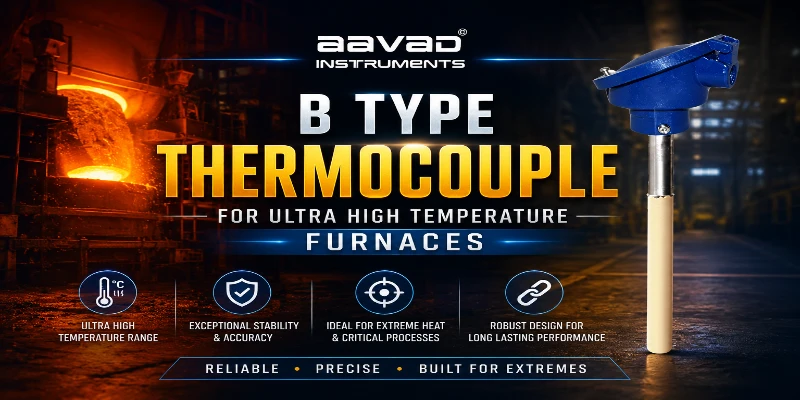
B Type Thermocouple with NABL Calibration Certificate: India’s Definitive Guide for Ultra-High-Temperature Furnaces, Kilns & Metallurgical Processes
Among all commercially available thermocouple types, the B Type thermocouple holds a singular position: it measures the widest practical temperature span, reaches the highest continuous operating temperature, and uniquely benefits from NABL-accredited calibration that provides the traceable accuracy documentation that high-stakes industrial and research applications demand. From India’s blast furnaces and electric arc steelmaking operations to platinum-glass forming lines and molten metal operations, the B Type thermocouple is the instrument of last resort when every other thermocouple type has run out of range.
This guide delivers Aavad’s complete ABHS B Type Thermocouple specification, the engineering reasoning behind every design choice, application maps across Indian industry, and a deep FAQ section covering every question buyers ask before their first noble-metal thermocouple purchase.
What Makes B Type Thermocouple Unique Among All Thermocouple Types
The B Type thermocouple is manufactured from two platinum-rhodium alloys:
- Positive leg: 70% Platinum + 30% Rhodium (Pt30%Rh)
- Negative leg: 94% Platinum + 6% Rhodium (Pt6%Rh)
This specific construction gives B type three properties that no other common thermocouple type shares simultaneously:
1. The Widest Practical Operating Range: 600°C to 1,704°C B type covers a 1,104°C operating span at the extreme high end — from 600°C to 1,704°C — making it the only thermocouple type that can be used continuously at temperatures approaching the melting point of pure platinum (1,768°C).
2. The Lowest Drift of Any Noble Metal Type at Extreme Temperatures Both legs are platinum-rhodium alloys (compared to S and R types, which use pure platinum for the negative leg). This symmetry means both conductors oxidize at similar rates, resulting in lower net calibration drift under sustained extreme-temperature operation compared to S and R types.
3. Near-Zero Output Below 50°C — No Cold Junction Compensation Error B type’s thermoelectric EMF is near zero at room temperature, which means practical cold junction compensation errors at ambient temperature are negligible. This unique property makes B type measurements less sensitive to cold junction temperature variations than S or R type in some measurement setups.
### Full Specifications: Aavad ABHS B Type Thermocouple
| Parameter | Specification | Engineering Significance |
|---|---|---|
| Type | B (Pt30%Rh/Pt.6%Rh) | Both legs platinum-rhodium; widest range noble metal type |
| Make | Aavad Instrument | ISO 9001:2015 |
| Model | ABHS | Standard B Type ceramic tube assembly |
| Element | Pt30%Rh/Pt.6%Rh | Noble metal dual-rhodium construction |
| Element diameter | 0.45 mm | Standard noble metal wire gauge |
| Calibration standard | ANSI MC 96.1 | International accuracy compliance |
| Configuration | Simplex | Single element, 2-wire output |
| Insulation | Twin hole ceramic Ker-710 | High-purity alumina 99.7% — isolates conductors at extreme temps |
| Hot junction | Un-grounded | Electrically isolated from sheath structure |
| Terminal block | Ceramic with nickel-plated brass terminals | High-temperature terminal construction |
| Head | Die-cast aluminum weatherproof ANSI, Blue, threaded cover and chain | IP-65 protection head |
| Cable entry | 3/4″ ET | Standard cable entry |
| Holding tube MOC | SS 310 tube | High-temperature stainless steel for transition zone |
| Holding tube diameter | 30 mm | Outer holding tube diameter |
| Holding tube length | 150 mm | Metallic section length |
| No. of protection | Double protection | Both inner and outer ceramic tubes — superior element protection |
| Outer ceramic diameter | 19 × 14 mm ID, Ker-710 alumina 99.7%, 700 mm long | Primary outer ceramic protection tube |
| Inner ceramic diameter | 12 × 8 mm ID, Ker-710 alumina 99.7%, 700 mm long | Secondary inner ceramic protection tube |
| Exposed ceramic length | 550 mm | Ceramic zone inside the furnace atmosphere |
| Range | Up to 1,700°C | Continuous high-temperature operating range |
Double Ceramic Protection: Why B Type Assemblies Use Two Ceramic Tubes
Unlike simpler thermocouple constructions that use a single outer protection tube, the ABHS B Type uses double protection — both an outer and an inner ceramic tube, each made from Ker-710 alumina 99.7%. This double-tube arrangement is standard practice for noble metal thermocouple elements at extreme temperatures because:
Outer tube (19 × 14 mm ID, 700 mm): The first line of defense against the furnace atmosphere — combustion gases, metallic vapors, slag, and particulate matter that would directly attack and contaminate the platinum-rhodium sensing wires. The outer tube sacrifices itself to corrosion before the inner assembly is exposed.
Inner tube (12 × 8 mm ID, 700 mm): Provides a secondary clean, controlled atmosphere around the sensing element itself, ensuring the platinum-rhodium wires are shielded from any gases or vapors that penetrate or diffuse through the outer tube over extended service.
The cost of skipping double protection: In glass furnaces and metal melting operations, silica vapor, molten glass splash, and metallic vapors contaminate and react with platinum at high temperatures — a process called “rhodium drift” or silicon contamination — that permanently alters the thermoelectric properties of the sensing element. Double protection dramatically extends the service interval before this contamination reaches the sensing wires.
The NABL Calibration Certificate: Why It Matters for B Type Specifically
NABL-accredited calibration matters for all precision instruments, but it carries particular importance for B Type thermocouples:
High-value noble metal elements: A B Type thermocouple represents a significant material cost investment because both legs contain platinum and rhodium. Confirming the element’s calibration at purchase and periodically during service protects this investment by verifying performance before and during operation.
Critical process applications: The industries that use B Type thermocouples — blast furnace iron making, EAF steelmaking, glass melting, aluminium smelting — operate at temperatures where measurement error directly translates into major process consequences. NABL-calibrated sensors with known, documented accuracy provide the measurement integrity these operations require.
Regulatory and quality system compliance: Facilities operating under ISO 9001, IATF 16949, or industry-specific quality standards need traceable calibration records. Aavad’s NABL-accredited in-house laboratory issues certificates traceable to national standards — the documentation form that audit teams and quality engineers recognize and accept.
Critical Application Note: B Type Is Not Suitable Below 600°C
This is the most important application caution for B Type thermocouples — one that costs plants real money when overlooked. B type’s thermoelectric EMF is near zero at room temperature and very low at temperatures below approximately 600°C. At temperatures below 600°C, the B type output is so small and non-linear that accurate temperature measurement becomes unreliable. A B type thermocouple in a furnace still at 400°C during startup will not give you a meaningful temperature reading.
Practical implications:
- Do not use B type for startup temperature monitoring below 600°C — use a K or N type for the lower range and switch to B type control above 600°C
- B type is a specialist sensor for the 600°C–1,700°C range only — it is not a general-purpose replacement for S or R type across all operating conditions
- For operations requiring continuous monitoring from ambient through to extreme temperatures, a parallel K-type or N-type sensor handles the startup and lower-range zone while the B type handles the high-temperature operating range
Industries and Applications Across India
Iron and Steel — Blast Furnace, EAF, and Ladle Operations
Hubs: Jamshedpur (Jharkhand — Tata Steel, Tinplate) | Bhilai (Chhattisgarh — SAIL) | Rourkela (Odisha — SAIL) | Durgapur (WB — SAIL) | Angul (Odisha — NALCO, JSPL) | Visakhapatnam (AP — Vizag Steel) | Hazira, Surat (Gujarat — Essar Steel, POSCO) | Bellary/Hospet (Karnataka — JSW Steel)
Blast furnace tuyere zone temperatures (up to 1,600°C+), EAF steel bath temperatures, ladle preheating temperatures, and torpedo ladle temperatures all fall within B type’s operating range. For iron and steel operations running at the extreme end of the temperature scale, the B type’s lower drift compared to S type and its wider operating range make it the premium specification.
Glass Industry — Melting Furnaces and Specialist Applications
Hubs: Firozabad, Agra (UP) | Bharuch, Surat (Gujarat) | Kolkata, Howrah (WB) | Nashik (Maharashtra) | Hyderabad (Telangana)
In glass furnaces where melt temperatures exceed 1,500°C — particularly for borosilicate, specialty, and technical glass production — B type extends the measurement capability beyond S type’s practical ceiling. Platinum-glass forming operations (where molten glass contacts platinum-lined vessels) specifically require B type measurement due to the platinum-contamination risk to S type elements from direct glass contact.
Aluminium Smelting — Carbon Baking Furnaces
Hubs: Angul (Odisha — NALCO) | Renukoot (UP — HINDALCO) | Hirakud (Odisha) | Mettur (Tamil Nadu)
Carbon anode baking furnaces for aluminium smelting operate at temperatures up to 1,200°C–1,250°C, while some special process conditions reach higher. B type thermocouples are specified for the highest-temperature zones in anode baking furnace monitoring.
Aerospace and Materials Testing — High-Temperature Research
Hubs: Bengaluru (ISRO, HAL, DRDO, NAL, VSSC satellite projects) | Hyderabad (DRDL, BDL — missile systems) | Pune (ARDE) | Trombay (BARC)
Propulsion test rigs testing jet engines and rocket motors, hypersonic wind tunnels, materials testing furnaces for refractory characterization, and nuclear fuel research furnaces all operate in the 1,000°C–1,700°C+ range where B type thermocouples are the appropriate precision measurement instrument.
Refractory and Technical Ceramics Manufacturing
Hubs: Jabalpur (MP) | Rajkot (Gujarat) | Belgaum/Belagavi (Karnataka) | Wankaner (Gujarat) | Ranchi (Jharkhand)
Sintering of advanced refractory materials, high-performance technical ceramics, and specialty alumina components requires furnace temperatures regularly exceeding 1,500°C, where B type thermocouples provide the measurement range other types cannot reach.
India-Wide Coverage
Aavad Instrument supplies B Type Thermocouples with NABL Calibration Certificates PAN India from Ahmedabad, Gujarat:
Gujarat: Ahmedabad, Vadodara, Surat, Rajkot, Morbi, Wankaner, Bharuch, Jamnagar, Ankleshwar, Vapi, Dahej, Gandhinagar, Hazira, Porbandar, Bhavnagar
Maharashtra: Pune, Nashik, Mumbai, Aurangabad, Nagpur, Chandrapur, Raigad
UP: Firozabad, Agra, Renukoot, Noida, Kanpur, Lucknow, Rihand Nagar
Rajasthan: Jaipur, Chittorgarh, Beawar, Kota, Bhilwara, Alwar, Jodhpur
Odisha: Bhubaneswar, Rourkela, Angul, Hirakud, Talcher, Paradip, Sambalpur
Jharkhand: Jamshedpur, Bokaro, Ranchi, Dhanbad
Chhattisgarh: Raipur, Bhilai, Korba, Raigarh
WB: Kolkata, Durgapur, Haldia, Asansol, Howrah, Bardhaman
Tamil Nadu: Chennai, Coimbatore, Mettur, Ennore, Tuticorin, Hosur
Karnataka: Bengaluru, Mysuru, Ballari, Hospet, Belagavi, Gulbarga, Mangaluru
Telangana & AP: Hyderabad, Ramagundam, Visakhapatnam, Kadapa, Nalgonda
MP: Indore, Bhopal, Jabalpur, Singrauli, Pithampur, Dewas
Delhi NCR: Delhi, Noida, Gurugram, Faridabad, Ghaziabad
Haryana & Punjab: Gurugram, Panipat, Ludhiana, Mohali, Chandigarh
Kerala: Kochi, Thiruvananthapuram, Thrissur
HP & Uttarakhand: Baddi, Nalagarh, Haridwar, Roorkee, Kashipur
Assam: Guwahati, Numaligarh | Goa: Panaji, Vasco, Ponda
Aavad Instrument: India’s #1 B Type Thermocouple Manufacturer
Aavad Instrument Pvt. Ltd., Chandkheda, Ahmedabad, Gujarat:
- ISO 9001:2015 certified | In-house NABL-accredited calibration laboratory — NABL certificates issued with every B type thermocouple on request
- 15+ years | 38M+ installations | 2,900+ customers | 12+ countries
- Trusted by BHEL, ONGC, HAL, BARC, NALCO, Indian Railways, NPCIL, L&T, MIDHANI, Torrent Pharma, Piramal Glass, Aditya Birla Group, Saint-Gobain, Cera, RVUN
- Full Ceramic Tube Thermocouple Manufacturer category
Frequently Asked Questions
Q1. What is a B Type thermocouple and what makes it different from S and R types?
A B Type thermocouple uses platinum-rhodium alloys for both the positive leg (Pt30%Rh) and the negative leg (Pt6%Rh), compared to S type (Pt10%Rh/Pt) and R type (Pt13%Rh/Pt), which use pure platinum for the negative leg. The dual platinum-rhodium construction gives B type the widest operating range (600°C–1,704°C), the lowest drift at extreme temperatures, and near-zero output at room temperature.
Q2. What is the maximum temperature of Aavad’s B Type Thermocouple (ABHS)?
The ABHS is rated for continuous service up to 1,700°C (the product page states “Up to 1700°C”), with the theoretical B type limit at 1,704°C.
Q3. Why is B Type not suitable for temperatures below 600°C?
B type’s thermoelectric EMF is near zero at ambient and very low below 600°C. This means the sensor output in this range is too small and non-linear to give accurate temperature readings. B type is specifically designed for the 600°C–1,700°C range and should not be used as the primary temperature sensor below 600°C.
Q4. What does “double protection” mean in the ABHS B Type specification?
Double protection means the sensing element assembly uses both an outer ceramic protection tube (19 × 14 mm ID) and an inner ceramic protection tube (12 × 8 mm ID), both made from Ker-710 high-purity alumina 99.7%. The outer tube intercepts contamination from the furnace atmosphere before it reaches the inner tube, and the inner tube provides a second barrier protecting the sensing element itself — extending service life in contaminating environments.
Q5. Why is NABL calibration especially important for B Type thermocouples?
B Type thermocouples represent a significant precious-metal material investment. NABL-accredited calibration certificates provide traceable accuracy documentation — confirming that the measurement is correct and defensible for ISO quality systems, regulatory audits, and high-stakes process control decisions in operations like blast furnace iron making, EAF steelmaking, and glass melting.
Q6. Can B Type thermocouples be used in reducing atmospheres?
No. Noble metal thermocouples — including B type — must be used in oxidizing or inert atmospheres. Reducing atmospheres (those deficient in oxygen) cause rapid contamination and degradation of the platinum-rhodium elements. Ceramic protection tubes must be used, and the furnace atmosphere at the measurement point should be confirmed as oxidizing or inert before specifying a noble metal thermocouple.
Q7. How does B Type compare to S Type for glass furnace applications?
S Type (up to 1,500°C) covers most glass melting applications — container glass, float glass, and most specialty glass. B Type (up to 1,700°C) is specified for applications where furnace temperatures exceed 1,500°C, for operations where platinum contamination risk makes B type’s dual-rhodium construction preferable, or where the lower drift of B type at extreme sustained temperatures is the priority. Discuss your specific furnace temperatures and glass type with Aavad’s engineering team to determine the appropriate specification.
Q8. Does Aavad supply B Type Thermocouples across all Indian states?
Yes — PAN India from Ahmedabad, with active deployments across Gujarat, Maharashtra, UP, Rajasthan, Odisha, Jharkhand, Chhattisgarh, WB, Tamil Nadu, Karnataka, Telangana, AP, MP, Delhi NCR, Haryana, Punjab, Kerala, HP, Uttarakhand, Goa, and Assam.
Buy B Type Thermocouples with NABL Certificate from India’s #1 Manufacturer
View the product page and download datasheet ABHS_12X700 or contact Aavad Instrument for a quote.
📞 +91 90996 22823 | ✉ hrg@aavadinstrument.com | ISO 9001:2015 | NABL Accredited | Ahmedabad, Gujarat | PAN India Supply