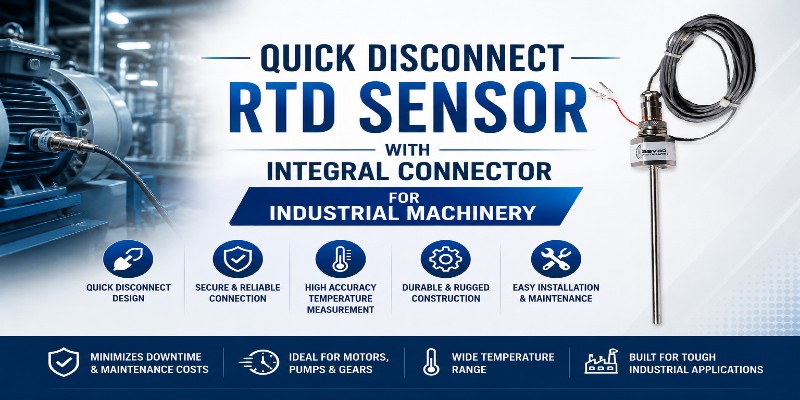
Quick Disconnect RTD Sensor: How Integral Connectors Cut Sensor Replacement Downtime Across Indian Industry
Every maintenance engineer who has replaced a hardwired RTD sensor in a running plant knows the sequence: isolate the instrument loop, open the terminal block, identify and remove three wires, insert three wires from the new sensor in the correct terminals, tighten, reconnect the loop, verify the reading — and then do it all again at the next sensor. If there are a dozen sensors on a single production line, that sequence consumes hours of scheduled maintenance time and introduces the polarity and wiring errors that come with rushing the job. Quick Disconnect RTD sensors replace this entire sequence with a single motion: unplug the failed sensor, plug in the replacement. Total time: under thirty seconds per sensor, with zero wiring work and zero polarity error risk.
What Is a Quick Disconnect RTD Sensor?
A Quick Disconnect RTD sensor is a PT100 Resistance Temperature Detector built with an integral connector — a plug or jack permanently attached to the cable end of the sensor that mates with a matching socket on the instrument-side cable. Instead of terminating in bare wire leads or a terminal block, the sensor terminates in a precision connector that allows it to be connected and disconnected from its measurement circuit in a single, tool-free action.
Aavad’s APES-PJ model adds this connector interface to a Class A PT100, 6mm OD, 150mm sensor length probe — providing measurement precision equal to any hardwired sensor, with the replacement speed of a plug-and-socket system.
Full Specifications: Aavad APES-PJ Quick Disconnect RTD Sensor
| Parameter | Specification | Engineering Significance |
|---|---|---|
| Type | PT-100 | Standardised platinum resistance element |
| Make | Aavad Instrument | ISO 9001:2015 |
| Model | APES-PJ | Plug-Jack quick disconnect RTD |
| Configuration | Simplex | Single PT100 element |
| Total wires | 3 | 3-wire for lead-resistance compensation |
| Accuracy | Class A | ±(0.15 + 0.002 |
| Temperature range | -50 to 400°C | Wide range covering industrial process, HVAC, cold chain |
| Material | SS 316 | Corrosion-resistant sheath |
| Insulation | Compacted MgO | Stable electrical isolation |
| Cable length | 3 metres | Extended cable for routing to instrument panel |
| Cable type | Teflon/Teflon | Chemical and heat resistant; flexible |
| Sensor OD | 6 mm | Standard for most industrial insertion points |
| Sensor length | 150 mm | Extended 150mm — reaches deep sensor ports and vessel nozzles |
| Termination | Integral plug-jack connector | Quick connect / quick disconnect at instrument-side connection |
Why 150mm Sensor Length Sets This Apart from Compact Bayonet RTDs
The 150mm sensor length of the APES-PJ is a critical specification that differentiates it from the bayonet RTD range (50mm–75mm tips). This extended probe reaches:
- Deep thermowell installations where the sensing tip must project 100mm+ from the process connection face to reach the process fluid in a large-bore pipeline or vessel
- Process vessels and reactors where the probe must clear the vessel wall thickness and project into the true bulk fluid
- Test chambers and ovens where the probe enters through a wall port and must reach a defined measurement point inside the chamber
- Industrial machinery with deeper sensor pockets than the 50–75mm range that bayonet probes serve
The 150mm length combined with the quick-disconnect connector creates a practical probe for frequent-removal applications — calibration checks, comparison measurements against portable reference instruments, and scheduled sensor swaps where the probe is regularly withdrawn and reinserted.
The Integral Connector Advantage: Five Specific Benefits for Indian Industrial Plants
Benefit 1: Replacement in Under 30 Seconds
The entire sensor replacement process — from starting to remove the failed sensor to verifying the reading from the replacement — takes under 30 seconds with a plug-jack connector. For plants with multiple sensors on a single machine or system, this compounds: a 12-sensor extruder that would take 2+ hours to service with hardwired sensors can be completely re-sensored in under 10 minutes.
Benefit 2: Zero Polarity Wiring Errors
3-wire PT100 connections require specific wiring: which wire connects to which terminal matters for accurate lead-resistance compensation. In a rush maintenance situation, wiring errors are common — leading to systematic measurement errors that may not be caught immediately. A properly specified integral connector (with type-matched contacts and a keyed or polarised connector body) prevents this class of error completely.
Benefit 3: Enables Rapid Calibration Rotation
Plants with quality systems requiring periodic sensor calibration — ISO 9001, pharmaceutical GMP, food HACCP — can rotate calibrated spare sensors into position quickly while the removed sensor is sent for recalibration. Quick disconnect connectors make this rotation fast enough to be practical, whereas the wiring complexity of hardwired sensors often leads to “recalibrate in place” approaches that are technically inferior.
Benefit 4: Reduces Electrician Dependency
A hardwired terminal block connection requires a qualified electrician or instrument technician to terminate correctly in compliance with plant electrical safety standards. A quick-disconnect connection can typically be made by any trained maintenance technician — reducing the dependency on specialised trades for routine sensor maintenance.
Benefit 5: Supports OEM Modular Equipment Design
Machine manufacturers (OEMs) building modular equipment — food processing lines, test and measurement equipment, laboratory instruments, packaging machinery — specify integral connector RTDs because they allow end-users to replace sensors without any wiring expertise. This reduces after-sales support requirements and improves user satisfaction with the equipment.
Available Connector Types and How to Specify
The APES-PJ range supports multiple connector styles to match different instrument-side connection systems:
- Standard industrial PT100 connector (Plug-Jack style): The most common configuration for general industrial process sensors
- DIN-style circular connectors: Common on European OEM machine designs
- M12 connectors: Widely used in IIoT sensor networks, machine automation, and fieldbus-connected instrumentation
- Custom connector integration: For OEM designs with proprietary connector standards
Critical specification requirement: The connector on the sensor must exactly match the socket on the instrument-side cable. Confirm the connector family, gender (male probe / female instrument side is standard), number of contacts, and pin assignment with Aavad’s team when ordering — particularly for OEM applications where a specific connector standard is pre-defined by the equipment design.
Industries and Applications Across India
Industrial Machinery — OEM and Replacement
Nationwide plastic, rubber, food processing, textile, and packaging machinery manufacturers and end-users across: Gujarat (Ahmedabad, Rajkot, Vadodara, Surat, Vapi) | Maharashtra (Pune, Nashik, Mumbai, Aurangabad) | Delhi NCR (Noida, Faridabad) | Haryana (Gurugram, Manesar) | Tamil Nadu (Chennai, Hosur, Coimbatore) | Karnataka (Bengaluru) | Punjab (Ludhiana)
Quick disconnect RTD sensors are standard on modern OEM machinery where end-users are expected to perform routine sensor maintenance without specialist support. When OEM sensors fail, the APES-PJ provides a compatible replacement that matches the original sensor’s connector interface and accuracy class.
Test Benches and Laboratory Equipment
Engineering colleges, research institutes, automotive testing centres, QC laboratories: ARAI (Pune) | NATRiP testing centres (Manesar, Chennai, Ahmednagar) | CSIR labs (Bengaluru, Hyderabad, Chennai, Pune) | IIT labs nationwide | NABL-accredited testing labs across India
Test and measurement equipment requires sensors that can be quickly reconfigured between test setups. Quick disconnect RTDs allow the same measurement system to be used with different probes for different tests without rewiring.
Process Industries — Calibration Rotation Programs
Chemical, pharma, food, and petrochemical plants across: Ankleshwar, Vapi, Bharuch, Dahej (Gujarat) | Pune, Nashik, Raigad (Maharashtra) | Hyderabad (Telangana) | Chennai (TN)
Plants with formal sensor calibration programs — where sensors are periodically removed for NABL-accredited recalibration and replaced with calibrated spares — benefit from quick disconnect connections that make the rotation fast enough to execute on a scheduled basis without production impact.
HVAC and Building Automation
Commercial and industrial buildings across all major Indian cities
HVAC systems increasingly use sensor networks where individual zone or coil sensors can be replaced by facilities maintenance staff without instrument technician support. Quick disconnect connections on a 150mm probe suit direct immersion in chilled or hot water coil return headers.
Portable Temperature Measurement and Inspection
Nationwide industrial inspection, commissioning, and troubleshooting applications
A quick-disconnect probe paired with a handheld 3-wire PT100 indicator provides a flexible, portable temperature measurement system that can be inserted into any compatible socket across a facility — calibration bath, process vessel, equipment housing — and removed for the next measurement point without disconnecting bare wires each time.
India-Wide Coverage
Aavad Instrument supplies Quick Disconnect RTD Sensors PAN India from Ahmedabad, Gujarat:
Gujarat: Ahmedabad, Vadodara, Surat, Rajkot, Ankleshwar, Vapi, Bharuch, Dahej, Jamnagar, Gandhinagar, Morbi, Mehsana
Maharashtra: Pune, Nashik, Mumbai, Aurangabad, Nagpur, Kolhapur, Raigad, Navi Mumbai
Delhi NCR: Noida, Greater Noida, Faridabad, Gurugram, Ghaziabad
Haryana: Gurugram, Manesar, Faridabad, Panipat, Bahadurgarh
Tamil Nadu: Chennai, Coimbatore, Hosur, Tiruppur, Sriperumbudur
Karnataka: Bengaluru, Mysuru, Hubballi, Belagavi, Tumakuru
Telangana & AP: Hyderabad, Sangareddy, Visakhapatnam
Rajasthan: Jaipur, Bhiwadi, Alwar, Neemrana, Kota
UP: Noida, Greater Noida, Lucknow, Kanpur, Agra
Punjab: Ludhiana, Amritsar, Mohali, Jalandhar
WB: Kolkata, Howrah, Durgapur | MP: Indore, Bhopal, Pithampur
CG, Jharkhand, Odisha, Bihar, HP, Uttarakhand, Kerala, Goa, Assam: PAN India
Aavad Instrument: India’s #1 Quick Disconnect RTD Manufacturer
Aavad Instrument Pvt. Ltd., Chandkheda, Ahmedabad, Gujarat:
- ISO 9001:2015 certified | NABL-accredited calibration laboratory
- 15+ years | 38M+ installations | 2,900+ customers | 12+ countries
- Trusted by BHEL, ONGC, HAL, BARC, NALCO, Indian Railways, Indian Oil, L&T, Torrent Pharma, Aditya Birla Group, Sintex, PepsiCo, Kohler, Saint-Gobain, Cera, MIDHANI, RVUN
Frequently Asked Questions
Q1. What is a Quick Disconnect RTD sensor and how does it differ from a standard wire-type RTD?
A Quick Disconnect RTD has an integral plug-jack connector at the cable end instead of bare wire leads or a terminal block. This allows the sensor to be connected and disconnected from the measurement circuit in a single, tool-free action without any wiring work — enabling sensor replacement in under 30 seconds vs the several minutes required for a hardwired terminal connection.
Q2. Does the integral connector affect measurement accuracy?
No — when the connector contacts are correctly specified for PT100 (copper or plated contacts with adequate contact resistance), the connector junction introduces negligible measurement error. The APES-PJ maintains Class A accuracy (±0.15°C at 0°C) through and beyond the connector interface.
Q3. Why is the sensor length 150mm rather than the 50–75mm range on bayonet RTDs?
The 150mm length suits deeper thermowell installations, large-vessel insertion points, and test chamber applications where the sensing tip must reach further from the process connection face than the short bayonet probe tips can achieve. For extruder barrel bayonet applications, the shorter 50–75mm bayonet RTD range is more appropriate.
Q4. How do I specify the right connector type for my instrument system?
Identify your existing instrument-side cable termination — the connector family (standard plug-jack, M12, DIN, or other), number of contacts, gender, and pin assignment. Provide this information to Aavad’s team when ordering to ensure the APES-PJ’s connector exactly matches your instrument-side socket.
Q5. Can this sensor be used in hazardous areas?
Confirm with Aavad’s engineering team whether your specific installation requires Ex-rated (intrinsically safe or flameproof) certification — the standard APES-PJ is specified for general industrial use. For hazardous area applications, a specific Ex-rated configuration may be required.
Q6. Is NABL calibration available for Quick Disconnect RTD sensors?
Yes — Aavad’s in-house NABL-accredited calibration laboratory issues traceable Class A calibration certificates on request.
Q7. Does Aavad supply Quick Disconnect RTD sensors across India?
Yes — PAN India from Ahmedabad with active deployments across Gujarat, Maharashtra, Delhi NCR, Haryana, Tamil Nadu, Karnataka, Telangana, AP, Rajasthan, UP, Punjab, WB, MP, and all other Indian states.
Buy Quick Disconnect RTD Sensors from India’s #1 Manufacturer
View the product page or contact Aavad Instrument to confirm the right connector type for your instrument system.
📞 +91 90996 22823 | ✉ hrg@aavadinstrument.com | ISO 9001:2015 | NABL Accredited | Ahmedabad, Gujarat | PAN India Supply