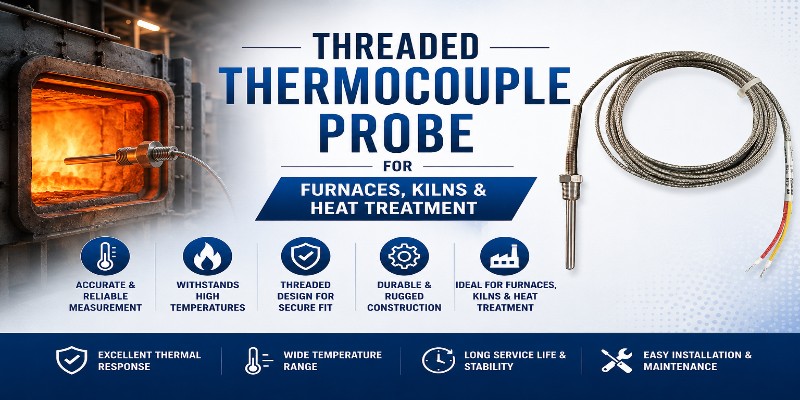
Threaded Thermocouple Probe: What Is the Best K-Type Sensor for Furnaces, Kilns & Heat Treatment?
Across India’s heat-processing industries — from the heat treatment and forging units of Faridabad and Ludhiana, to the ceramic tile and sanitaryware furnaces of Morbi in Gujarat, to the glass manufacturing belt of Firozabad, and the foundries and boiler installations scattered through Pune, Coimbatore, and Rajkot — one instrumentation requirement comes up on nearly every high-temperature process: a rugged, screw-in sensor that can be installed directly into a threaded port and hold up reliably at temperatures well above 500°C. That sensor is the Threaded Thermocouple Probe, a K-type thermocouple built with a standard NPT process connection for direct installation into furnaces, ovens, and process equipment.
What Is a Threaded Thermocouple Probe?
A Threaded Thermocouple Probe is a Type K (Chromel/Alumel) temperature sensor terminated in a standard NPT-threaded process connection, allowing it to be screwed directly into a tapped port on a furnace wall, oven chamber, pipe, or vessel. Unlike weld pad or bayonet-style sensors, the threaded connection makes it simple to install, remove, and replace without hot work or special tooling — while still providing a secure, leak-resistant seal at the process boundary.
Its defining characteristics for high-temperature industrial duty:
- Type K thermocouple element: dependable, fast-responding, and well suited to temperatures above 540°C in oxidizing atmospheres
- 0°C to 600°C measurement range: covers the majority of furnace, kiln, and heat treatment process temperatures
- 1/8″ NPT male threaded connection: direct screw-in installation into standard tapped ports
- FG/FG/SS braided cable: fibreglass insulation rated for sustained high-temperature service near the process connection
Full Specifications: Aavad AKES-5X50 Threaded Thermocouple Probe
| Parameter | Specification | Engineering Significance |
|---|---|---|
| Type | K (Chromel/Alumel) | Wide compatibility, dependable and fast-responding at high temperature |
| Make | Aavad Instrument | ISO 9001:2015 |
| Model | AKES | Standard threaded wire-type thermocouple |
| Datasheet | AKES-5X50 | Available for download from product page |
| Configuration | Simplex | Single measuring junction |
| Temperature range | 0°C to 600°C | Covers most furnace, kiln, boiler, and heat treatment process temperatures |
| Material of construction | SS 316 | Corrosion-resistant, durable in industrial process environments |
| Insulation | Compacted MgO | Fast response and stable insulation resistance under thermal cycling |
| Process connection | NPT | Standard tapered thread for secure, leak-resistant installation |
| Process connection size | 1/8″ (M) | Fits standard small-bore tapped ports |
| Cable length | 3 metres | Standard; custom lengths available |
| Cable type | FG/FG/SS | Fibreglass-insulated, SS-braided for high-temperature durability |
| Sensor OD | 5 mm | Compact fit for standard process ports |
| Sensor length | 50 mm | Standard immersion length for typical furnace and pipe installations |
Why K-Type Thermocouples Are the Standard Choice for High-Temperature Threaded Installations
1. Wide Working Range With Fast Response
K-type thermocouples measure reliably from -270°C to 1,372°C, though Aavad’s standard AKES-5X50 is specified to 600°C for typical industrial process duty. Their fast thermal response makes them well suited to processes with rapidly changing temperatures, such as furnace start-up and heat treatment cycles.
2. Strong Performance in Oxidizing Atmospheres
K-type thermocouples are specifically well suited to oxidizing atmospheres and perform best at temperatures above 540°C — precisely the operating window found in furnaces, kilns, and heat treatment equipment across metal processing and ceramics industries.
3. Simple, Secure Threaded Installation
The 1/8″ NPT male connection allows the probe to be screwed directly into a tapped port, providing a leak-resistant seal without welding or specialized mounting hardware — making installation and future replacement straightforward for maintenance teams.
4. Economical and Dependable
K-type thermocouples remain one of the most cost-effective, dependable sensing technologies available, which is why they continue to be specified as the default sensor type across a very broad range of industrial heating and process applications.
Threaded Thermocouple Probe vs. Other Process-Mounted Sensors
| Method | Installation | Temperature Ceiling | Best Use Case |
|---|---|---|---|
| Threaded Thermocouple Probe | Screw-in NPT, simple and fast | Up to 600°C (standard) | Furnaces, kilns, boilers, heat treatment, general process ports |
| Weld Pad Thermocouple | Permanently welded | Up to 400°C (surface) | Permanent surface/skin monitoring on pipes and vessels |
| Spring Loaded Bayonet Sensor | Bayonet lock, quarter-turn | Up to 250°C | Extruder barrels, injection molding platens |
| Melt Bolt Thermocouple | Bolted, removable | Application-dependent | Flat surfaces requiring periodic sensor swap |
For applications needing a simple, removable, high-temperature process connection, the threaded thermocouple probe is generally the most practical and cost-effective option — reserving weld pad or bayonet-style mounting for the specific situations where welding or spring-loaded contact is required instead.
Industries and Applications Across India
High-Temperature Furnaces & Kilns
Ceramic and glass manufacturing hubs: Morbi (Gujarat — India’s largest ceramic tile and sanitaryware cluster) | Firozabad (Uttar Pradesh — glass manufacturing) | Khurja (UP — ceramics) | Thangadh (Gujarat — ceramics)
Kiln and furnace zone temperature monitoring in tile, sanitaryware, and glass manufacturing requires dependable, screw-in thermocouples that can be installed and replaced without disrupting the refractory lining.
Heat Treatment & Metal Processing
Heat treatment and forging clusters: Faridabad (Haryana) | Ludhiana, Jalandhar (Punjab) | Pune, Aurangabad (Maharashtra) | Coimbatore (Tamil Nadu) | Rajkot (Gujarat)
Furnace and heat treatment cycle monitoring — annealing, hardening, tempering, and normalizing — relies on threaded thermocouples installed directly into furnace chamber ports for accurate zone temperature control.
Boilers & Thermal Power Plants
Boiler zone and flue gas path temperature monitoring across thermal power stations and industrial boiler installations uses threaded thermocouple probes wherever a direct screw-in process connection is preferred over welded or insertion thermowell mounting.
Plastic Extrusion & Injection Molding
Higher-temperature barrel zones and die adapters on some extrusion and molding lines specify threaded K-type thermocouples where process temperatures exceed the range suited to spring-loaded bayonet RTDs.
Chemical & Petrochemical Processing
Chemical process hubs: Ankleshwar, Vapi, Dahej (Gujarat) | Panipat (Haryana) | Vizag (Andhra Pradesh)
Reactor, pipeline, and process vessel temperature monitoring where a threaded process connection provides a practical, serviceable installation point.
Exhaust Gas & Engine Temperature Monitoring
Industrial engine test benches and exhaust monitoring systems use threaded K-type thermocouples for reliable, fast-responding temperature data in demanding thermal environments.
Threaded Thermocouple Probe vs. Melt Bolt Thermocouple: Key Distinction
Buyers sometimes compare the Threaded Thermocouple Probe (AKES-5X50) with the Melt Bolt Thermocouple. Both mount into a process port — the key differences:
| Feature | Threaded Thermocouple Probe (AKES-5X50) | Melt Bolt Thermocouple |
|---|---|---|
| Mounting method | 1/8″ NPT screw-in | Bolted, flush-mounted |
| Typical application | Furnace, kiln, boiler, general process ports | Extruder barrel melt zones, flush surface sensing |
| Temperature range | 0°C to 600°C | Application-dependent, typically lower-range melt zones |
| Serviceability | Unscrew and replace | Unbolt and replace |
Threaded Thermocouple Probe: general-purpose screw-in sensor for a wide range of furnace, boiler, and process port installations up to 600°C
Melt Bolt Thermocouple: flush-mounted sensor specifically suited to extruder barrel melt zone surface temperature sensing
India-Wide Coverage
Aavad Instrument supplies Threaded Thermocouple Probes PAN India from Ahmedabad, Gujarat:
Gujarat: Ahmedabad, Morbi, Thangadh, Rajkot, Vadodara, Ankleshwar, Vapi, Dahej
Uttar Pradesh: Firozabad, Khurja, Noida, Kanpur
Haryana & Delhi NCR: Faridabad, Panipat, Gurugram, Delhi
Punjab: Ludhiana, Jalandhar, Mohali, Amritsar
Maharashtra: Pune, Aurangabad, Mumbai, Nagpur
Tamil Nadu: Chennai, Coimbatore, Tiruchirappalli
Andhra Pradesh & Telangana: Visakhapatnam, Hyderabad
Karnataka: Bengaluru, Mangaluru
Rajasthan, West Bengal, Madhya Pradesh, Bihar, and all other states: PAN India delivery available
Aavad Instrument: India’s Trusted Threaded Thermocouple Probe Manufacturer
Aavad Instrument Pvt. Ltd., Chandkheda, Ahmedabad, Gujarat:
- ISO 9001:2015 certified | NABL-accredited calibration laboratory
- 15+ years | 38M+ installations | 2,900+ customers | 12+ countries
- Trusted by BHEL, ONGC, Indian Oil, Bharat Petroleum, L&T, HAL, BARC, NALCO, Sintex, Cera, Saint-Gobain, Rallis
Frequently Asked Questions
Q1. What is a threaded thermocouple probe used for?
A threaded thermocouple probe is used to measure process temperature in furnaces, kilns, boilers, and general industrial equipment by screwing the sensor directly into a tapped NPT port — commonly used up to 600°C in heat treatment, ceramics, glass, and metal processing applications.
Q2. What temperature range does a K-type threaded thermocouple cover?
K-type thermocouples can measure from -270°C to 1,372°C in general, though Aavad’s standard AKES-5X50 threaded probe is specified for 0°C to 600°C, which covers most furnace, kiln, and heat treatment process temperatures. K-type thermocouples perform best above 540°C in oxidizing atmospheres.
Q3. What process connection does the threaded thermocouple probe use?
It uses a standard 1/8″ NPT male threaded connection, allowing direct screw-in installation into a tapped port without welding or special mounting hardware.
Q4. What material is the threaded thermocouple probe made of?
The sensor sheath is SS 316 with compacted MgO insulation, and the lead wire uses FG/FG/SS (fibreglass-insulated, stainless-steel-braided) construction for durability in high-temperature process environments.
Q5. Why is K-type preferred over other thermocouple types for furnace applications?
K-type thermocouples offer a wide working range, fast thermal response, low cost, and strong performance in oxidizing atmospheres above 540°C — making them the most commonly specified thermocouple type for furnaces, kilns, and heat treatment equipment.
Q6. Can the threaded thermocouple probe be customized?
Yes. Aavad manufactures both standard and fully custom threaded thermocouple probes — including custom sensor length, cable length, and thread size — to match specific process port requirements through the Build Your Products service.
Q7. Which industries commonly use threaded thermocouple probes?
Ceramics and glass manufacturing (kilns and furnaces), heat treatment and metal processing, boilers and thermal power plants, plastic extrusion, chemical and petrochemical processing, and engine/exhaust gas temperature monitoring.
Q8. Does Aavad supply threaded thermocouple probes across India?
Yes — PAN India from Ahmedabad, with active supply into ceramic, glass, heat treatment, and process industry hubs across Gujarat, Uttar Pradesh, Haryana, Punjab, Maharashtra, Tamil Nadu, Andhra Pradesh, Telangana, Karnataka, and all other Indian states.
Buy Threaded Thermocouple Probes from India’s Trusted Manufacturer
View the product page and download datasheet AKES-5X50 or contact Aavad Instrument for furnace, kiln, and heat treatment sensor requirements.
📞 +91 90996 22823 | ✉ hrg@aavadinstrument.com | ISO 9001:2015 | NABL Accredited | Ahmedabad, Gujarat | PAN India Supply