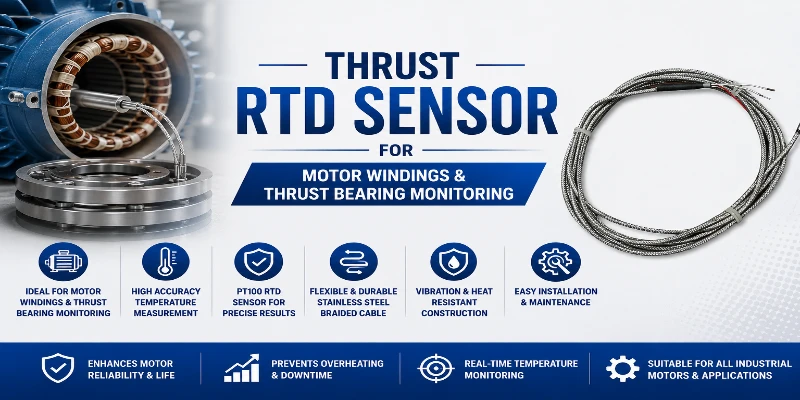
Thrust RTD Sensor: India’s Most Compact PT100 for Thrust Bearing Plates, Motor Windings & Confined Space Temperature Monitoring
Every thermal protection system has a hierarchy of measurement points, and at the tightest end of that hierarchy — where bearing housings narrow to a few millimetres of clearance, where thrust bearing plates are separated from adjacent components by the thinnest of gaps, where motor stator windings leave no room for anything but the most compact probe imaginable — standard RTD sensors simply will not fit. This is the specific engineering problem that the Thrust RTD Sensor solves: a miniature, low-mass PT100 probe in a 3mm OD × 20mm construction that installs where no other sensor in Aavad’s catalogue can reach, while still delivering Class A accuracy and fast response on a 3-wire, Teflon-cable assembly rated to 400°C.
What Is a Thrust RTD Sensor?
A Thrust RTD Sensor is a miniature PT100 resistance temperature detector specifically designed for confined-space temperature monitoring in rotating machinery — particularly thrust bearing plates, axial bearing positions, motor end-shield bearing recesses, and between motor stator windings, where the physical space available for a temperature sensor is severely restricted.
The name “thrust” refers to its primary application: thrust bearing temperature monitoring — measuring the temperature of the axial (thrust) bearing in turbines, generators, pumps, and motors, where the thrust load is taken on a thrust collar or thrust plate and the bearing temperature is monitored for protection and condition monitoring purposes.
Full Specifications: Aavad APES-3X20 Thrust RTD Sensor
| Parameter | Specification | Engineering Significance |
|---|---|---|
| Type | PT-100 | Standardised platinum resistance element |
| Make | Aavad Instrument | ISO 9001:2015 |
| Model | APES | Wire-type miniature RTD |
| Datasheet | APES-3X20 | Available for download from product page |
| Configuration | Simplex | Single PT100 element |
| No. of wires | 3 | 3-wire lead-resistance compensation |
| Accuracy | Class A | ±(0.15 + 0.002 |
| Temperature range | -50 to 400°C | Covers all bearing and motor winding operating ranges |
| Material | SS 316 | Corrosion-resistant; compatible with lubricating oils and greases |
| Insulation | Compacted MgO | Stable electrical isolation; supports compact probe construction |
| Cable length | 3 metres | Standard to nearby junction box or instrument |
| Cable type | Teflon/Teflon/SS | Chemical and oil resistant; SS braid for mechanical protection |
| Sensor OD | 3 mm | Narrowest probe OD in Aavad’s range |
| Sensor length | 20 mm | Shortest sensor tip in Aavad’s range |
Why 3mm OD and 20mm Length Are Engineering-Critical Dimensions
These two dimensions define what the Thrust RTD can do that nothing else in Aavad’s catalogue can.
The 3mm OD: Fitting Where Others Can’t
The standard bearing RTD (APED-8×35) uses an 8mm OD probe — appropriate for the machined pockets in most rotating equipment bearing housings. But thrust bearing plates, motor end-shield bearing recesses, and gaps between motor stator winding conductors are machined or wound to different, tighter geometries. A 3mm OD probe (the industry minimum for a functional PT100 in this construction type) fits into:
- Thrust plate pocket bores drilled to 3mm or 4mm diameter in the steel or white-metal thrust collar
- Motor winding slots between stator conductors, where the winding geometry leaves approximately 3–4mm of accessible space between winding bundles
- Shaft rider recesses in small turbines where the rotor shaft groove is machined to accommodate only a 3mm probe
- Miniature bearing housings on pumps, small motors, and auxiliary equipment where even the most compact general bearing RTD would not physically clear the adjacent components
The 20mm Length: Sitting Flush in Confined Spaces
At 20mm active tip length — the shortest in Aavad’s range — the Thrust RTD positions its sensing element within the shallow pockets available in thrust plates and motor windings without projecting into or contacting adjacent rotating components. In a thrust bearing assembly, the clearances between the thrust plate, thrust collar, and adjacent shaft components are measured in millimetres; a 35mm or 50mm tip would cross these clearances and potentially contact rotating parts during operation.
Why “Low Mass” and “Fast Response” Are Specific Performance Requirements
The product description specifically notes “miniature low mass sensors which are fast responding.” For bearing protection systems, both properties are functionally important:
Low Mass for Fast Response
A smaller, lower-mass sensing element reaches thermal equilibrium with its surroundings faster than a larger probe — meaning it responds more quickly to temperature changes at the measurement point. For bearing protection, where a developing hot spot in a thrust plate can progress from “slightly elevated” to “critically hot” within minutes, a fast-responding sensor provides more useful early warning than a slow-responding, higher-mass alternative.
Low Mass for Minimal Thermal Loading
In a thrust plate or motor winding environment, the sensor itself should not represent a significant thermal mass that distorts the temperature at the measurement point — it should measure the point’s temperature without changing it. A 3mm × 20mm probe has negligible thermal mass compared to the bearing plate or motor winding it’s monitoring, ensuring the measurement represents the actual condition rather than the sensor’s own thermal equilibrium state.
How Thrust RTD Sensors Fit into Machine Protection Philosophy
In Steam Turbines and Gas Turbines
Steam and gas turbine protection systems typically monitor multiple bearing temperature points — journal bearings, thrust bearings, and pad bearings — as part of the turbine’s protection relay logic. A thrust bearing temperature trip (typically triggered when the measured temperature exceeds a defined absolute limit or a rate-of-rise threshold) protects the turbine from thrust collar seizure that could result in catastrophic axial damage to the turbine rotor and blades. The Thrust RTD’s compact probe sits in the thrust plate’s shallow sensor pocket, positioned to measure the pad or collar temperature directly at the bearing film.
In Electric Motors
Motor winding temperature monitoring serves a different but equally important protection function: stator winding insulation degrades at an accelerating rate as temperature rises. The IEC motor protection standard relates thermal class (E, B, F, H) to maximum permissible winding temperature; operating a motor winding above its rated class temperature steadily shortens insulation life. A 3mm RTD embedded between winding conductors measures the winding slot temperature — the hottest zone in a loaded motor — rather than the bearing housing or frame temperature, which would underestimate the actual thermal stress on the insulation.
In Pumps and Compressors
Axial thrust on pump and compressor rotors is taken on the thrust bearing. In vertical pumps particularly, the full rotor weight plus hydrodynamic thrust loads on the top or bottom thrust bearing, and bearing temperature monitoring at the thrust position is the primary protection against bearing overload. The compact APES-3X20 fits the restricted space of the pump thrust chamber where larger sensors cannot.
Direct Comparison: Thrust RTD vs Bearing RTD — Which to Specify?
| Parameter | Thrust RTD (APES-3X20) | Bearing RTD (APED-8×35) |
|---|---|---|
| Sensor OD | 3mm | 8mm |
| Sensor length | 20mm | 35mm |
| Configuration | Simplex | Duplex |
| Primary application | Thrust plates, motor windings, shaft slots, miniature housings | General journal and rolling-element bearing housings |
| Space requirement | Ultra-confined — 3–4mm bore | Standard bearing pocket — 8–10mm bore |
| Redundancy | Single element | Two independent elements — built-in standby |
Selection rule:
- Available space <5mm bore, pocket depth <25mm → Thrust RTD (APES-3X20)
- Standard bearing housing 8mm+ bore → Bearing RTD (APED-8×35)
- Critical turbine or continuous-run equipment needing redundancy → Turbine RTD (APED-8X25) or Bearing RTD duplex
Industries and Applications Across India
Power Generation — Steam Turbine Thrust Bearings
All major thermal power stations: Korba (NTPC/CSEB, CG) | Singrauli, Vindhyachal (NTPC, MP) | Rihand, Obra, Anpara (UPRVUNL) | Ramagundam (NTPC, AP) | Gandhinagar, Wanakbori, Ukai (GSECL, Gujarat) | Chandrapur, Bhusawal (MAHAGENCO) | Ennore, Mettur (TANGEDCO, TN) | Talcher (NTPC/OPGC, Odisha) | Bokaro, Patratu (Jharkhand)
Every large steam turbine set has thrust and journal bearing RTDs as part of its bearing protection relay system. The thrust RTD’s compact probe fits the thrust bearing’s sensor pocket geometry.
Steel and Heavy Industry — Motor Protection
Hubs: Jamshedpur (Tata Steel) | Bhilai (SAIL) | Rourkela (SAIL) | Angul (NALCO) | Hospet (JSW Steel) | Visakhapatnam (RINL) | Hazira (Gujarat)
Large drive motors on rolling mills, blast furnace blowers, ore handling conveyors, and steel process machinery — all requiring stator winding RTD protection for motor insulation thermal class compliance.
Oil and Gas — Pump and Compressor Thrust Protection
Hubs: Jamnagar, Dahej, Hazira, Ankleshwar (Gujarat) | Rajahmundry (AP) | Mumbai (Maharashtra) | Mangaluru (Karnataka) | Visakhapatnam (AP)
Centrifugal pump thrust bearing monitoring in pipeline stations and process plants; compressor thrust bearing protection in gas processing facilities.
Cement — Kiln Drive Motors and Fan Motors
Hubs: Chittorgarh, Beawar (Rajasthan) | Nalgonda (AP) | Gulbarga (Karnataka) | Porbandar, Rajkot (Gujarat) | Jabalpur (MP)
Large kiln drive motors and induced draft / forced draft fan motors — all requiring winding RTD protection.
Hydro Power — Generator Thrust Bearings
Major hydro stations: Bhakra-Nangal (Punjab/HP) | Koyna (Maharashtra) | Idukki (Kerala) | Tehri (Uttarakhand) | Sardar Sarovar (Gujarat) | Nagarjunasagar (AP)
Vertical hydro generators carry the full rotor weight on the main guide bearing and thrust bearing. Thrust bearing RTD monitoring is a fundamental protection requirement for all hydro units.
Rotating Equipment OEM Manufacturers
Pump manufacturers: Kirloskar (Pune) | KSB (Pune) | Flowserve | Grundfos (India operations) Motor manufacturers: ABB (Bengaluru) | Siemens (multiple) | Bharat Bijlee (Mumbai) | CG Power (Mumbai) | Hindustan Motors
OEM manufacturers incorporate Thrust RTDs as standard sensor specifications in their bearing protection system packages for large machines.
India-Wide Coverage
Aavad Instrument supplies Thrust RTD Sensors PAN India from Ahmedabad:
Gujarat: Ahmedabad, Vadodara, Surat, Rajkot, Ankleshwar, Jamnagar, Bharuch, Dahej, Gandhinagar, Hazira, Kutch
Maharashtra: Pune, Mumbai, Nashik, Nagpur, Aurangabad, Kolhapur, Navi Mumbai
UP: Rihand Nagar, Obra, Anpara, Noida, Kanpur, Lucknow
MP: Singrauli, Vindhyachal, Pithampur, Indore, Bhopal | CG: Korba, Sipat, Raipur, Bhilai
Odisha: Talcher, Rourkela, Angul, Bhubaneswar | Jharkhand: Jamshedpur, Bokaro, Ranchi
WB: Kolkata, Durgapur, Haldia, Asansol | AP & Telangana: Ramagundam, Visakhapatnam, Hyderabad
Tamil Nadu: Chennai, Ennore, Mettur, Hosur, Coimbatore | Karnataka: Bengaluru, Ballari, Mangaluru
Rajasthan: Jaipur, Chittorgarh, Kota | Kerala: Idukki, Kochi, Thiruvananthapuram
HP & Uttarakhand: Nangal, Haridwar, Roorkee, Tehri | Punjab: Ludhiana, Mohali
Delhi NCR, Haryana, Bihar, Assam, Goa, North-East: PAN India
Aavad Instrument: India’s #1 Thrust RTD Manufacturer
Aavad Instrument Pvt. Ltd., Chandkheda, Ahmedabad, Gujarat:
- ISO 9001:2015 certified | NABL-accredited calibration laboratory
- 15+ years | 38M+ installations | 2,900+ customers | 12+ countries
- Trusted by BHEL, ONGC, HAL, BARC, NALCO, Indian Railways, NPCIL, L&T, MIDHANI, Indian Oil, Bharat Petroleum, Torrent Power, RVUN, NLC
Frequently Asked Questions
Q1. What is a Thrust RTD Sensor and why is it different from a standard bearing RTD?
A Thrust RTD Sensor is an ultra-compact PT100 probe (3mm OD × 20mm length) designed for confined-space monitoring in thrust bearing plates, motor windings, and other locations too physically restricted for standard bearing RTDs (8mm OD). Where a standard bearing RTD probe would not fit, the Thrust RTD’s miniature dimensions allow installation in the tight pockets of thrust collars, motor stator slots, and miniature bearing housings.
Q2. What is the sensor OD and length of the APES-3X20?
3mm OD and 20mm active sensing length — the smallest probe configuration in Aavad’s complete RTD range.
Q3. Why is Class A accuracy specified for thrust bearing temperature monitoring?
Thrust bearing degradation begins with small temperature rises above the bearing’s normal operating baseline — often 5°C–10°C above established normal. Class A accuracy (±0.15°C at 0°C) provides the measurement precision to detect these small deviations reliably and distinguish them from normal sensor variance, giving protection systems the earliest possible alarm trigger.
Q4. What is the difference between the Thrust RTD (APES-3X20) and the Bearing RTD (APED-8×35)?
Thrust RTD: 3mm OD, 20mm length, Simplex — for ultra-confined thrust plates, motor windings, and miniature housings. Bearing RTD: 8mm OD, 35mm length, Duplex — for standard rotating equipment bearing housing pockets with standby element redundancy. Choose based on your available bore diameter and pocket depth.
Q5. Can the 3mm Thrust RTD be used for motor winding temperature monitoring?
Yes — the 3mm OD is specifically designed to fit between motor stator winding conductors, making it suitable for direct winding slot temperature monitoring, which measures the hottest zone in a loaded motor more accurately than an external frame or bearing housing temperature measurement.
Q6. Is NABL calibration available for Thrust RTD Sensors?
Yes — Aavad’s in-house NABL-accredited calibration laboratory issues traceable calibration certificates on request.
Q7. Does Aavad supply Thrust RTD Sensors across all Indian states?
Yes — PAN India from Ahmedabad with active deployments across power generation, steel, oil and gas, cement, hydro power, and heavy industry locations across all major Indian states.
Buy Thrust RTD Sensors from India’s #1 Manufacturer
View the product page and download datasheet APES-3X20 or contact Aavad Instrument for a quote.
📞 +91 90996 22823 | ✉ hrg@aavadinstrument.com | ISO 9001:2015 | NABL Accredited | Ahmedabad, Gujarat | PAN India Supply