N Type Thermocouple Cable: India’s Complete Supplier Guide for Power Generation, High-Temperature Kilns & Long-Run Installations
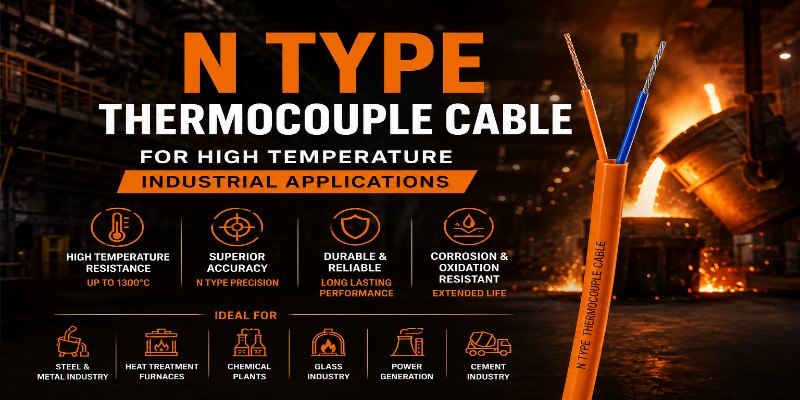
When an Indian plant engineer specifies a Type N thermocouple — choosing it specifically because its Nicrosil/Nisil alloy offers superior long-term stability and oxidation resistance compared to Type K at sustained high temperatures — the cable connecting that sensor to the control system must continue to support that choice. An N-type thermocouple connected with Type K extension cable, or ordinary copper wire, produces a corrupted signal. The superior sensor performance is entirely negated by the cable. N Type Thermocouple Cable closes this gap — it is the only cable that correctly extends an N-type thermocouple’s signal without thermoelectric error.
This guide covers the full technical specification of Aavad’s N Type Thermocouple Cable, why the CuNi conductor specification is correct for this application, where it’s used across India’s industries, and everything an instrumentation engineer or procurement team needs to source it correctly.
Why N-Type Thermocouple Cable Is a Distinct Specification — Not Interchangeable With K-Type
N-type thermocouples (Nicrosil positive / Nisil negative) were developed as an improved alternative to K-type, specifically addressing K-type’s susceptibility to “green rot” — oxidation-driven calibration drift at sustained high temperatures above approximately 800°C–1,000°C. For power plants, high-temperature kilns, cement plants, and refinery furnace zones where sensors run continuously for thousands of hours at elevated temperatures, N-type’s long-term stability is a meaningful advantage over K-type.
But that advantage only reaches the control system intact if the extension cable maintains thermoelectric compatibility with the N-type sensor conductors. The N-type thermoelectric EMF-vs-temperature curve is different from K-type — they are not interchangeable at the cable level. Using K-type extension cable with an N-type thermocouple introduces a systematic thermoelectric error at the splice junction that corrupts the measurement signal, typically causing the instrument to read incorrect temperatures without any obvious fault indication.
N Type Thermocouple Cable uses CuNi (copper-nickel) conductor alloys selected specifically to match the thermoelectric characteristic of N-type thermocouples at the cable operating temperature range, ensuring the junction between sensor lead wires and extension cable generates no net thermoelectric error.
Full Specifications: Aavad N Type Thermocouple Cable
| Parameter | Specification | Engineering Significance |
|---|---|---|
| Thermocouple type | N | Matched to Nicrosil/Nisil N-type thermocouple sensors |
| Conductor type | CuNi (copper-nickel alloy) | Thermoelectrically matched to N-type sensor for signal accuracy |
| Size | 3/24 SWG | Standard instrumentation cable gauge for single-pair thermocouple extension |
| Inner insulation material | PVC | Provides primary electrical isolation of each conductor |
| Color code | BS (British Standard) | Standard color identification for N-type polarity (Pink positive, Orange negative per BS 4937) |
| Temperature (cable ambient) | 105°C | Maximum continuous ambient temperature for PVC-insulated cable routing |
| Length | As per requirement | Custom cut lengths supplied — specify your run length when ordering |
| Accuracy | Standard | Meets standard thermocouple extension cable error limits |
| Number of cores | 2 core | Single thermocouple pair (positive and negative conductors) |
| Outer jacket | HR PVC (Heat Resistant PVC) | Outer jacket with improved heat resistance vs standard PVC |
The CuNi Conductor: Why This Specific Alloy Combination Is Used
N-type extension cables use CuNi conductor alloys — copper-nickel combinations — because their thermoelectric output approximates the thermoelectric characteristic of the full Nicrosil/Nisil N-type alloy pair at the cable’s operating temperature range (near ambient, where the cable is located). This approximation is sufficient to eliminate practical thermoelectric error at typical cable ambient temperatures found in most industrial installation paths.
The distinction between N-type thermocouple cable (which uses compensating CuNi conductors) and N-type thermocouple wire (which uses the actual Nicrosil/Nisil alloys as used in the sensor itself) matters when your cable routing passes through hot zones:
- At ambient or near-ambient cable temperatures — CuNi compensating conductors in N-type cable introduce negligible thermoelectric error. This is the correct specification for most industrial panel wiring, cable tray runs, and junction box connections.
- At elevated cable ambient temperatures — if your cable run passes through hot zones where the cable itself exceeds approximately 100°C, the thermoelectric approximation of CuNi conductors begins to deviate from the true N-type EMF curve, introducing measurement error. For hot zone cable runs, the transition joint thermocouple design (true alloy conductors through the hot zone) or fiberglass-insulated cable with a better temperature rating is more appropriate.
HR PVC Outer Jacket: What It Offers Over Standard PVC
Standard PVC cable begins to soften and degrade at sustained temperatures above approximately 70°C. HR PVC (Heat Resistant PVC) offers an improved continuous service temperature — approximately 105°C — making it more suitable for cable runs near warm process equipment, in warm cable trays, or in plant areas with elevated ambient temperature from nearby process heat.
For cable routes with sustained ambient temperatures above 105°C, alternative insulation options — fiberglass, PTFE, or Kapton — should be specified instead of HR PVC. Aavad’s complete RTD & Thermocouple Cable category covers all insulation types for different temperature requirements.
Industries and Applications Across India Where N-Type Cable Is Essential
Power Generation — Thermal Power Stations
Hubs: Korba, Raigarh (Chhattisgarh) | Singrauli, Satpura (MP) | Rihand, Obra, Anpara (UP) | Ramagundam, Kothagudem (AP) | Ennore, Tuticorin (Tamil Nadu) | Gandhinagar, Wanakbori (Gujarat) | Chandrapur, Nashik, Trombay (Maharashtra) | Talcher, Ib Valley (Odisha) | Badarpur, Jhajjar (Delhi/Haryana)
Boiler superheater and reheater temperature monitoring, flue gas temperature monitoring at economizer sections, and steam turbine exhaust temperature monitoring — all using N-type thermocouples for their superior long-term stability — need matched N-type extension cable to carry accurate temperature signals over cable run distances that can reach 100–200+ metres from the boiler zone to the plant’s DCS room.
Cement Industry — Kiln Zone Monitoring
Hubs: Morbi, Porbandar (Gujarat) | Chittorgarh, Beawar (Rajasthan) | Nalgonda, Yerraguntla (AP) | Gulbarga (Karnataka) | Jabalpur (MP)
N-type thermocouples are increasingly specified in cement plants — particularly at kiln burning zone and preheater cyclone points — for their reduced drift compared to K-type at sustained temperatures above 900°C. N-type cable completes this specification by matching the sensor’s thermoelectric characteristic through the cable run back to the kiln control room.
Steel and Metals — Furnace Monitoring
Hubs: Jamshedpur (Jharkhand — Tata Steel) | Bhilai (Chhattisgarh) | Rourkela (Odisha) | Durgapur (WB) | Angul (Odisha — NALCO) | Hazira, Surat (Gujarat)
EAF, IF, and soaking pit furnace temperature monitoring at zones where K-type drift has historically been a maintenance problem is being upgraded to N-type sensors at many Indian steel plants. N-type cable is the essential companion to this sensor upgrade.
Petrochemical and Refinery Furnaces
Hubs: Jamnagar (Reliance, Essar) | Vadodara (Gujarat) | Visakhapatnam (HPCL) | Mumbai (BPCL Trombay) | Chennai (CPCL) | Mangaluru (MRPL)
Fired heater and process furnace zone temperature monitoring in refineries and petrochemical plants, where N-type sensors are used for their stability advantage at sustained high-temperature hydrocarbon processing conditions.
Research, Defence, and High-Precision Instrumentation
Hubs: Bengaluru (ISRO, DRDO, HAL) | Hyderabad (DRDL) | Pune (ARDE) | Trombay (BARC)
N-type thermocouples are used in aerospace propulsion test rigs, materials testing furnaces, and research instrumentation environments where long-term calibration stability at high temperature is a measurement integrity requirement. N-type cable with correct CuNi conductors is the matched cable specification for these systems.
Specifying N-Type Cable Length: Custom Lengths for Every Installation
Unlike standard copper signal cable, thermocouple extension cable is consumed in the exact length of each cable run — mid-run splices using mismatched conductors are not acceptable. Aavad supplies N Type Thermocouple Cable in custom cut lengths as per your requirement, eliminating the need to purchase fixed drum lengths that result in excess cable.
When specifying your cable length, measure or estimate:
- The distance from the thermocouple connection head or junction box to the next intermediate junction or terminal strip
- Add approximately 10–15% for routing bends, drip loops, and termination allowances
- Specify the total length per run — Aavad supplies cut to length
India-Wide Coverage
Aavad Instrument supplies N Type Thermocouple Cable PAN India from Ahmedabad, Gujarat:
Gujarat: Ahmedabad, Vadodara, Surat, Rajkot, Ankleshwar, Vapi, Dahej, Jamnagar, Morbi, Gandhinagar, Bharuch, Hazira, Porbandar
Maharashtra: Pune, Nashik, Mumbai, Aurangabad, Nagpur, Chandrapur, Trombay, Raigad
Tamil Nadu: Chennai, Coimbatore, Ennore, Tuticorin, Hosur, Tiruchirappalli
Karnataka: Bengaluru, Mysuru, Hubballi, Ballari, Belagavi, Gulbarga
Telangana & AP: Hyderabad, Sangareddy, Ramagundam, Kothagudem, Visakhapatnam, Kadapa
Rajasthan: Jaipur, Kota, Bhilwara, Chittorgarh, Beawar, Alwar, Bhiwadi
UP: Noida, Greater Noida, Lucknow, Kanpur, Rihand Nagar, Anpara, Agra
MP: Indore, Bhopal, Pithampur, Singrauli, Satpura, Jabalpur
Odisha: Bhubaneswar, Rourkela, Angul, Talcher, Ib Valley, Paradip, Sambalpur
WB: Kolkata, Durgapur, Haldia, Asansol, Howrah
Delhi NCR: Noida, Greater Noida, Gurugram, Faridabad, Badarpur
Haryana: Gurugram, Faridabad, Jhajjar, Panipat, Bahadurgarh
Punjab: Ludhiana, Amritsar, Mohali, Jalandhar
Jharkhand: Jamshedpur, Bokaro, Ranchi, Dhanbad
Chhattisgarh: Raipur, Bhilai, Korba, Raigarh
Kerala: Kochi, Thrissur, Kozhikode, Thiruvananthapuram
Uttarakhand: Haridwar, Roorkee, Kashipur
Aavad Instrument: India’s #1 N Type Thermocouple Cable Supplier
Aavad Instrument Pvt. Ltd., Chandkheda, Ahmedabad, Gujarat:
- ISO 9001:2015 certified | NABL-accredited calibration laboratory
- 15+ years | 38M+ installations | 2,900+ customers | 12+ countries
- Trusted by BHEL, ONGC, HAL, BARC, NALCO, Indian Railways, Indian Oil, Bharat Petroleum, NPCIL, L&T, Torrent Pharma, Aditya Birla Group, MIDHANI, RVUN
- Full RTD & Thermocouple Cable category
Frequently Asked Questions
Q1. What is N Type Thermocouple Cable and why is it different from K Type cable?
N Type Thermocouple Cable uses CuNi (copper-nickel) conductors matched to the thermoelectric characteristic of N-type (Nicrosil/Nisil) thermocouples. K Type cable uses different conductors matched to K-type thermocouple alloys. Using K-type cable with an N-type thermocouple — or vice versa — creates a thermoelectric mismatch at the cable-to-sensor splice, introducing systematic temperature measurement error that the instrument displays without any fault indication.
Q2. What does “BS colour code” mean on N Type thermocouple cable?
BS refers to British Standard BS 4937, which defines colour coding for thermocouple extension cables. For N-type cable per BS 4937: the positive conductor (Nicrosil-equivalent) is Pink and the negative conductor (Nisil-equivalent) is Orange, with an overall Orange outer jacket. International IEC colour coding is also available on request from Aavad.
Q3. What is the maximum cable ambient temperature for HR PVC insulated N type cable?
The HR PVC (Heat Resistant PVC) jacket on Aavad’s N Type Thermocouple Cable is rated for continuous cable ambient temperatures up to approximately 105°C. For cable runs through higher-temperature zones, specify fiberglass, PTFE, or Kapton insulated cable instead.
Q4. Can N Type thermocouple cable be supplied in custom lengths rather than full drums?
Yes — Aavad supplies N Type Thermocouple Cable in custom cut lengths as per your requirement. Specify your required lengths per run when requesting a quote.
Q5. Why is N type thermocouple cable increasingly specified over K type cable in power plants?
N-type thermocouples were designed specifically to overcome K-type’s susceptibility to oxidation-driven calibration drift (“green rot”) at sustained temperatures above approximately 800°C–1,000°C. As more power plants upgrade their boiler and furnace thermocouple specifications from K-type to N-type for improved long-term measurement stability, N-type matched extension cable becomes the required companion for that sensor upgrade.
Q6. What is a 3/24 SWG cable construction?
3/24 SWG denotes 3 strands of 24 SWG (Standard Wire Gauge) conductors per core. This is a standard instrumentation cable construction providing a balance of flexibility and mechanical strength suitable for most industrial cable tray and conduit installation applications.
Q7. Does Aavad supply N Type Thermocouple Cable PAN India?
Yes — supply and delivery PAN India from Ahmedabad with active deployments across all major Indian industrial states including Gujarat, Maharashtra, Rajasthan, Tamil Nadu, Karnataka, AP, Telangana, UP, Delhi NCR, Odisha, WB, MP, Chhattisgarh, Jharkhand, Punjab, Kerala, and Uttarakhand.
Buy N Type Thermocouple Cable from India’s #1 Supplier
View the product page or contact Aavad Instrument for custom length pricing and quantity requirements.
📞 +91 90996 22823 | ✉ hrg@aavadinstrument.com | ISO 9001:2015 | NABL Accredited | Ahmedabad, Gujarat | PAN India Supply