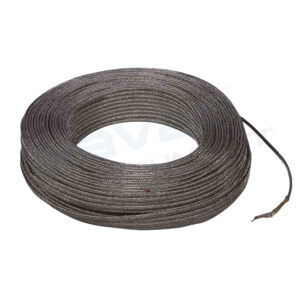
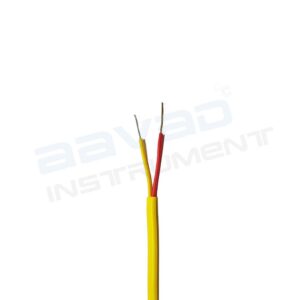
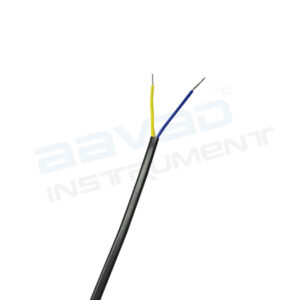
Kapton Insulated Thermocouple Cable | Polyimide Cable

Kapton Insulated Thermocouple Cable | Polyimide Cable
| Parameter | Specification |
|---|---|
| Insulation | Ptfe/ kapton |
| Temperature range | Upto 260 deg c |
| Type | Thermocouple/ RTD cable |
| Minimum order quantity | 100meter |
| Aerospace Industry | Power Generation |
| Laboratories | Petrochemical Plants |
| Cryogenic | Applications |
| Pharmaceutical | Autoclaves |
| Conductors | Solid or stranded thermocouple wire per ASTM E230 & ANSI MC96.1 |
| Insulation | Two layers of fused polyimide tape, color coded with a polyimide coating |
| Construction | Parallel conductors |
| Jacket | Two layers of fused polyimide tape |
| Operating Temperature | -400F (-240C) to 500F ( 260C) continuous |
| Limits of Error | Conforms to ASTM E230, IEC 584 and ANSI MC 96.1 |
| Color Code | Conforms to ASTM E230 and ANSI MC96.1 (International Color Codes Available) * |
| *Note – Polyimide jackets are not color coded |
Description
The Kapton Insulated Thermocouple Cable is engineered for reliable temperature signal transmission in applications requiring exceptional thermal stability, dielectric performance, and resistance to harsh operating environments. Designed for use with thermocouples and RTD sensors, the cable utilizes two layers of fused Kapton (polyimide) tape bonded with FEP adhesive to provide a lightweight yet highly durable insulation system. Unlike conventional PVC or standard PTFE insulated cables, Kapton insulation maintains excellent electrical and mechanical properties across an extremely wide operating range of -240°C to +260°C, making it suitable for both cryogenic and elevated-temperature applications where long-term reliability is critical.
The cable is manufactured in accordance with ASTM E230, ANSI MC96.1, and IEC 584 standards, ensuring compatibility with internationally recognized thermocouple and instrumentation requirements. Kapton insulation offers high dielectric strength, excellent dimensional stability, and outstanding resistance to chemicals, abrasion, and thermal aging while maintaining flexibility despite its thin wall construction. It also retains its physical integrity after gamma radiation exposure, making it suitable for specialized environments where conventional cable insulation may degrade. International colour code options are available for conductor identification, while the polyimide outer insulation itself remains uncoloured as part of its standard construction.