Description
A PTFE Coated Thermowell is a protective fitting designed to shield RTDs, Pt100 sensors, thermocouples, and other industrial temperature sensors from corrosive process media while maintaining the mechanical strength required for industrial installations. By combining the structural properties of stainless steel with the chemical resistance of a PTFE coating, this thermowell is well suited for applications involving aggressive chemicals where standard stainless steel may require additional protection.
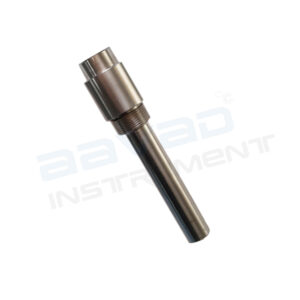
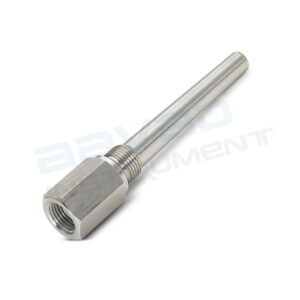
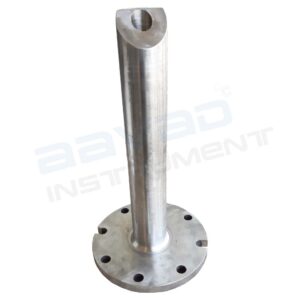
The Aavad Instrument PTFE Coated Thermowell (Model TW-PTFE-100) is manufactured with an SS316 stainless steel body and a PTFE coating over the wetted surface. This combination helps resist attack from many acids, alkalis, and other corrosive process fluids while retaining the mechanical integrity of the stainless steel substrate. The thermowell features a 1.5-inch Raised Face (RF) flange, 12 mm stem diameter, and 100 mm U-length, providing secure installation and compatibility with a wide range of industrial temperature sensors.
Unlike a thermowell manufactured entirely from a corrosion-resistant alloy, the PTFE-coated design uses stainless steel for structural support while the PTFE layer provides an additional barrier between the process fluid and the metal surface. For many low- to medium-pressure corrosive applications, this approach can provide an effective balance of corrosion resistance, mechanical strength, and cost.
The flanged process connection enables installation on pipelines, reactors, vessels, and tanks while allowing removal of the RTD or thermocouple for maintenance without disturbing the process connection. This simplifies routine inspection and calibration in chemical service where maintenance planning is important.
The PTFE Coated Thermowell is widely used in chemical processing, pharmaceutical manufacturing, biotechnology, electroplating, water treatment, effluent treatment, and laboratory applications where reliable temperature measurement is required in the presence of corrosive media.
Key Features
-
Dual-Layer Composite Architecture Combines the inert chemical resistance of a PTFE Teflon outer layer with the structural, pressure-retaining strength of an SS316 core.
-
Complete pH Range Resistance ($text{pH } 0text{–}14$) Defends against strong inorganic acids, aggressive alkalis, chlorinated compounds, and corrosive chemical mixtures.
-
Cost-Effective Alternative to Exotic Alloys Delivers superior chemical protection in low-to-medium pressure applications at a fraction of the cost of Hastelloy or Tantalum thermowells.
-
Standard 1.5″ ANSI Raised Face (RF) Flange Enables direct mounting onto lined chemical piping, vessel nozzles, and glass-lined process reactors.
-
100mm Immersion Insertion Depth ($U$-Length) Sized for precise thermal immersion into standard chemical transfer lines and mixing tanks.
-
Non-Stick Anti-Fouling Surface Profile PTFE’s extremely low coefficient of friction prevents chemical crystallization, polymer scaling, and slurry buildup on the stem.
-
In-Line Maintenance & Inspection Allows technicians to remove, calibrate, or replace internal temperature sensors safely without draining process fluid from tanks or lines.
Applications
-
Chemical Processing & Acid Handling Plants Hydrochloric acid ($text{HCl}$), sulfuric acid ($text{H}_2text{SO}_4$), nitric acid, and chlorine processing loops.
-
Pharmaceutical & Fine Chemical Manufacturing Corrosive reaction vessels, solvent recovery systems, and high-purity chemical lines.
-
Industrial Effluent & Wastewater Treatment (ETP) Acidic waste neutralization tanks, chemical dosing systems, and corrosive sludge manifolds.
-
Electroplating & Metal Surface Treatment Pickling acid baths, anodizing lines, and electroplating chemical circulation tanks.
-
Fertilizer & Petrochemical Auxiliaries Acidic fertilizer slurry lines, chemical storage tanks, and pilot plant testing loops.
Datasheet
FAQs
1. What is a PTFE Coated Thermowell?
A PTFE Coated Thermowell is a stainless steel thermowell with a PTFE (Polytetrafluoroethylene) coating applied to its wetted surface. The coating improves resistance to many corrosive chemicals while protecting RTDs, Pt100 sensors, Pt1000 sensors, and thermocouples from process pressure, corrosion, and mechanical damage in aggressive industrial environments.
2. Why is PTFE used on a Thermowell?
PTFE offers excellent resistance to many acids, alkalis, solvents, and corrosive chemicals. Applying a PTFE coating to the thermowell helps protect the stainless steel surface from chemical attack in compatible process applications while maintaining accurate and reliable temperature measurement.
3. What is the benefit of using SS316 beneath the PTFE Coating?
The SS316 stainless steel base provides the mechanical strength, pressure resistance, and structural integrity required for industrial installation, while the PTFE coating enhances chemical resistance on the process-contact surface. This combination offers both durability and protection in demanding chemical service.
4. Is a PTFE Coated Thermowell suitable for Acid service?
Yes. PTFE Coated Thermowells are commonly selected for many acid, alkali, and corrosive chemical applications where PTFE is chemically compatible with the process fluid. However, material compatibility should always be verified based on the specific chemical composition, concentration, operating temperature, and process pressure before selection.
5. Which industries commonly use PTFE Coated Thermowells?
PTFE coated thermowells are widely used in chemical processing, pharmaceutical manufacturing, biotechnology, electroplating, water treatment, wastewater treatment, effluent treatment plants (ETP), specialty chemical production, fertilizer plants, and other corrosive process applications where enhanced chemical resistance is required.