Description
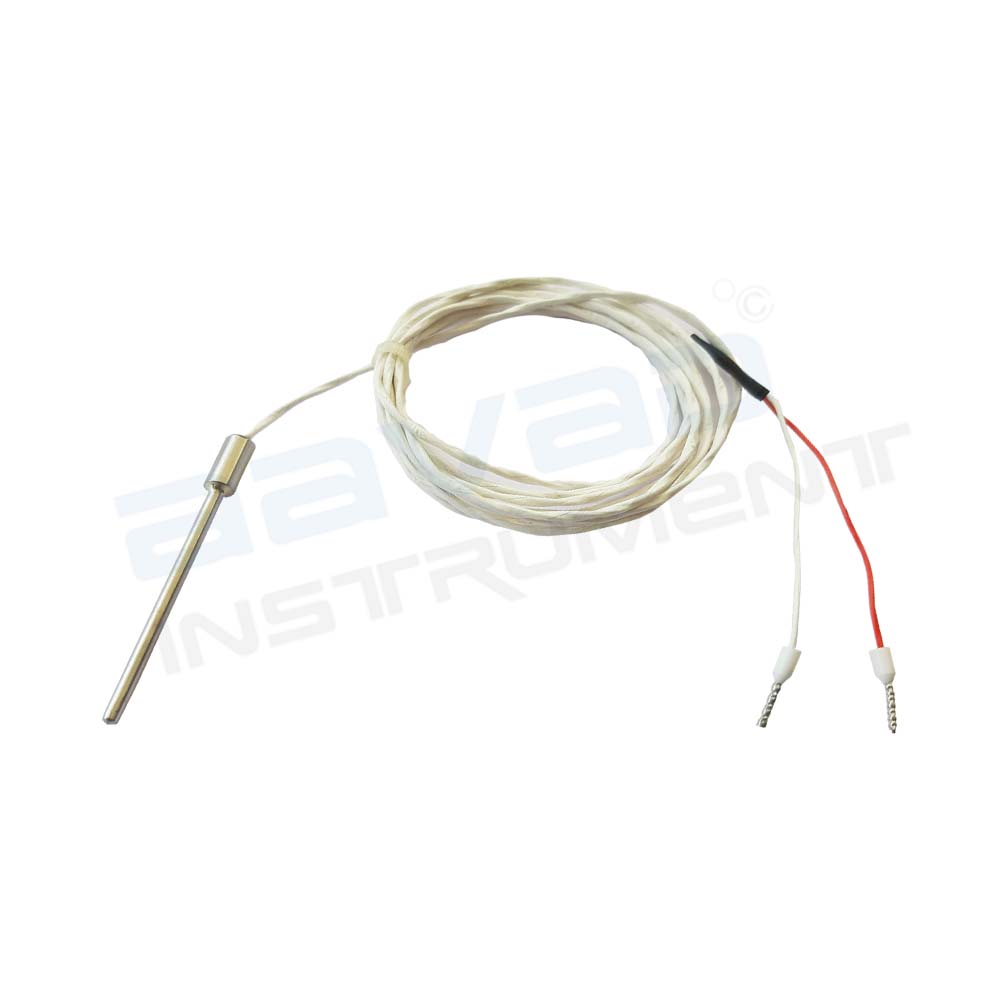
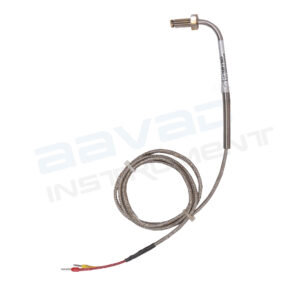
Transition Joint PT100 RTD Sensor (Model APES-5×80) is designed for reliable temperature measurement in industrial processes requiring a rigid stainless steel sensing probe and a durable transition between the sensing sheath and extension cable. The transition joint provides mechanical support at the cable entry while maintaining dependable performance in demanding process environments.
The sensor features a PT100 Simplex 2-wire sensing element with Class B accuracy and an operating temperature range of -50°C to +250°C. Its SS316 stainless steel sheath offers corrosion resistance for applications in chemical processing, food manufacturing, pharmaceutical production, and general industrial equipment.
The rigid sheath construction is intended for straight installations and is not designed for field bending. For longer insertion lengths or applications requiring probe flexibility, a mineral insulated (MI) RTD sensor may be a more suitable option. The standard TF/TF insulated 2-meter cable provides reliable performance in industrial environments while maintaining a compact and durable assembly.
Aavad also manufactures customized transition joint RTD sensors with different probe diameters, insertion lengths, sensing elements, cable constructions, and termination options for OEM and industrial applications.
Key Features
-
Rigid Non-Bendable SS316 Sheath Construction Engineered with a solid-wall stainless steel tube that provides structural rigidity and high chemical resistance (best specified at sheath lengths $le 300text{mm}$).
-
Smooth, Hygienic Stainless Steel Finish SS316 sheath surface prevents bacterial trap sites and resists corrosion from wash-down chemicals, organic acids, and process solvents.
-
Class B PT100 Sensing Element Precision platinum resistance element delivers dependable, linear temperature output across -50°C to 250°C.
-
Potted Transition Sleeve Junction Heavy-duty stainless steel transition joint protects internal lead wire solder points from mechanical strain and flexing stress.
-
Chemical-Resistant Teflon Lead Wire (TF/TF) 2-meter dual-layer Teflon insulated cable resists oil penetration, moisture, and ambient chemical vapors.
-
Versatile Fluid & Gas Sensing Ideal for direct immersion into process tanks, pipelines, or insertion into matching thermowells and compression fittings.
Applications
-
Chemical Processing Plants Temperature monitoring in liquid storage tanks, chemical feed lines, and acid mixing vessels.
-
Food & Beverage Processing Thermal tracking in sanitary liquid lines, wash-down kettles, and ingredient mixing tanks.
-
Pharmaceutical Utility Lines Purified water (PW) distribution loops, steam condensate lines, and non-sterile process tanks.
-
General Machinery & Plant Utilities Bearing oil reservoirs, hydraulic skids, and HVAC fluid loops requiring straight-tube insertion.
-
Process Vessels & Pipelines Direct surface-well or thermowell immersion in short-run process pipework.
Datasheet
FAQs
1. What is a Transition Joint PT100 RTD Sensor?
A Transition Joint PT100 RTD Sensor is a PT100 Resistance Temperature Detector (RTD) that features a reinforced transition joint between the stainless steel sensing probe and the extension cable. This construction improves mechanical durability by reducing stress at the cable entry point, making it ideal for demanding industrial temperature measurement applications.
2. What is the purpose of the Transition Joint?
The transition joint provides additional mechanical support and protects the connection between the sensing probe and the extension cable from vibration, pulling forces, repeated bending, and installation stress. This helps improve sensor reliability and extend its service life.
3. Is the Sheath bendable?
No. This Transition Joint PT100 RTD Sensor features a rigid stainless steel sheath designed for straight installations. The sheath should not be bent during installation, as bending may damage the sensing element and affect measurement accuracy.
4. Where are Transition Joint RTD Sensors commonly used?
Transition Joint RTD Sensors are widely used in chemical processing, food manufacturing, pharmaceutical production, process tanks, pipelines, reactors, water treatment plants, industrial machinery, and automation systems where durable and accurate temperature measurement is required.