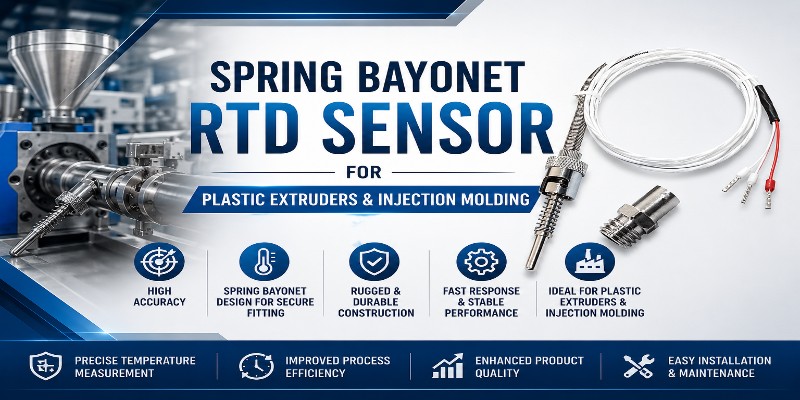
A spring-loaded bayonet RTD requires a specific cap (single vs. double slot) to securely lock into an extruder’s recess. Using the correct cap ensures constant, calibrated spring pressure—critical for maintaining accurate temperature measurement and efficient heat transfer in plastic processing and industrial injection molding machinery.
- A coil spring inside the sensor body that presses the sensing tip continuously forward against the bottom of the machined recess, maintaining constant contact regardless of thermal expansion or vibration
- A rotating bayonet cap that turns to lock the sensor into the machine’s recess after the spring is compressed to the correct pre-load — the rotation allows the cable exit to be positioned in any direction before locking
- A choice of two cap configurations to match the two standard recess geometries found across different extruder and injection molding machine designs
Full Specifications: Aavad APES_5X65 Spring Bayonet RTD
| Parameter | Specification | Engineering Significance |
|---|---|---|
| Assembly | Rotating Bayonet | Rotates to align cable exit before locking |
| Type | PT100 | Standardised resistance sensing element |
| Make | Aavad Instrument | ISO 9001:2015 |
| Accuracy | Class A | ±(0.15 + 0.002 |
| Configuration | Simplex | Single PT100 element |
| No. of wire | 3-wire | Lead-resistance compensation for full accuracy |
| Temperature range | -50 to 250°C | Covers full commodity plastics processing range |
| Material | SS 316 | Corrosion-resistant industrial sheath |
| Wire insulation | Teflon/Teflon/SS | Chemical and heat resistant with SS braid for mechanical protection |
| Wire length | 2 metre | Standard machine panel wiring |
| Adapter | 1/4″ BSP | Most common extruder barrel heater zone thread |
| Tip diameter | 5 mm | Standard for most extruder barrel sensor wells |
| Tip length | 50 mm | Compact active sensing length |
| Bayonet cap | OD 14.10mm, ID 12.00mm, 1-pin locking | Standard bayonet cap dimensions |
| Spring length | 60mm threaded (adjustable) | Shorter spring vs APES_5X45 — for shallower recess geometries |
| Fixing cap options | Single slot 11.5mm ID or Double slot 12.5mm ID | Two standard recess geometries matched |
| Datasheet | APES_5X65 | Available from product page |
Single Slot vs Double Slot: The Critical Fixing Cap Selection
This is the question that most differentiates a successful bayonet RTD installation from a failed one — and almost no Indian supplier explains it clearly.
What the Slot Refers To
The “slot” in a bayonet cap refers to the pin track geometry inside the cap’s bayonet ring: the slot that the machine’s recess pin engages with when the sensor is twisted to lock. This is the physical interface between the sensor’s cap and the machine’s recess.
Single Slot Cap (11.5mm ID)
A single-slot cap has one L-shaped track — the pin enters one slot and the cap is turned until the pin seats at the end of the L. This is used on machines where:
- The recess has one locating pin
- The machine designer specified a single-slot bayonet interface
- Generally found on older or simpler extruder/injection molding machine designs, and many European-origin machines
Single slot cap: 11.5mm ID — the inner bore that accepts the machine recess outer diameter
Double Slot Cap (12.5mm ID)
A double-slot cap has two L-shaped tracks 180° apart — two pins simultaneously engage two slots, turning to seat both pins at once. This is used on machines where:
- The recess has two opposing locating pins
- The machine designer specified a double-slot bayonet interface for better rotational stability
- Generally more common on modern Asian-manufactured injection molding and extrusion equipment
- The 12.5mm ID accommodates the slightly larger recess geometry of two-pin designs
Double slot cap: 12.5mm ID — the inner bore for the two-pin recess
How to Determine Which Cap Your Machine Needs
- Remove the existing sensor (if present) and inspect the recess opening: look inside with a light to count the pins. One pin = single slot cap. Two opposing pins = double slot cap.
- Inspect the old sensor’s cap: if you can read any markings on the existing bayonet cap, confirm whether it’s a 1-pin or 2-pin design.
- Consult your machine’s documentation: the machine manual’s sensor specification section may list the bayonet type (single or double slot).
- Contact Aavad with your machine make and model: experienced suppliers recognize common extruder and injection molding machine bayonet standards across major Indian machine brands and European OEM machines.
The 60mm Threaded Spring: Shorter Than the 200mm Spring on APES_5X45 — Why?
The Spring Bayonet RTD (APES_5X65) uses a 60mm threaded spring, while the Plastic Bayonet PT100 Fixed Length sensor (APES_5X45) uses a 200mm spring. This is not an error — it reflects different sensor well geometry targets:
- 60mm spring (APES_5X65): For shallower recess depths where the bayonet cap locks close to the barrel surface and a shorter spring travel provides the correct contact pre-load
- 200mm spring (APES_5X45): For deeper recesses or applications where the bayonet cap sits further from the barrel surface, requiring more spring travel to maintain contact at the tip while still pre-loading the spring by the correct amount
Practical rule: If you don’t know your recess depth, start with the standard 60mm spring variant. If the spring is fully compressed when locked (bottom of spring coil just touching the cap face), your recess is too deep for 60mm — specify the longer 200mm spring variant or the Adjustable Length Bayonet RTD (APES_5X75).
Why Class A RTD Outperforms a Thermocouple for Extruder Temperature Control
At typical commodity plastic processing temperatures (150°C–240°C), a Class A PT100 RTD:
- Is approximately 3–6× more accurate than a J or K type thermocouple at these temperatures
- Drifts significantly less over months of continuous operation in the barrel zone environment
- Produces cleaner signals with less EMI susceptibility in a busy machine panel
- Provides better controller stability — tighter control over actual barrel temperature vs setpoint
These benefits compound across a multi-zone extruder: six or twelve zones each running 2°C closer to their optimum setpoints means lower scrap, more consistent melt quality, and less energy wasted compensating for temperature deviation.
Industries and Applications Across India
Plastic Extrusion — Blown Film, Pipe, Cable, Profile
Hubs: Ahmedabad, Rajkot (Gujarat) | Pune, Nashik (Maharashtra) | Noida, Greater Noida (UP) | Ludhiana (Punjab) | Chennai (TN) | Hyderabad (Telangana)
Every barrel zone on every extruder needs a bayonet-mounted sensor. When plants upgrade from J-type thermocouple bayonet sensors to PT100 bayonet RTDs, temperature control tightens measurably and process consistency improves.
Injection Molding — Engineering Plastics and Precision Components
Hubs: Rajkot, Ahmedabad (Gujarat) | Pune, Nashik, Aurangabad (Maharashtra) | Noida, Faridabad (NCR) | Chennai (TN) | Ludhiana (Punjab)
Precision injection molding of engineering plastics — PC, PA, POM, PBT — where melt temperature directly affects dimensional consistency and material properties.
Rubber Processing and Vulcanization
Hubs: Faridabad, Ballabhgarh (Haryana) | Vadodara, Ahmedabad (Gujarat) | Pune (Maharashtra) | Kottayam (Kerala)
Rubber extruder barrel temperature monitoring where the Spring Bayonet RTD’s positive contact mechanism handles the high back-pressure from viscous rubber compounds.
Blow Molding, Thermoforming, and Packaging
Nationwide: Packaging machinery and blow molding equipment across India’s consumer goods, food, pharmaceutical, and FMCG packaging manufacturing base.
OEM Replacement Sensors — Any Brand of Machine
The Spring Bayonet RTD (APES_5X65) is compatible with any extruder or injection molding machine that uses a 5mm bayonet sensor in a 1/4″ BSP adapter thread — covering replacement of sensors from European OEM machines (commonly single-slot), Asian OEM machines (commonly double-slot), and custom machines across India’s own plastics machinery manufacturing sector.
Three-Product Bayonet RTD Comparison: Which Aavad Bayonet RTD Is Right for Your Application?
| Parameter | Spring Bayonet RTD (APES_5X65) | Bayonet RTD Adjustable (APES_5X75) | Plastic Bayonet Fixed (APES_5X45) |
|---|---|---|---|
| Tip length | 50 mm | 75 mm | 75 mm |
| Spring length | 60 mm | 60 mm | 200 mm |
| Cable type | TF/TF/SS | TF/TF | TF/TF |
| Cap options | Single slot 11.5mm or Double slot 12.5mm | Same | 1-pin standard |
| Best for | Standard extruder recesses needing slot option flexibility | Deeper recesses — same spring, longer tip | Fixed-depth wells needing maximum spring travel |
| Datasheet | APES_5X65 | APES_5X75 | APES_5X45 |
India-Wide Coverage
Aavad Instrument supplies Spring Bayonet RTD Sensors PAN India from Ahmedabad, Gujarat:
Gujarat: Ahmedabad, Vadodara, Surat, Rajkot, Ankleshwar, Vapi, Morbi, Bharuch, Gandhinagar, Jamnagar, Mehsana
Maharashtra: Pune, Nashik, Mumbai, Aurangabad, Nagpur, Kolhapur
Delhi NCR: Noida, Greater Noida, Faridabad, Gurugram | Haryana: Faridabad, Ballabhgarh, Gurugram, Manesar
Tamil Nadu: Chennai, Coimbatore, Hosur, Tiruppur, Sriperumbudur
Karnataka: Bengaluru, Mysuru, Hubballi, Tumakuru | Telangana & AP: Hyderabad, Visakhapatnam
UP: Noida, Greater Noida, Lucknow, Kanpur | Rajasthan: Jaipur, Bhiwadi, Alwar
Punjab: Ludhiana, Amritsar, Mohali | Kerala: Kochi, Kottayam, Thrissur
WB, MP, CG, Jharkhand, Odisha, Bihar, HP, Uttarakhand, Goa, Assam: PAN India
Aavad Instrument: India’s #1 Spring Bayonet RTD Manufacturer
Aavad Instrument Pvt. Ltd., Chandkheda, Ahmedabad:
- ISO 9001:2015 certified | NABL-accredited calibration laboratory
- 15+ years | 38M+ installations | 2,900+ customers | 12+ countries
- Trusted by Sintex, PepsiCo, Kohler, BHEL, ONGC, L&T, Aditya Birla Group
Frequently Asked Questions
Q1. What is a Spring Bayonet RTD and how does it maintain accurate extruder barrel temperature readings?
A Spring Bayonet RTD uses a coil spring inside the sensor body to press the PT100 tip continuously against the bottom of the extruder’s machined recess. This constant contact eliminates the air gap that forms between a loose sensor tip and the barrel wall — an air gap causes the sensor to read lower than the actual barrel temperature, leading the controller to overheat the zone in compensation.
Q2. How do I choose between single slot and double slot bayonet caps?
Remove the existing sensor and count the pins inside your machine’s recess: one pin = single slot cap (11.5mm ID); two opposing pins = double slot cap (12.5mm ID). Alternatively, contact Aavad with your machine’s make and model.
Q3. What is the difference between the Spring Bayonet RTD (APES_5X65) and the Bayonet RTD Adjustable Length (APES_5X75)?
Both have the same 60mm spring and rotating bayonet cap. The key differences are tip length (50mm vs 75mm) and cable type (TF/TF/SS with SS braid vs TF/TF without). Choose the 50mm tip for shallower recesses; 75mm for deeper recesses where a longer tip is needed to reach the recess bottom.
Q4. Can a Spring Bayonet RTD replace a bayonet thermocouple on my existing machine?
It can replace the mechanical sensor body if dimensions match (5mm tip, 1/4″ BSP adapter, matching cap slot). However, you must also change the temperature controller’s input type from thermocouple (J or K) to PT100 RTD — controllers are not interchangeable between thermocouple and RTD inputs without reconfiguration.
Q5. Why does the Spring Bayonet RTD use TF/TF/SS cable instead of standard PVC?
Teflon/Teflon/SS cable resists the elevated ambient temperatures near extruder barrels, the plasticizer vapors and cleaning solvents common in plastics processing environments, and the mechanical abrasion from cable trays and machine surfaces — all failure modes that PVC cable experiences over time in extruder environments.
Q6. Is NABL calibration available for Spring Bayonet RTD sensors?
Yes — Aavad’s in-house NABL-accredited calibration laboratory issues traceable calibration certificates on request.
Buy Spring Bayonet RTD Sensors from India’s #1 Manufacturer
View the product page and download datasheet APES_5X65 or contact Aavad Instrument to confirm the right slot configuration for your machine.
📞 +91 90996 22823 | ✉ hrg@aavadinstrument.com | ISO 9001:2015 | NABL Accredited | Ahmedabad, Gujarat | PAN India Supply