Surface Temperature Sensor: How to Measure Pipe Temperature Without Drilling, Welding, or Shutting Down the Process
In an ideal instrumentation world, every pipeline temperature measurement point has a properly tapped nozzle, a thermowell, and a process-immersion RTD or thermocouple that reads the fluid temperature directly. In the real world of Indian industrial plants — where pipelines were laid decades before the need for a monitoring point was recognized, where pressurized lines carry fluids too hazardous to tap while in service, where regulatory compliance timelines don’t allow process shutdowns, and where retrofit instrumentation budgets favour non-intrusive solutions — the surface temperature sensor with pipe clamp is the practical answer to a measurement problem that direct-immersion sensors simply cannot solve without significant process disruption.
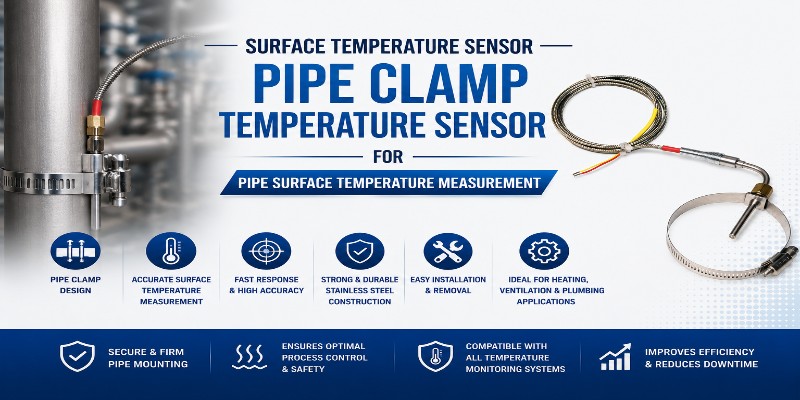
Aavad’s AKXS-Clamp Surface Temperature Sensor clamps directly onto the outside of a 1-inch pipe using a heavy-duty stainless steel worm-gear clamp mechanism, pressing the K-type thermocouple sensing element continuously against the pipe’s outer surface to measure pipe skin temperature up to 600°C — with no drilling, no welding, no process tapping, and no requirement to take the line offline.
What Is a Surface Temperature Sensor (Pipe Clamp Type)?
A surface temperature sensor in pipe clamp configuration is a K-type thermocouple probe built into a mechanical clamp assembly that secures the sensor against the outer surface of a pipeline, providing a continuous, direct-contact pipe skin temperature measurement without penetrating the pipe wall. The measurement is non-invasive — the process fluid never contacts the sensor, the pipe’s pressure integrity is never compromised, and installation or removal can be done on a live, pressurised line.
The clamp assembly uses a worm-gear tightening mechanism — the same principle as a hose clamp — to draw the sensor tip firmly and uniformly against the curved pipe surface, maintaining mechanical contact through thermal expansion, vibration, and the thermal cycling that industrial pipe systems experience during normal operation.
Full Specifications: Aavad AKXS-Clamp Surface Temperature Sensor
| Parameter | Specification | Engineering Significance |
|---|---|---|
| Type | K (Chromel/Alumel) | Universal standard; matches any K-type controller or indicator |
| Make | Aavad Instrument | ISO 9001:2015 |
| Model | AKXS-Clamp | Standard pipe clamp surface thermocouple |
| SKU | AKXS-CLAMP-1 | 1-inch pipe configuration |
| Configuration | Simplex | Single element, 2-wire output |
| Clamp size | Suitable for 1-inch pipe | Specifically sized for 1″ NPS outer diameter |
| Sensor body MOC | SS 316 | Corrosion-resistant probe body |
| Clamp MOC | SS (stainless steel worm-gear) | Heavy-duty clamp; resists corrosion and high ambient temperatures |
| Temperature range | Up to 600°C | Pipe skin temperature range covering steam, hot water, thermal oil, industrial gases |
| Cable insulation | FG/FG/SS | Fiberglass/Fiberglass/SS braid — handles hot ambient near the pipe |
| Cable length | 1 metre | Standard; custom lengths available |
| Datasheet | APWS-Clamp | Available for download from product page |
The Three Installation Problems This Sensor Solves
Problem 1: The Live Pressurised Line That Cannot Be Tapped
Hundreds of thousands of kilometres of industrial piping in India carry fluids at pressure — steam at 10–25 bar, process chemicals, hot oil, compressed gas, and high-pressure water systems. Tapping into a live pressurised line to install a thermowell and immersion sensor requires either:
- Process shutdown — stopping the flow, depressurising, and taking the line off service while the nozzle is welded and the thermowell installed
- Hot-tap equipment — specialised pressurised drilling under flow, which is expensive and requires specialist contractors
For most routine temperature monitoring additions to existing pipelines — a new monitoring point for energy efficiency tracking, an alarm point added for compliance, or a process audit requirement — neither option is cost-effective compared to a clamp-on surface sensor. The AKXS-Clamp installs with a screwdriver, in minutes, on a fully pressurised and flowing line.
Problem 2: The Pipeline Where Tapping Is Restricted or Hazardous
In some industrial scenarios, tapping the pipe wall is either technically prohibited or carries specific safety risks:
- Thin-wall piping where drilling compromises structural integrity
- Pipelines carrying hazardous or toxic chemicals where any additional penetration is minimised under ATEX/PESO regulations and process safety management principles
- Pharmaceutical and food-grade stainless steel piping where each welded joint or penetration requires revalidation and sanitisation
- Insulated cryogenic or high-pressure lines where the insulation and pressure containment system design prohibits field modifications
The non-invasive clamp sensor requires no modification to the pipe wall — it is mechanically clamped to the outside surface, maintaining 100% of the pipe’s original pressure boundary integrity.
Problem 3: Temporary and Audit Measurement Points
Process audits, energy surveys, heat balance studies, and commissioning activities frequently need temperature data at pipe points that are not permanently instrumented. Installing and then removing pipe tapping fittings for these temporary measurements is disproportionately complex and expensive. A clamp-on surface sensor installs in minutes, delivers the required data, and is removed and relocated to the next measurement point with equal ease — making it the standard tool for temporary process surveys.
How the Worm-Gear Clamp Maintains Accurate Surface Contact
The accuracy of a surface temperature sensor depends entirely on the quality of thermal contact between the sensing element and the pipe surface. Air is a poor thermal conductor; any gap between the sensor tip and the pipe face causes the sensor to read the temperature of the trapped air rather than the pipe surface. The worm-gear clamp mechanism on the AKXS-Clamp addresses this precisely:
Mechanical pre-load through worm-gear tightening: The worm-gear (like a hose clamp) is tightened around the pipe circumference, drawing the SS 316 sensor body’s contact face down onto the pipe outer surface with consistent, calibrated mechanical force. This pre-load ensures intimate surface contact from the moment of installation.
Maintains contact through thermal cycling: As the pipe heats and cools during process operation, the worm-gear clamp’s mechanical compliance allows it to follow the pipe’s thermal expansion without losing contact — unlike spring-type clamps that can lose preload as the pipe expands beyond the spring’s free-load position.
Stainless steel clamp resists temperature and corrosion: The SS clamp body handles the elevated surface temperatures near the pipe (up to 600°C rated range), humidity, chemical splash, and the outdoor exposure typical of industrial piping installations without the corrosion or strength degradation that a non-stainless clamp would experience.
Surface Temperature vs Process Temperature: Understanding the Difference
This is the most important technical limitation to understand about surface contact temperature sensors — and it’s a distinction that most Indian supplier product pages omit entirely.
A surface clamp sensor measures the pipe outer skin temperature, not the process fluid temperature inside the pipe. These two temperatures differ because heat must conduct from the fluid through the pipe wall to the pipe surface before the sensor can measure it. The difference between them is governed by:
1. Pipe material and wall thickness: A 1-inch schedule 40 carbon steel pipe with high thermal conductivity produces a smaller temperature difference between fluid and outer skin than a stainless steel pipe with lower conductivity and thicker walls.
2. Pipe insulation: An insulated pipe’s outer surface temperature may be significantly lower than the process fluid temperature, since the insulation prevents heat flow to the surface.
3. Ambient conditions: Exposed outdoor piping in cold weather, or piping under forced convection (wind or cooling air), loses heat from the outer surface — further reducing outer skin temperature below process temperature.
4. Flow velocity: Higher flow velocity improves convective heat transfer from fluid to pipe wall, reducing the fluid-to-wall temperature difference.
Practical implication: For steam lines, hot water circuits, thermal oil systems, and other applications where relative pipe temperature (rise, fall, deviation from normal) is the monitoring objective — rather than an absolute accurate measurement of the fluid temperature — surface clamp sensors are fully adequate and practical. For applications requiring accurate measurement of the actual fluid temperature, a direct-immersion thermocouple or RTD through a thermowell remains the correct specification.
Industries and Applications Across India Where AKXS-Clamp Is the Correct Solution
Steam Distribution Lines — Industrial Plants
All major industrial estates and complexes across: Ankleshwar, Vapi, Bharuch, Dahej (Gujarat) | Raigad, Pune, Nashik (Maharashtra) | Aurangabad (Maharashtra) | Panipat (Haryana) | Ludhiana (Punjab) | Delhi NCR | Hyderabad (Telangana) | Chennai (TN) | Bengaluru (Karnataka)
Steam distribution headers, trap outlet lines, and steam-to-process connections across industrial plants — where monitoring steam supply temperatures at individual use points identifies heat tracing failures, steam trap bypass, and distribution loss without modifying the existing steam system piping.
Pharmaceutical and Biotech Manufacturing
Hubs: Ahmedabad, Ankleshwar, Vadodara, Vapi (Gujarat) | Aurangabad, Pune, Badlapur (Maharashtra) | Hyderabad, Sangareddy (Telangana) | Baddi, Nalagarh (HP) | Noida (UP)
In GMP-regulated pharmaceutical plants where each additional pipe penetration requires revalidation, the non-invasive clamp sensor provides process area temperature monitoring (steam supply lines, WFI distribution, CIP supply lines) without triggering a revalidation cycle.
Food and Beverage Processing — CIP and Process Lines
Hubs: Ahmedabad, Anand (Gujarat) | Pune, Nashik (Maharashtra) | Ludhiana, Amritsar (Punjab) | Delhi NCR | Hyderabad (Telangana)
CIP (Clean-in-Place) supply line temperature monitoring, pasteurisation heat-hold tube external monitoring, and steam supply pipe temperature tracking on food processing lines — where the non-invasive sensor eliminates any hygiene or contamination risk associated with adding penetrations to food-contact piping.
Oil and Gas — Pipeline and Process Monitoring
Hubs: Jamnagar, Dahej, Hazira, Ankleshwar (Gujarat) | Visakhapatnam (AP) | Mumbai (Maharashtra) | Mangaluru (Karnataka) | Chennai (TN)
Pipeline skin temperature monitoring on crude oil, refined product, and gas processing lines — particularly for insulated pipelines carrying waxy crude where outer skin temperature indicates whether the insulation system is maintaining the minimum flow temperature needed to prevent wax deposition.
Power Generation — Auxiliary Pipeline Monitoring
All major thermal power stations across India
Auxiliary steam lines, condensate return lines, cooling water supply pipes, and lube oil pipework — all benefit from non-invasive clamp monitoring for leak detection (a hot spot on a normally cool line), insulation integrity checking (cool spot on a normally hot steam line indicates insulation damage), and energy audit purposes.
Chemical Plants — Process Safety and Energy Audits
Chemical clusters: Ankleshwar, Vapi, Bharuch (Gujarat) | Raigad, Patalganga (Maharashtra) | Hyderabad (Telangana)
Chemical plants under PESO-regulated or process safety management requirements often need additional monitoring points on high-pressure or hazardous chemical lines that cannot be tapped while under process conditions. Clamp sensors provide the monitoring capability without the process safety risk of adding penetrations to pressurised hazardous chemical lines.
HVAC and Chilled Water Systems
Commercial buildings and industrial facilities across all major Indian cities
Chilled water supply and return line temperature monitoring, cooling tower supply lines, and AHU chilled water coil piping — where the facilities management team needs temperature data points at locations not instrumented in the original building design, without invasive modifications to the existing HVAC piping system.
Refinery and Petrochemical Heat Tracing
Hubs: Jamnagar (Reliance, HPCL) | Vadodara (IOCL) | Visakhapatnam (HPCL) | Mumbai (BPCL) | Mangaluru (MRPL) | Chennai (CPCL)
Steam heat tracing outlet monitoring — verifying that steam-traced product lines are maintaining minimum product temperature — using surface clamp sensors on the tracer and product pipe surfaces to identify failed tracing sections or failed steam traps.
Temporary Process Surveys and Energy Audits
Nationwide: BEE-commissioned energy audits | Plant turnaround commissioning checks | Heat balance studies | Process optimisation surveys
Qualified energy auditors and process engineers across India use clamp-type surface sensors as portable, relocatable temperature measurement points during energy audits, heat balance calculations, and commissioning activities — where a permanent sensor installation would not be justified but temperature data is needed for a defined period.
Comparison: Clamp Sensor vs Weld Pad vs Immersion Thermocouple
| Method | Installation | Invasive? | Accuracy | Best For |
|---|---|---|---|---|
| Pipe Clamp (AKXS-Clamp) | Clamp onto pipe OD surface | ❌ Non-invasive — zero pipe modification | Surface skin temperature | Live lines, temporary monitoring, restricted-tap locations |
| Weld Pad (AKES-6X50) | Welded to pipe exterior | ⚠️ Permanent weld — no pipe penetration | Surface skin temperature | Permanent installation, tube skin / refinery fired heater tubes |
| Immersion + Thermowell | Tapped nozzle + thermowell | ✅ Invasive — pipe must be tapped | True process fluid temperature | Permanent, accurate process temperature measurement |
Decision guide:
- Need temperature data on a live line today, no drilling allowed → Pipe Clamp (AKXS-Clamp)
- Need permanent tube skin monitoring on refinery furnace tubes → Weld Pad
- Need accurate true fluid temperature as a permanent installation → Immersion thermocouple or RTD through thermowell
India-Wide Coverage
Aavad Instrument supplies Surface Temperature Sensors (Pipe Clamp type) PAN India from Ahmedabad, Gujarat:
Gujarat: Ahmedabad, Vadodara, Surat, Rajkot, Ankleshwar, Vapi, Bharuch, Dahej, Jamnagar, Gandhinagar, Hazira, Morbi, Porbandar, Mehsana
Maharashtra: Pune, Nashik, Mumbai, Aurangabad, Nagpur, Raigad, Patalganga, Badlapur, Kolhapur
Delhi NCR: Noida, Greater Noida, Faridabad, Gurugram, Ghaziabad, Delhi
Haryana: Gurugram, Manesar, Panipat, Faridabad, Bahadurgarh
Punjab: Ludhiana, Amritsar, Jalandhar, Mohali, Patiala
Tamil Nadu: Chennai, Coimbatore, Hosur, Tiruppur, Ennore, Manali (refinery corridor)
Karnataka: Bengaluru, Mysuru, Hubballi, Mangaluru, Belagavi
Telangana & AP: Hyderabad, Sangareddy, Visakhapatnam, Vijayawada, Kakinada
Rajasthan: Jaipur, Kota, Bhilwara, Alwar, Bhiwadi, Neemrana
UP: Noida, Greater Noida, Lucknow, Kanpur, Agra, Mathura (refinery)
MP: Indore, Bhopal, Pithampur, Dewas, Bina (refinery)
WB: Kolkata, Howrah, Haldia (petrochemicals), Durgapur, Asansol
Odisha: Bhubaneswar, Rourkela, Paradip (IOCL refinery), Angul, Sambalpur
Jharkhand: Jamshedpur, Bokaro, Ranchi | CG: Raipur, Bhilai, Korba
Bihar: Patna, Barauni (IOCL refinery), Muzaffarpur
HP: Baddi, Nalagarh, Parwanoo | Uttarakhand: Haridwar, Roorkee, Rishikesh
Kerala: Kochi (BPCL refinery), Thiruvananthapuram, Thrissur, Kozhikode, Alappuzha
Assam: Guwahati, Numaligarh (NRL refinery), Digboi, Dibrugarh
Goa: Panaji, Vasco, Ponda | Chandigarh, J&K, Sikkim, North-East states: PAN India
Aavad Instrument: India’s #1 Surface Temperature Sensor Manufacturer
Aavad Instrument Pvt. Ltd., Sangath Mall-1, 216-217, Chandkheda, Ahmedabad, Gujarat:
- ISO 9001:2015 certified | NABL-accredited calibration laboratory
- 15+ years | 38M+ installations | 2,900+ customers | 12+ countries
- Trusted by BHEL, ONGC, HAL, BARC, NALCO, Indian Railways, NPCIL, L&T, MIDHANI, Indian Oil, Bharat Petroleum, Torrent Pharma, Piramal Glass, Aditya Birla Group, Atul Ltd., Sintex, PepsiCo, Kohler, Saint-Gobain, Cera, RVUN, NLC
Custom configurations through Build Your Products:
- Pipe sizes other than 1 inch (specify your pipe OD or nominal size)
- Different clamp material (carbon steel, Inconel, higher-grade stainless)
- Different thermocouple type (J, T for lower range; N for improved high-temperature stability)
- Custom cable lengths beyond 1 metre
Frequently Asked Questions
Q1. What is a surface temperature sensor and how is it different from an immersion thermocouple?
A surface temperature sensor measures the external skin temperature of a pipe, vessel, or surface without penetrating the pipe wall. An immersion thermocouple penetrates the pipe wall (via a tapped nozzle and thermowell) to measure the actual process fluid temperature inside. The surface sensor is non-invasive — the pipe integrity is never compromised — while the immersion sensor gives accurate process fluid temperature.
Q2. Can I measure the actual fluid temperature inside the pipe with a clamp-on surface sensor?
Not directly. The clamp sensor measures the pipe’s outer surface temperature, which differs from the internal fluid temperature due to heat conduction through the pipe wall, ambient heat loss, and insulation effects. For most industrial monitoring applications — identifying relative temperature changes, verifying heat tracing, energy auditing — surface temperature is adequate. For accurate process temperature control, direct immersion through a thermowell is the correct method.
Q3. Does the AKXS-Clamp require the pipe to be shut down for installation?
No — this is the sensor’s primary advantage. The worm-gear clamp installs on a live, pressurised, flowing pipeline with no process interruption, no drilling, and no welding. Installation takes minutes and requires only a screwdriver.
Q4. What pipe size does the AKXS-CLAMP-1 fit?
The AKXS-CLAMP-1 is specifically sized for 1-inch NPS (nominal pipe size) pipes. For other pipe sizes, contact Aavad’s team to discuss availability or custom sizing through the Build Your Products service.
Q5. What is the maximum temperature for the AKXS-Clamp surface sensor?
The AKXS-Clamp is rated up to 600°C — covering steam distribution lines, hot water and thermal oil systems, industrial gas lines, boiler auxiliary piping, and most industrial pipeline applications. For pipe surface temperatures above 600°C (e.g., directly adjacent to furnace or kiln walls), a weld pad thermocouple with SS 310 construction may be more appropriate.
Q6. Why does this sensor use FG/FG/SS cable instead of PVC?
FG/FG/SS (Fiberglass/Fiberglass/SS braid) cable handles the elevated ambient temperatures near hot industrial pipelines — where a PVC cable would soften, degrade, and eventually fail. Fiberglass insulation maintains its integrity at continuous ambient temperatures far above PVC’s ~70–90°C limit, and the SS braid provides mechanical protection against abrasion from nearby pipe insulation, clamps, and structural steelwork.
Q7. How does the worm-gear clamp maintain accurate contact as the pipe heats and expands?
The worm-gear clamp’s mechanical compliance allows it to follow the pipe’s thermal expansion — as the pipe diameter increases slightly with temperature, the clamp tightens slightly further to maintain consistent contact pressure. This self-adjusting characteristic distinguishes worm-gear clamps from fixed-geometry spring clamps that can lose contact as the pipe expands beyond the spring’s pre-set range.
Q8. Is NABL calibration available for the surface temperature sensor?
Yes — Aavad’s in-house NABL-accredited calibration laboratory issues traceable calibration certificates on request.
Q9. Does Aavad supply surface temperature sensors across all Indian states?
Yes — PAN India from Ahmedabad with active deployments across Gujarat, Maharashtra, Delhi NCR, Haryana, Punjab, Tamil Nadu, Karnataka, Telangana, AP, Rajasthan, UP, MP, WB, Odisha, Jharkhand, CG, Bihar, Kerala, HP, Uttarakhand, Assam, Goa, and all other Indian states and refinery, petrochemical, and pharmaceutical corridors.
Buy Surface Temperature Sensors from India’s #1 Manufacturer
View the product page and download datasheet APWS-Clamp or contact Aavad Instrument to discuss your pipe size, temperature range, and monitoring requirements.
📞 +91 90996 22823 | ✉ hrg@aavadinstrument.com | ISO 9001:2015 | NABL Accredited | Ahmedabad, Gujarat | PAN India Supply