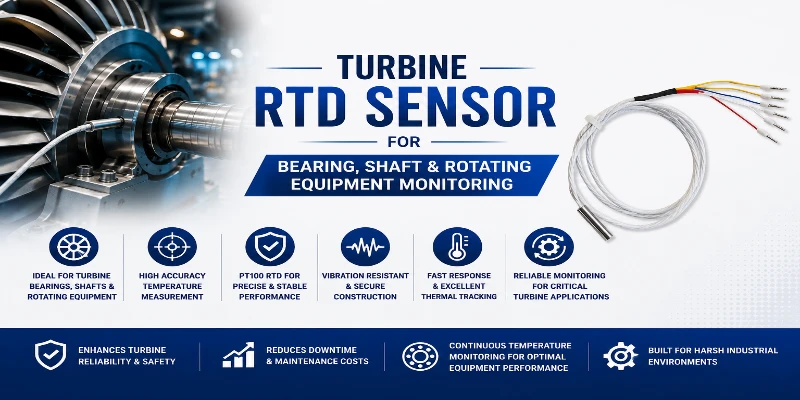
Across India’s power generation and heavy machinery base — from the thermal and combined-cycle power stations of Korba, Ramagundam, and Vindhyachal, to the gas turbine installations serving refinery and petrochemical captive power plants in Jamnagar and Vizag, to heavy diesel engine and turbocharger manufacturing hubs in Pune and Pithampur, and industrial compressor and process vessel operators nationwide — one instrumentation requirement runs through nearly every rotating and high-value asset: redundant, dependable temperature monitoring at bearings, shafts, and lubrication systems, in a footprint compact enough to fit tight equipment access points. The sensor engineered for exactly this is the Turbine RTD Sensor, Aavad’s Model APED duplex PT100 probe.
What Is a Turbine RTD Sensor?
The Aavad Model APED Turbine RTD Sensor is a high-accuracy, Class A PT100 temperature sensor purpose-built for demanding industrial turbine systems and heavy-duty rotating machinery. It operates reliably from -50°C to 400°C and is built around a duplex configuration — two independent 3-wire measurement circuits packed into a single compact housing. This dual-circuit design gives industrial operators built-in redundancy, allowing readings to be sent simultaneously to a primary control PLC and a secondary safety interlock panel or backup display without signal cross-talk.
Its defining characteristics for turbine and rotating-equipment duty:
- Class A PT100 element: exceptional measurement accuracy and long-term calibration stability
- Dual-circuit duplex configuration: independent signal pathways for redundant control and protection system feeds
- Rugged SS 316 probe shell: excellent structural durability and corrosion resistance
- Heavily compacted MgO insulation: maximizes resistance to vibration, structural shock, and mechanical wear
- Compact 25mm probe body, 8mm OD: fits tight installation points on turbine casings, bearing housings, and compressor stages
- 3-metre Teflon/Teflon insulated lead: resists moisture contamination and chemical exposure
Full Specifications: Aavad APED-8X25 Turbine RTD Sensor
| Parameter | Specification | Engineering Significance |
|---|---|---|
| Type | PT-100 | Standardised 100 Ohms at 0°C; IEC 60751 resistance curve |
| Make | Aavad Instrument | ISO 9001:2015 |
| Model | APED | High-accuracy duplex compact RTD probe |
| Datasheet | APED_8X25 | Available for download from product page |
| Configuration | Duplex | Two independent 3-wire elements in one sheath |
| No. of wire in simplex | 3-wire | Lead-resistance compensation for accurate readings |
| Total no. of wire | 3 + 3 | Enables simultaneous primary and backup/safety-loop connection |
| Accuracy | Class A | Exceptional measurement accuracy and long-term calibration stability |
| Temperature range | -50°C to 400°C | Covers turbine bearing, shaft, lubrication, and exhaust duct temperature ranges |
| Material of construction | SS 316 | Corrosion-resistant, structurally durable under heavy industrial conditions |
| Insulation | Compacted MgO | Maximizes resistance to vibration, shock, and mechanical wear |
| Cable length | 3 metres | Standard; custom lengths available |
| Cable type | Teflon/Teflon | Resists moisture contamination and chemical exposure |
| Sensor length | 25 mm | Compact length suited to tight turbine casing and bearing access points |
| Sensor OD | 8 mm | Standard diameter for turbine and rotating-equipment instrumentation ports |
Why Duplex Configuration and Compact Sizing Matter for Turbine Monitoring
1. Built-In Redundancy for Protection-Critical Measurement Points
The dual-circuit duplex design lets industrial operators send readings simultaneously to a primary control PLC and a secondary safety interlock panel or backup display — without signal cross-talk between the two circuits. For measurement points where an undetected overheating condition could mean catastrophic mechanical failure, this redundancy is essential rather than optional.
2. Compact Size for Space-Constrained Installation Points
The sensor’s 25mm probe body and 8mm outer diameter are sized specifically for the tight installation points typical of turbine bearing housings, shaft assemblies, and compressor stages — locations that often can’t accommodate larger general-purpose probes without modification.
3. Class A Accuracy for Long-Term Calibration Stability
Beyond initial accuracy, Class A elements hold their calibration more reliably over extended service life — a meaningful advantage for protection-critical measurement points that aren’t recalibrated on a frequent schedule.
4. Engineered for Heavy Industrial Vibration and Shock
Heavily compacted MgO insulation packs the internal elements tightly, giving the sensor maximum resistance to the heavy industrial vibration, structural shock, and mechanical wear typical of rotating equipment and heavy machinery environments.
Turbine RTD Sensor vs. Standard General-Purpose RTD Sensor
| Feature | Turbine RTD Sensor (APED-8X25) | General-Purpose RTD Sensor |
|---|---|---|
| Configuration | Duplex (built-in redundancy) | Typically simplex |
| Sensor length | 25 mm (compact) | Often longer, application-dependent |
| Vibration/shock resistance | Engineered for heavy industrial vibration | Standard duty |
| Best for | Bearings, shafts, compressor stages, protection-critical points | General process piping, tanks, and vessels with standard-sized ports |
For turbine, compressor, and rotating-equipment monitoring where space is limited and signal redundancy matters, the compact duplex Turbine RTD Sensor is purpose-built for the job — a general-purpose Stainless Steel RTD Sensor remains the right choice for standard process piping and vessel measurement points elsewhere in the plant.
Industries and Applications Across India
Power Generation — Gas & Steam Turbines
Thermal and combined-cycle power hubs: Korba, Sipat (Chhattisgarh) | Ramagundam (Telangana) | Vindhyachal, Singrauli (UP/MP) | Mundra, Kawas (Gujarat) | Chandrapur, Koradi (Maharashtra) | Neyveli (Tamil Nadu)
Monitoring bearing housing and shaft temperatures on high-speed industrial gas and steam turbines is a routine, protection-critical instrumentation point across thermal and combined-cycle power stations.
Large Power Generation Units — Stator Windings & Cooling Systems
Tracking stator winding and cooling system heat levels inside large power generation units is essential to preventing insulation degradation and unplanned generator downtime — the duplex APED design supports both monitoring and independent protection-loop feeds for this application.
Lubrication & Hydraulic Systems
Measuring primary oil temperatures inside critical industrial lubrication systems and heavy hydraulic packs protects bearing life and hydraulic fluid integrity across turbines, compressors, and heavy rotating machinery.
Diesel Engines & Turbochargers
Heavy equipment and diesel engine manufacturing hubs: Pune, Pithampur (Maharashtra/MP) | Jamshedpur (Jharkhand) | Faridabad (Haryana)
Tracking heat distribution inside large industrial diesel engines and heavy equipment turbochargers is critical for both performance optimization and preventing thermal damage to turbocharger components.
Chemical Reactors & High-Pressure Process Vessels
Chemical process hubs: Ankleshwar, Vapi, Dahej (Gujarat) | Panipat (Haryana) | Vizag (Andhra Pradesh)
Monitoring core thermal profiles in specialized chemical reactors and high-pressure process vessels benefits from the same compact, robust, high-accuracy design used in turbine applications.
Compressor Stages & Process Exhaust Ducts
Measuring critical fluid temperatures inside high-speed compressor stages and process exhaust ducts supports both operational efficiency monitoring and equipment protection across industrial compressor installations.
Redundant Safety Backup for High-Value Machinery Protection Loops
Wherever a high-value machinery protection control loop needs a dependable, independent backup measurement — separate from the primary monitoring signal — the duplex configuration provides that redundancy from a single physical sensor installation.
Turbine RTD Sensor vs. Autoclave Validation RTD: Both Duplex, Different Purpose
Buyers sometimes notice that Aavad’s Autoclave Validation RTD is also a duplex PT100 sensor and wonder about the difference. Both use the duplex principle for redundancy, but are built for very different environments:
| Feature | Turbine RTD Sensor (APED-8X25) | Autoclave Validation RTD (APED-6X30) |
|---|---|---|
| Sensor length | 25 mm | 30 mm |
| Sensor OD | 8 mm | 6 mm |
| Cable type | Teflon/Teflon | Teflon/Teflon |
| Primary use case | Turbine/compressor bearing, shaft, and rotating equipment temperature, engineered for heavy vibration | Autoclave/sterilizer chamber and load temperature mapping for validation studies |
Turbine RTD Sensor: compact duplex probe engineered for heavy vibration, sized for rotating equipment bearing housings, shafts, and compressor stages
Autoclave Validation RTD: duplex probe sized for placement throughout a sterilization chamber during IQ/OQ/PQ mapping studies
India-Wide Coverage
Aavad Instrument supplies Turbine RTD Sensors PAN India from Ahmedabad, Gujarat:
Gujarat: Ahmedabad, Vadodara, Jamnagar, Mundra, Kawas, Ankleshwar, Vapi, Dahej
Chhattisgarh: Korba, Sipat, Raipur
Telangana: Ramagundam, Hyderabad
Uttar Pradesh & Madhya Pradesh: Vindhyachal, Singrauli, Bhopal, Pithampur
Maharashtra: Chandrapur, Koradi, Mumbai, Pune
Andhra Pradesh: Visakhapatnam
Haryana: Panipat, Faridabad
Jharkhand: Jamshedpur
Tamil Nadu: Chennai, Manali, Neyveli, Coimbatore
Odisha, Karnataka, Rajasthan, and all other states: PAN India delivery available
Aavad Instrument: India’s Trusted Turbine RTD Sensor Manufacturer
Aavad Instrument Pvt. Ltd., Chandkheda, Ahmedabad, Gujarat:
- ISO 9001:2015 certified | NABL-accredited calibration laboratory
- 15+ years | 38M+ installations | 2,900+ customers | 12+ countries
- Trusted by BHEL, ONGC, Indian Oil, Bharat Petroleum, NPCIL, L&T, HAL, BARC, NALCO, Aditya Birla Group, Indian Railways
For a complete, ready-to-install measurement point, pair the Turbine RTD Sensor with a protective thermowell and a temperature transmitter to convert the RTD signal to a 4-20mA output for PLC/SCADA integration, or order the RTD Sensor with Thermowell as a ready-to-install combo assembly.
Frequently Asked Questions
Q1. What is a turbine RTD sensor used for?
A turbine RTD sensor is a compact, duplex PT100 probe used to measure temperature at bearing housings, shafts, stator windings, lubrication systems, and compressor stages on turbines and heavy rotating machinery, supporting both continuous monitoring and independent protection systems.
Q2. Why does the turbine RTD sensor use a duplex configuration?
Duplex configuration provides two independent 3-wire measurement circuits from a single probe, allowing readings to be sent simultaneously to a primary control PLC and a secondary safety interlock panel or backup display without signal cross-talk — important for protection-critical measurement points.
Q3. What temperature range does Aavad’s turbine RTD sensor cover?
The APED-8X25 model covers -50°C to 400°C using a duplex PT100 element with Class A accuracy, suited to turbine bearing, shaft, lubrication, and exhaust duct temperature ranges.
Q4. Why is the turbine RTD sensor so compact?
Its 25mm sensor length and 8mm OD are specifically sized to fit the tight installation points typical of turbine bearing housings, shaft assemblies, and compressor stages, which are often too space-constrained for larger general-purpose RTD probes.
Q5. What material is the turbine RTD sensor made of, and how does it handle vibration?
The sensor shell is SS 316 with heavily compacted Magnesium Oxide (MgO) insulation packed tightly around the internal elements, giving it maximum resistance to heavy industrial vibration, structural shock, and mechanical wear.
Q6. Can the turbine RTD sensor be customized?
Yes. Aavad manufactures both standard and fully custom turbine RTD sensors — including custom sensor length, OD, and cable length — through the Build Your Products service to match specific turbine, compressor, or engine dimensions.
Q7. Which industries commonly use turbine RTD sensors?
Power generation (gas and steam turbines, stator winding cooling systems), lubrication and hydraulic systems, diesel engines and turbochargers, chemical reactors and high-pressure process vessels, and industrial compressor installations.
Q8. Does Aavad supply turbine RTD sensors across India?
Yes — PAN India from Ahmedabad, with active supply into thermal power, combined-cycle, heavy engine manufacturing, and chemical process hubs across Gujarat, Chhattisgarh, Telangana, Uttar Pradesh, Madhya Pradesh, Maharashtra, Andhra Pradesh, Haryana, Jharkhand, Tamil Nadu, and all other Indian states.
Buy Turbine RTD Sensors from India’s Trusted Manufacturer
View the product page and download datasheet APED-8X25 or contact Aavad Instrument for turbine, compressor, and rotating equipment temperature sensor requirements.
📞 +91 90996 22823 | ✉ hrg@aavadinstrument.com | ISO 9001:2015 | NABL Accredited | Ahmedabad, Gujarat | PAN India Supply