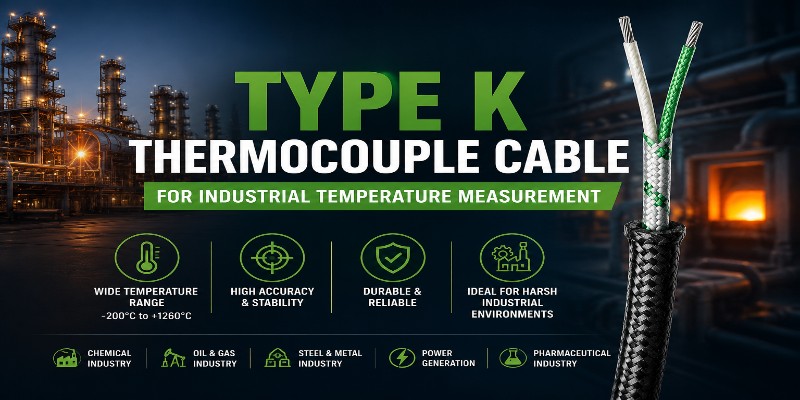
Type K Thermocouple Cable: India’s Complete Supplier Guide for Chemical, Power, Pharma & Industrial Plants
If you’re installing, extending, or replacing thermocouple wiring in a chemical plant in Ankleshwar, a power station in Korba, a cement kiln in Morbi, or a pharmaceutical production line in Aurangabad — the cable you choose between the sensor junction and the temperature controller determines whether the measurement reaching your control system is accurate, stable, and reliable, or slowly drifting toward an invisible error that your process pays for in quality or efficiency.
Type K thermocouple cable is the single most widely used thermocouple cable specification in India and globally — because it pairs precisely with K-type thermocouple sensors (the most installed sensor type across industry) and must carry the sensor’s millivolt output to the measurement instrument without introducing thermoelectric error from dissimilar metal junctions in the cable path. This guide explains the technical foundation behind this requirement, the full specification of Aavad’s Type K Thermocouple Cable, and where it’s used across Indian industry.
The Critical Principle Behind Thermocouple Cable Selection
This is the single most important technical concept for anyone specifying thermocouple cable:
You cannot use ordinary copper cable to extend a thermocouple signal.
A thermocouple sensor generates its signal as a tiny millivolt voltage at the junction of two dissimilar metal wires. This voltage is a function of the temperature difference between the hot junction (at the process) and the cold junction (at the measuring instrument). If you introduce a copper wire splice between the thermocouple’s lead wires and the instrument — without matched extension cable — you create new, unintended thermocouple junctions at every connection point, each generating its own parasitic EMF. The instrument receives the sum of the intended process signal plus all the unintended junction voltages, reading a corrupted temperature.
Type K thermocouple extension cable solves this by using conductors that generate the same thermoelectric output as the K-type thermocouple alloys (Chromel/Alumel) themselves. When the cable is used correctly, any junction formed between the cable conductors and the sensor’s lead wires produces no net thermoelectric error — because both sides of the junction are made from the same alloy. The signal that reaches the instrument is the pure process temperature, uncontaminated by parasitic cable junctions.
This is why matching your thermocouple type to the same type of extension cable is a fundamental instrumentation requirement, not an optional best practice.
Full Specifications: Aavad Type K Thermocouple Cable
| Parameter | Specification | Engineering Significance |
|---|---|---|
| Type | K (Chromel/Alumel matched conductors) | Matched to K-type thermocouple sensors; generates identical thermoelectric characteristic |
| Temperature range | -20°C to +450°C | Covers the cable’s own operating range as well as supporting the full K-type thermocouple measurement range for typical industrial applications |
| Power / Voltage rating | 600V | Suitable for installation alongside control wiring in industrial cable trays and conduits |
| Length | 100 m standard | Standard supply drum; cut lengths available |
| Inner material | Alloy (Chromel/Alumel matched) | Thermoelectric-matched conductors for K-type signal integrity |
| Construction | Parallel pair | Standard configuration for single thermocouple pair extension |
Why the 600V Rating Matters for Industrial Cable Tray Installation
In Indian industrial plants — chemical factories, refineries, power stations, pharmaceutical facilities — thermocouple cables are typically routed through the same cable trays, conduit runs, and junction boxes as control and instrumentation wiring. A 600V voltage rating on the thermocouple cable ensures it meets the electrical safety requirements for routing alongside higher-voltage control wiring without requiring a separate, isolated cable pathway.
For plant instrumentation engineers specifying cable routes in accordance with IS:694, IS:1554, or international equivalent standards, confirming the thermocouple cable’s voltage rating is a standard step in cable installation planning.
Understanding the -20°C to 450°C Temperature Range
The specified temperature range covers two distinct requirements:
The cable’s own operating temperature — the ambient temperature in the cable path between the sensor and the instrument. In high-temperature process areas, cable runs near hot pipework, furnace walls, or hot equipment housings can experience elevated ambient temperatures. The 450°C upper limit indicates the cable can be routed through environments where the cable itself (not just the sensor) experiences elevated temperatures. For ambient cable temperatures approaching or exceeding this value, fiberglass or Kapton insulated cables are more appropriate.
Support for K-type sensor signal range — K-type thermocouples can measure from -270°C to 1,372°C at the sensor junction. The cable’s temperature range rating doesn’t limit the sensor’s measurement range; it describes the temperature conditions the cable itself can survive during operation.
Industries and Applications Across India
Chemical and Petrochemical Industry
Hubs: Gujarat (Ankleshwar, Vapi, Dahej, Bharuch, Vadodara) | Maharashtra (Raigad, Pune, Nagpur) | Rajasthan (Kota, Baran)
K-type thermocouple cables run from reactor zone sensors, distillation column tray sensors, and heat exchanger monitoring points back to DCS/PLC marshalling panels. The 600V rating allows routing through standard process plant cable trays alongside other I&C wiring.
Power Generation — Thermal, Gas, and Captive Power Plants
Hubs: Chhattisgarh (Korba, Raigarh) | UP (Rihand, Obra, Anpara) | MP (Singrauli) | AP (Ramagundam, Simhadri) | Tamil Nadu (Ennore, Tuticorin) | Gujarat (Gandhinagar, Wanakbori) | Maharashtra (Trombay, Chandrapur)
Boiler zone thermocouples, flue gas monitoring sensors, turbine exhaust temperature sensors, and heat recovery steam generator (HRSG) thermocouples all need K-type matched extension cable to carry their signals to the plant’s DCS without introducing thermoelectric error across cable drum lengths of 50–200+ metres.
Cement, Ceramics, and Building Materials
Hubs: Morbi, Rajkot (Gujarat — ceramics and tiles) | Chittorgarh, Beawar (Rajasthan — cement) | AP, Karnataka (cement)
Kiln zone thermocouples, preheater cyclone temperature sensors, and clinker cooler monitoring points — all K-type sensors on high-temperature equipment — need long runs of matched extension cable back to the plant control room.
Pharmaceutical and Life Sciences Manufacturing
Hubs: Ahmedabad, Ankleshwar, Vadodara (Gujarat) | Aurangabad, Pune, Badlapur (Maharashtra) | Hyderabad (Telangana) | Baddi (HP)
Sterilization oven, autoclave, dryer, and reactor temperature monitoring using K-type thermocouples requires matched extension cable to maintain signal accuracy from process point to GMP-documented temperature controller — error introduced by a mismatched cable directly undermines validation data integrity.
Steel, Metals, and Metal Processing
Hubs: Jamshedpur (Jharkhand) | Bhilai (Chhattisgarh) | Rourkela (Odisha) | Durgapur (WB) | Angul (Odisha) | Hazira, Surat (Gujarat)
EAF, IF, and rolling mill furnace thermocouples generate signals that travel from the furnace zone to the melt shop control room — cable runs that may exceed 100 metres across a large steel plant floor, making drum-length supply essential for single-run installation without mid-cable splices.
Food and Beverage Processing
Hubs: Ahmedabad, Anand (Gujarat) | Pune, Nashik (Maharashtra) | Ludhiana (Punjab) | Hyderabad (Telangana) | Delhi NCR
Baking oven, pasteurization tunnel, frying line, and dryer K-type thermocouples all need matched extension cable for accurate temperature signal transmission to their respective controllers.
HVAC, Building Automation, and Industrial Refrigeration
Cities: Delhi, Mumbai, Bengaluru, Hyderabad, Chennai, Pune, Ahmedabad, Kolkata, and all major Indian metro and industrial cities
Commercial HVAC systems, industrial cold storage facilities, and building management systems using K-type sensors for zone temperature monitoring specify matched type K cable for signal integrity across their building automation wiring runs.
How to Route and Install Type K Thermocouple Cable Correctly
1. Maintain thermocouple type consistency throughout the entire signal path From the sensor junction to the instrument input terminal, every conductor in the signal circuit — sensor lead wires, extension cable, and instrument terminal — must maintain thermoelectric compatibility with the K-type specification. A single copper splice creates a new junction that introduces error.
2. Avoid routing directly alongside high-current power cables While the 600V rating allows routing in shared cable trays, separate the thermocouple cable from high-current power cables by the maximum practical distance to minimize electromagnetic induction onto the low-level millivolt thermocouple signal.
3. Keep cable runs as short as practically possible While extension cable itself introduces no thermoelectric error when correctly matched, longer cable runs increase the cable’s resistance, which can add a small resistive voltage drop — particularly relevant for very long runs or installations near their voltage rating limits.
4. Use a single continuous drum run where possible Mid-cable splices create additional junction points that need to be properly terminated with matched connectors to avoid introducing thermoelectric error. Where possible, specify a single cable run from sensor connection to instrument input without intermediate splices.
5. Identify polarity correctly at both ends before connection Type K cable’s positive conductor (Chromel/Yellow per ANSI convention) and negative conductor (Alumel/Red per ANSI convention) must connect to the corresponding polarity terminals at both the sensor junction and the instrument input. Reversing polarity causes the instrument to read backwards from the setpoint.
India-Wide Coverage
Aavad Instrument supplies Type K Thermocouple Cable PAN India from Ahmedabad, Gujarat:
Gujarat: Ahmedabad, Vadodara, Surat, Rajkot, Ankleshwar, Vapi, Bharuch, Dahej, Jamnagar, Morbi, Gandhinagar, Mehsana, Hazira
Maharashtra: Pune, Nashik, Mumbai, Aurangabad, Nagpur, Raigad, Chandrapur, Badlapur
Delhi NCR: Noida, Greater Noida, Faridabad, Gurugram, Ghaziabad
Haryana: Gurugram, Manesar, Faridabad, Panipat, Bahadurgarh
Tamil Nadu: Chennai, Coimbatore, Tiruppur, Hosur, Ennore, Tuticorin
Karnataka: Bengaluru, Mysuru, Hubballi, Ballari, Tumakuru
Telangana & AP: Hyderabad, Sangareddy, Visakhapatnam, Ramagundam
Rajasthan: Jaipur, Kota, Bhilwara, Alwar, Chittorgarh, Bhiwadi, Neemrana
UP: Noida, Greater Noida, Lucknow, Kanpur, Agra, Mathura
MP: Indore, Bhopal, Pithampur, Dewas, Singrauli
Odisha: Bhubaneswar, Rourkela, Angul, Talcher, Paradip
WB: Kolkata, Durgapur, Haldia, Asansol
Punjab: Ludhiana, Amritsar, Mohali, Jalandhar
HP: Baddi, Nalagarh, Parwanoo
Jharkhand: Jamshedpur, Bokaro, Ranchi, Dhanbad
Chhattisgarh: Raipur, Bhilai, Korba, Raigarh
Kerala: Kochi, Thrissur, Kozhikode, Thiruvananthapuram
Aavad Instrument: India’s #1 Type K Thermocouple Cable Supplier
Aavad Instrument Pvt. Ltd., Chandkheda, Ahmedabad, Gujarat:
- ISO 9001:2015 certified | NABL-accredited calibration laboratory
- 15+ years | 38M+ installations | 2,900+ customers | 12+ countries
- Trusted by BHEL, ONGC, HAL, BARC, NALCO, Indian Railways, Indian Oil, Bharat Petroleum, NPCIL, L&T, Torrent Pharma, Aditya Birla Group, Atul Ltd., Saint-Gobain, MIDHANI
- Full RTD & Thermocouple Cable category
Frequently Asked Questions
Q1. Why must I use Type K thermocouple cable specifically with a K-type thermocouple, instead of regular copper wire?
A thermocouple generates its signal from the thermoelectric properties of its specific alloy pair. If you splice copper wire into the signal path, you create new thermocouple junctions at every connection point — each generating a parasitic EMF that corrupts the signal reaching the instrument. Type K matched extension cable uses the same alloy combination as the K-type sensor, so no net thermoelectric error is generated at the cable splice, and the true process temperature signal reaches the instrument intact.
Q2. What is the voltage rating of Aavad’s Type K Thermocouple Cable?
600V — sufficient for routing in standard industrial cable trays and conduits alongside control wiring, per IS standards and common industrial instrumentation practice.
Q3. What is the standard supply length for Type K Thermocouple Cable?
100 metres per drum is the standard supply length. Contact Aavad at +91 90996 22823 to discuss cut lengths or multi-drum requirements for large plant installations.
Q4. Can I use Type K thermocouple cable for N-type or J-type thermocouples?
No. Each thermocouple type has a distinct alloy composition and thermoelectric characteristic. Using mismatched extension cable — for example, K-type cable with an N-type or J-type thermocouple — introduces systematic thermoelectric error at the cable splice point. Always match the extension cable type to the thermocouple type.
Q5. What is the difference between Type K thermocouple cable and Type K compensating cable?
Type K thermocouple cable uses the same alloy conductors as the K-type thermocouple itself (Chromel/Alumel). K-type compensating cable uses lower-cost alloy combinations that approximate the K-type thermoelectric output within a limited temperature range, but are not identical alloys. True thermocouple cable is more accurate across a wider temperature range; compensating cable is a lower-cost alternative for installations where the cable is at ambient temperature throughout its length and only modest accuracy is required.
Q6. How do I identify the correct polarity of Type K cable during installation?
Per ANSI MC96.1, the positive conductor (Chromel) is typically yellow and the negative conductor (Alumel) is typically red. Per BS/IEC color coding, different colors apply. Confirm the color code of your specific cable against the appropriate standard — Aavad’s cable conforms to ANSI MC96.1 as standard, with IEC color coding available on request.
Q7. Does Aavad supply Type K thermocouple cable across India?
Yes — PAN India supply from Ahmedabad with active deployments across all major Indian industrial zones including Gujarat, Maharashtra, Rajasthan, Tamil Nadu, Karnataka, AP, Telangana, UP, Delhi NCR, Punjab, MP, Odisha, WB, Jharkhand, Chhattisgarh, Kerala, and Himachal Pradesh.
Buy Type K Thermocouple Cable from India’s #1 Supplier
View the product page or contact Aavad Instrument for quantity pricing and custom length requirements.
📞 +91 90996 22823 | ✉ hrg@aavadinstrument.com | ISO 9001:2015 | NABL Accredited | Ahmedabad, Gujarat | PAN India Supply