Description
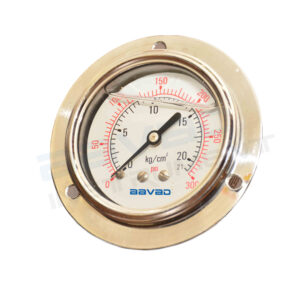
The Industrial Vacuum Gauge by Aavad Instrument Pvt. Ltd. is a precision Bourdon tube instrument specifically calibrated to measure vacuum or sub-atmospheric pressure — the difference between ambient atmospheric pressure and a lower internal system pressure. Built on the same robust SS 304/SS 316 construction as Aavad’s standard pressure gauges, this vacuum gauge provides accurate, repeatable negative-pressure readings essential for processes where maintaining a controlled vacuum is critical to product quality, safety, or process efficiency.
Featuring a 100 mm dial, SS 316 Bourdon tube sensing element, and standard glycerine filling for vibration damping, this industrial vacuum gauge delivers stable readings even in pulsating vacuum pump applications. The SS 304 bayonet case and acrylic shatterproof window ensure long service life in demanding plant environments, while ±1.0% FSD accuracy and 130% over-range protection provide dependable performance for critical vacuum monitoring tasks.
Key Features
- Glycerine fill is standard, not optional — vacuum pumps generate continuous pulsation that would otherwise blur the pointer reading on a dry gauge, especially noticeable at the low end of the vacuum scale
- Calibrated specifically for negative-pressure (vacuum) readout, avoiding the accuracy compromises of trying to repurpose a standard compound gauge for vacuum-only service
- Same SS 304/316 build quality as Aavad’s pressure gauge line means consistent reliability and spare-parts compatibility across a plant running both pressure and vacuum instrumentation
- Shatterproof acrylic window and bayonet case withstand the rough handling and dusty conditions typical of vacuum filtration and packaging line environments
- 130% over-range protection guards against accidental loss of vacuum or sudden pressure equalization events that could otherwise damage the Bourdon tube
- Compound (vacuum + pressure) range models are available where a single process swings between vacuum and positive pressure, avoiding the need for two separate gauges
Applications
- Vacuum filtration and vacuum drying systems
- Vacuum distillation columns in chemical and petrochemical plants
- Vacuum packaging machines in food processing
- Degassing and deaeration systems
- Vacuum pump suction-side performance monitoring
- Condenser vacuum monitoring in power plants
- Pharmaceutical freeze-drying (lyophilization) systems
- Vacuum-assisted resin transfer molding (VARTM) in composites manufacturing
- Refrigeration and air-conditioning system evacuation checks
- Laboratory vacuum chamber and desiccator monitoring
FAQs
1. What is an Industrial Vacuum Gauge?
An Industrial Vacuum Gauge is a mechanical pressure measuring instrument specifically designed to measure negative pressure (vacuum) in industrial systems. It is widely used for monitoring vacuum levels in vacuum pumps, filtration systems, vacuum chambers, packaging equipment, process plants, and other industrial vacuum applications.
2. How does a Mechanical Vacuum Gauge work?
A mechanical vacuum gauge uses a Bourdon tube sensing element that responds to pressure below atmospheric pressure. As the vacuum level changes, the Bourdon tube flexes, and this mechanical movement is transferred through a precision linkage mechanism to the pointer, which accurately displays the vacuum level on the calibrated dial.
3. Why choose a Vacuum-Only Gauge instead of a Compound Gauge?
A vacuum-only gauge features a dedicated scale for measuring negative pressure, making readings easier to interpret and providing better resolution and accuracy across the vacuum range. If your application operates under both vacuum and positive pressure, a compound pressure gauge is generally a more suitable choice.
4. Why is the Gauge Glycerine Filled?
The glycerine filling dampens pointer movement caused by vacuum pump vibration, pressure pulsations, and mechanical shock. This provides smoother, more stable, and easier-to-read measurements while helping extend the service life of the gauge’s internal mechanism in demanding industrial environments.