Description
N Type Thermocouple is a reliable temperature sensor designed for accurate and stable temperature measurement in industrial and process applications. It is made using Nickel-Chromium-Silicon (NiCrSi) and Nickel-Silicon-Magnesium (NiSiMg) thermoelements and offers excellent resistance to oxidation and drift at elevated temperatures.
N Type Thermocouples are suitable for applications where long-term measurement stability and reliable performance are required. Compared with conventional base-metal thermocouples, Type N provides improved thermoelectric stability in high-temperature environments and good resistance to oxidation.
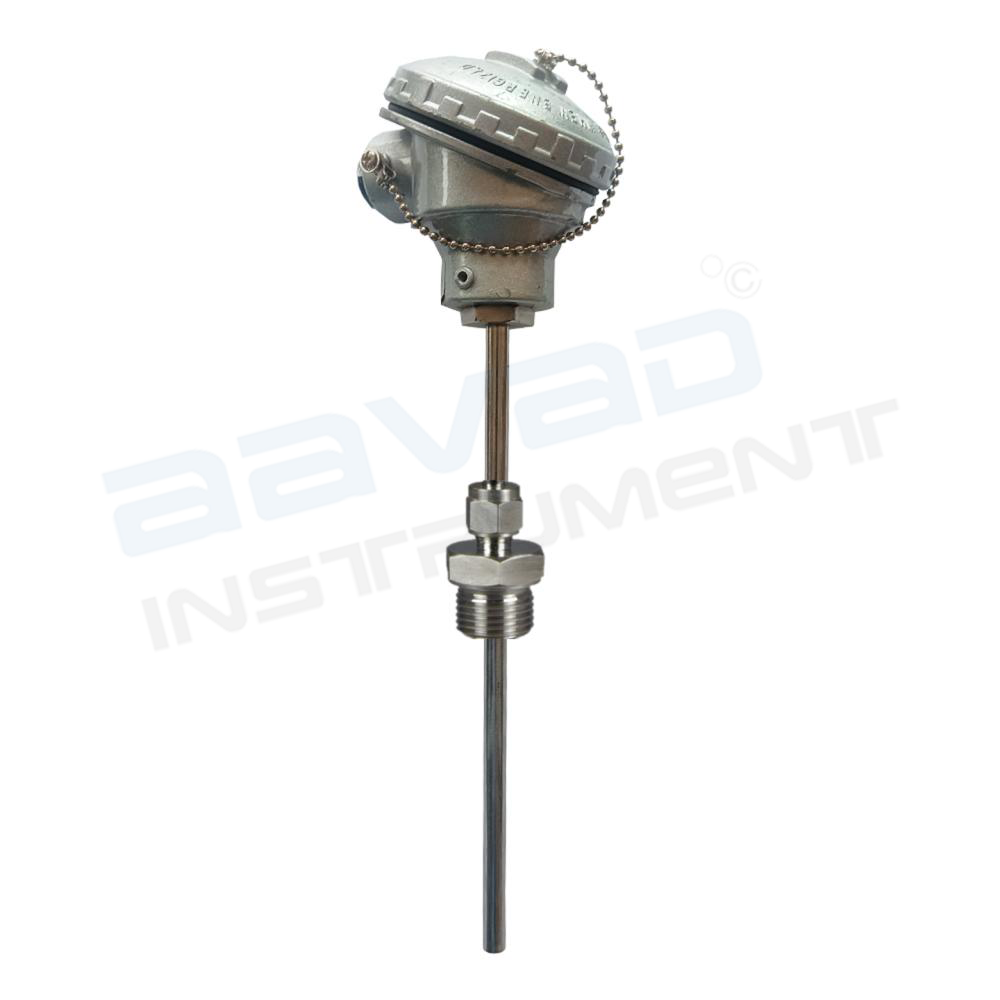
These thermocouples are available in different constructions, including mineral insulated, sheathed, probe type, duplex and simplex configurations, with suitable thermowells, connectors, extension cables and mounting arrangements as per application requirements.
FAQs
1. What is an N Type Thermocouple?
An N Type Thermocouple is a temperature sensor made from Nickel-Chromium-Silicon (NiCrSi) and Nickel-Silicon-Magnesium (NiSiMg) thermoelements. It is designed for accurate and stable temperature measurement, particularly in high-temperature industrial applications.
2. What is the temperature range of an N Type Thermocouple?
The typical operating range of an N Type Thermocouple is approximately -200°C to +1300°C, depending on the construction, insulation, sheath material and application conditions.
3. What are the main advantages of an N Type Thermocouple?
Key advantages include good temperature stability, excellent oxidation resistance, reliable performance at elevated temperatures and reduced drift compared with some other base-metal thermocouple types.
4. Where are N Type Thermocouples used?
N Type Thermocouples are commonly used in furnaces, kilns, cement plants, steel industries, heat-treatment equipment, chemical plants, power plants, glass industries and industrial heating systems.
5. What is the difference between N Type and K Type Thermocouple?
Both are widely used base-metal thermocouples. N Type generally offers better long-term stability and oxidation resistance at high temperatures, while K Type is widely used because of its broad availability and general-purpose applications.
6. Is N Type Thermocouple suitable for high-temperature applications?
Yes. N Type Thermocouples are well suited for many high-temperature applications, particularly where stable temperature measurement and oxidation resistance are important.
7. Can N Type Thermocouples be customized?
Yes. They can be customized according to probe length, diameter, sheath material, insulation, mounting arrangement, process connection, cable length and simplex or duplex configuration.
8. What sheath materials are available for N Type Thermocouples?
Depending on the application and temperature, N Type Thermocouples can be supplied with suitable metallic or mineral-insulated sheath constructions.
9. Can N Type Thermocouples be supplied with a thermowell?
Yes. An N Type Thermocouple can be supplied with a suitable thermowell to protect the sensing element from pressure, corrosion, abrasion and process conditions.
10. What type of output does an N Type Thermocouple provide?
An N Type Thermocouple produces a small thermoelectric voltage (mV) corresponding to the temperature difference between the measuring and reference junctions.
11. Can N Type Thermocouples be used with temperature controllers?
Yes. They can be connected to compatible temperature indicators, controllers, transmitters, PLC systems and data acquisition systems designed to accept Type N thermocouple input.
12. Can AAVAD supply N Type Thermocouples for industrial applications?
Yes. AAVAD Instrument can supply N Type Thermocouples in different industrial configurations and customized designs according to the required temperature range, dimensions and process requirements.