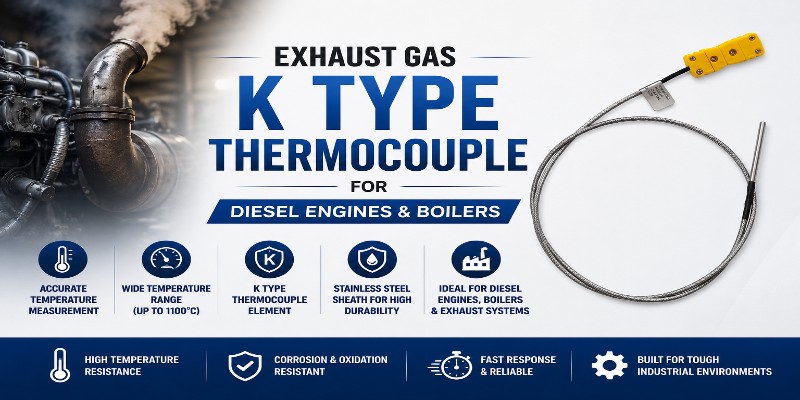
Exhaust Gas K Type Thermocouple: Which Sensor Works Best for Diesel Engines, Boilers & Industrial Exhaust Ducts?
Exhaust gas temperature measurement sits at the intersection of performance monitoring, fuel efficiency, and emissions compliance — three concerns that matter equally to a DG set operator in a Mumbai high-rise, a marine engineer on a Visakhapatnam coastal vessel, a power plant instrumentation technician in Korba, and an automotive test engineer at ARAI in Pune. In every one of these applications, the instrument doing the measuring is a K-type thermocouple in a fiberglass-cable construction — a sensor specifically engineered for the combination of high gas-phase temperatures, hot cable routing paths near exhaust components, and rapid temperature changes that define exhaust gas measurement duty.
This guide covers the complete specification of Aavad’s AKES-6×75 Exhaust Gas K Type Thermocouple, what makes its FG/FG/SS cable and 6mm construction specifically right for exhaust gas applications, and a complete map of the Indian industries and equipment types where this sensor is used.
What Is an Exhaust Gas Thermocouple?
An exhaust gas thermocouple is a K-type (Chromel/Alumel) sensing probe specifically built for direct immersion into exhaust gas streams — flue gases, engine exhaust, combustion products, and related gas-phase high-temperature flows — rather than liquid or solid process temperatures. Its defining characteristics, compared to a general-purpose thermocouple, are:
- A cable construction that survives the hot ambient environment between the exhaust point and the nearest instrument connection — this is what distinguishes exhaust gas thermocouples from general-purpose sensors most significantly
- A robust 6mm OD probe that handles the vibration, thermal cycling, and mechanical environment of engine and combustion equipment
- A quick-disconnect connector for maintenance access to exhaust measurement points without complex rewiring
- K-type sensing element covering the 0–600°C range of most exhaust gas measurement applications at this construction specification
Full Specifications: Aavad AKES-6×75 Exhaust Gas K Type Thermocouple
| Parameter | Specification | Engineering Significance |
|---|---|---|
| Type | K (Cr/Al) | Chromel/Alumel — standard for exhaust gas temperature measurement |
| Make | Aavad Instrument | ISO 9001:2015 |
| Model | AKES-6×75 | 6mm OD, 75mm sensor length exhaust gas thermocouple |
| Configuration | Simplex | Single element, 2-wire output |
| Temperature range | 0 to 600°C | Rated range for this SS 316 construction |
| Material | SS 316 | Corrosion-resistant sheath for exhaust gas service |
| Insulation | Compacted MgO | Stable electrical isolation under thermal cycling |
| Cable length | 1 metre | Short compact run from exhaust point to connector |
| Cable type | FG/FG/SS | Fiberglass/Fiberglass/SS braid — handles hot ambient routing near exhaust |
| Sensor OD | 6 mm | Robust OD for exhaust port/stack installation |
| Sensor length | 75 mm | Projects into the exhaust gas stream for representative measurement |
| Connector | Omega type small Male–Female | Quick disconnect — fast maintenance access without rewiring |
| Datasheet | AKES_6X75 | Available for download from product page |
Why the FG/FG/SS Cable Is the Most Important Specification for Exhaust Gas Duty
This is the specification most often overlooked when buyers search for a replacement exhaust thermocouple and find cheaper alternatives with standard PVC cable. In exhaust gas applications, the cable fails before the sensor element in the vast majority of cases — and it fails because the cable must survive in a zone that is:
- Hot from exhaust system radiation and conduction — cables routed near exhaust manifolds, exhaust pipes, turbocharger housings, and stack walls experience ambient temperatures that regularly reach 150°C–300°C at the cable surface
- Subject to constant mechanical vibration from the engine or combustion equipment driving the exhaust system
- Exposed to exhaust condensate and combustion byproducts — acidic condensate from sulfur-containing fuels, carbon soot, and moisture from combustion products all attack cable insulation over time
- In an environment where replacement access may be limited — particularly on marine engines, vehicle-mounted test equipment, and compact power genset installations
PVC cable softens at approximately 70°C–90°C sustained ambient temperature, becoming tacky, losing its mechanical integrity, and eventually melting or cracking in the hot environment near an engine or boiler exhaust. It also absorbs acidic exhaust condensate over time. In a DG set exhaust manifold environment where the cable runs along the manifold surface to the nearest junction box, PVC cable is typically failing within weeks to months.
FG/FG/SS cable — Fiberglass inner insulation, Fiberglass outer jacket, Stainless Steel braid — handles this environment correctly:
- Fiberglass withstands continuous ambient temperatures up to approximately 482°C for the glass-fibre itself, far above the exhaust ambient cable path temperatures
- Fiberglass does not absorb moisture or acidic condensate
- The stainless steel braid adds crush resistance, abrasion protection against cable contact with engine or exhaust components, and mechanical protection against the flexing that vibration induces in the cable over time
The 1-metre cable length is specifically chosen to reach from the exhaust immersion point to the nearest junction box or connector socket on the engine skid, control panel, or measurement system — with the minimum cable length needed, which minimises the length of cable exposed to the hot ambient exhaust environment.
Why 6mm OD Is Chosen Over 3mm for Exhaust Gas Service
The AKES-6×75 uses a 6mm OD probe sheath rather than the 3mm OD used on compact process thermocouples. For exhaust gas applications, this larger diameter provides:
Mechanical robustness against exhaust gas velocity forces: High-velocity exhaust gas exerts drag forces on the probe tip. At the flow velocities found in diesel engine exhaust stacks, turbine exhaust ducts, and industrial incinerator outlets, a 3mm probe would experience greater bending stress — potentially fatiguing the sheath at the process connection point over extended service. A 6mm sheath resists these forces more effectively.
Better vibration resistance: Engine exhaust systems transmit significant mechanical vibration through manifolds, ducting, and mounting points to any sensor attached to them. The greater mechanical stiffness of a 6mm sheath handles this vibration better than a slender 3mm probe.
Easier installation into standard exhaust port threads: Most diesel engine exhaust manifold temperature ports, boiler stack sensor ports, and industrial exhaust duct fittings are threaded for 6mm OD probes as the standard industrial size. The 6mm probe fits these without adapters.
The 75mm Sensor Length: Reaching the Representative Exhaust Gas Zone
A 75mm sensing tip projects the thermocouple junction approximately 75mm into the exhaust gas stream from the probe’s mounting point. This is important because:
- At the very edge of the exhaust stream (near the duct or manifold wall), the measured temperature is influenced by heat loss to the cooler duct wall — it reads lower than the true bulk exhaust gas temperature
- A probe that projects 75mm into the flow reaches beyond the near-wall thermal boundary layer and into the representative bulk exhaust gas, where the measured temperature reflects the actual exhaust condition being monitored
For narrow exhaust manifolds or ports where 75mm projection would cause the probe to cross the centre and project into the opposite wall, contact Aavad for a shorter custom tip length.
Understanding the 0–600°C Rating vs the K-Type’s Broader Capability
The AKES-6×75 spec table shows a 0–600°C temperature range, while the key features note general K-type thermocouple capability to higher temperatures. This distinction matters for correct application:
The 0–600°C rating applies to this specific model’s SS 316 sheath construction. SS 316 provides good oxidation resistance for sustained service up to approximately 870°C in some configurations, but the conservative 600°C model rating reflects the combination of:
- The SS 316 sheath’s practical long-term performance in corrosive exhaust gas atmospheres (which are more aggressive than clean oxidizing atmospheres at equivalent temperatures)
- The sensor’s overall construction and the temperature range most exhaust gas applications fall within
For applications where exhaust gas temperatures regularly exceed 600°C — heavy industrial furnace stacks, incinerator flue gas streams, high-temperature boiler flue gas ducts — an upgraded sheath material is the correct specification:
- SS 310 sheath: Provides better high-temperature oxidation resistance, rated to approximately 1,050°C continuous
- Inconel 600 sheath: For the most demanding exhaust gas and high-temperature applications up to approximately 1,175°C continuous
Aavad’s Build Your Products service and the AKES Steam Temperature Sensor (AKES-8×650) — which uses an SS 310 sheath rated to 1,200°C — address these higher-temperature exhaust gas applications.
The Omega Type Small Connector: Why Quick Disconnect Matters for Exhaust Measurement Points
Exhaust gas thermocouple maintenance is not like replacing a sensor in a clean process vessel. Exhaust components are:
- In confined, often hot spaces near engines, boilers, or furnaces
- Covered in carbon deposits, exhaust soot, and surface oxide scale
- Subject to fastener seizure from thermal cycling
The Omega type small Male-Female connector on the AKES-6×75 means that when the sensor needs to be replaced or removed for calibration check, the work at the measurement point itself is simply: unplug the old sensor’s connector, plug in the replacement. The wiring connection is made at the junction box or instrument panel end of the cable — in a cleaner, cooler, more accessible location — rather than at the exhaust manifold or stack.
Exhaust Gas Temperature Ranges Across Equipment Types in India
| Equipment Type | Typical Exhaust Gas Temperature | AKES-6×75 Coverage |
|---|---|---|
| Diesel gensets (50kVA–2000kVA) | 300°C–550°C | ✅ Fully within 0–600°C |
| Gas engines and gas gensets | 400°C–600°C | ✅ Fully within range |
| Automotive petrol engines (test) | 250°C–500°C | ✅ Fully within range |
| Heavy diesel vehicles (test rigs) | 350°C–600°C | ✅ Fully within range |
| Marine diesel engines | 300°C–500°C | ✅ Covered |
| Industrial boilers (flue gas) | 150°C–350°C at economizer exit | ✅ Covered |
| High-pressure boilers (flue gas pre-economizer) | 400°C–600°C+ | ✅/⚠️ — at upper limit; SS 310 sheath preferred above 600°C |
| Industrial incinerators | 600°C–1,000°C+ | ⚠️/❌ — specify SS 310 or Inconel sheath for continuous service above 600°C |
| Cement kiln preheater gas exits | 300°C–400°C | ✅ Fully covered |
| Gas turbine exhaust | 400°C–600°C | ✅ At spec limit — confirm temperature with Aavad |
Industries and Applications Across India
Diesel Generator Sets — Captive Power and Backup Power
Nationwide application: Every DG set installation in India — hospitals, data centres, commercial buildings, factories, telecom towers, housing complexes, and remote infrastructure
India has one of the world’s largest DG set populations, driven by grid reliability requirements across industry and commerce. Exhaust manifold temperature monitoring on diesel generators serves:
- Over-temperature alarm and protection: High exhaust temperature indicates engine overload, fuelling problems, or cooling failure — an alarm before these conditions cause engine damage
- Load monitoring and fuel efficiency tracking: Exhaust temperature correlates with engine load percentage, making it a useful indicator for load management
- Maintenance scheduling: Trending exhaust temperature over operating hours helps predict when service (valve adjustment, injection system maintenance) is needed
Major DG set markets: Mumbai, Delhi NCR, Bengaluru, Hyderabad, Chennai, Kolkata, Pune, Ahmedabad, Surat, Rajkot, Lucknow, Jaipur, Bhopal, Indore, Nagpur, Visakhapatnam, Kochi, Chandigarh, and all Indian cities with unreliable grid supply
Automotive and Vehicle Testing — EGT Measurement
Automotive testing centres:
- ARAI — Automotive Research Association of India, Pune (India’s primary vehicle certification authority)
- NATRiP test tracks — Manesar (Haryana), Chennai (Tamil Nadu), Ahmednagar (Maharashtra), Indore (MP), Rae Bareli (UP)
- OEM test facilities: Pune (Tata Motors, Bajaj, Mahindra), Gurugram (Maruti Suzuki, Hero MotoCorp), Chennai (Hyundai, Ford, BMW, Ashok Leyland), Ahmedabad (Tata Motors)
Exhaust Gas Temperature (EGT) measurement is a standard parameter in engine performance characterisation, emission compliance testing (BS VI), and thermal management system validation. Test bench EGT thermocouples see rapid temperature transients during acceleration, deceleration, and load change cycles — the AKES-6×75’s fast response from its compact 6mm tip suits this application.
Marine Engines — Coastal and Inland Shipping
Major Indian ports and ship repair facilities: Mumbai (Nhava Sheva, Mumbai Port) | Chennai Port | Visakhapatnam | Kolkata (Haldia, KoPT) | Kochi (Cochin Port) | Kandla, Mundra (Gujarat) | Paradip (Odisha) | New Mangalore, Tuticorin
Marine diesel engine exhaust monitoring for cylinder exhaust temperature measurement — used for detecting individual cylinder problems (misfiring cylinder shows lower EGT; over-fuelling shows higher EGT) and turbocharger performance tracking. The FG/FG/SS cable is specifically important in marine engine rooms where moisture, vibration, salt air, and confined hot spaces are constant conditions.
Power Generation — Boiler Flue Gas Monitoring
All major thermal power stations across India: NTPC (Rihand, Ramagundam, Vindhyachal, Sipat, Korba, Unchahar, Kahalgaon, Farakka, Dadri) | State gencos across Gujarat (GSECL), Maharashtra (MAHAGENCO), UP (UPRVUNL), MP (MPGENCO), Rajasthan (RVUNL), AP (APGENCO), Tamil Nadu (TANGEDCO), Karnataka (KPCL)
Boiler economiser inlet and outlet gas temperature monitoring, air heater gas temperature, and stack temperature measurement for combustion efficiency calculations and emission monitoring. The AKES-6×75 covers the economiser outlet flue gas range (typically 130°C–350°C); for higher-temperature flue gas measurement points, the SS 310 sheathed AKES-8×650 is more appropriate.
Industrial Burners, Furnaces, and Combustion Equipment
Industries: Chemical (Gujarat, Maharashtra, AP) | Cement (Rajasthan, AP, Gujarat, Karnataka) | Food processing (Gujarat, Punjab, Maharashtra) | Textile dyeing (Surat, Tiruppur) | Ceramic firing (Morbi, Gujarat)
Industrial burner exhaust temperature monitoring for combustion efficiency control — measuring the flue gas temperature at the stack or heat recovery point to optimize air-to-fuel ratio and minimize excess air energy losses.
Incinerators and Waste Treatment
Locations: Medical waste incinerators at hospitals across India | Industrial waste incineration facilities | CPCB-regulated common hazardous waste incinerators
Emission monitoring and process control for incinerators where exhaust gas temperatures typically range 600°C–1,000°C+ — the higher end of which requires the upgraded sheath material noted above.
Industrial Compressors and Gas Processing
Hubs: Jamnagar, Dahej, Hazira (Gujarat) | Rajahmundry, Kakinada (AP) | Mumbai (Maharashtra) | Goa
Compressor discharge temperature monitoring (which correlates with exhaust gas temperature in internal combustion engine-driven compressors), gas processing plant heater flue gas temperature, and pipeline station engine exhaust monitoring.
Locomotive and Railway Traction Equipment
Indian Railways loco sheds across India: Delhi (Tughlakabad, Shakurbasti) | Mumbai (LTT, Wadi Bunder) | Chennai (Perambur) | Bengaluru | Howrah | Ahmedabad | Vadodara | Nagpur | Visakhapatnam | Lucknow | Guwahati
Diesel locomotive exhaust monitoring for maintenance scheduling, turbocharger performance tracking, and engine health monitoring across Indian Railways’ large diesel fleet.
India-Wide Coverage
Aavad Instrument supplies Exhaust Gas K Type Thermocouples PAN India from Ahmedabad, Gujarat:
Gujarat: Ahmedabad, Vadodara, Surat, Rajkot, Ankleshwar, Vapi, Bharuch, Dahej, Jamnagar, Gandhinagar, Morbi, Hazira, Kutch (Kandla, Mundra), Bhavnagar
Maharashtra: Pune, Nashik, Mumbai, Aurangabad, Nagpur, Kolhapur, Ahmednagar
Delhi NCR: Noida, Greater Noida, Faridabad, Gurugram, Ghaziabad, Delhi
Haryana: Gurugram, Manesar, Faridabad, Panipat | Rajasthan: Jaipur, Kota, Chittorgarh, Bhilwara
Tamil Nadu: Chennai, Coimbatore, Hosur, Tiruppur, Sriperumbudur, Ennore, Tuticorin
Karnataka: Bengaluru, Mysuru, Hubballi, Ballari, Mangaluru, Belagavi
Telangana & AP: Hyderabad, Visakhapatnam, Ramagundam, Rajahmundry, Kakinada
UP: Rihand Nagar, Unchahar, Dadri, Rae Bareli, Noida, Kanpur, Lucknow
MP: Singrauli, Vindhyachal, Pithampur, Indore, Bhopal, Jabalpur
CG: Korba, Sipat, Raipur | Jharkhand: Jamshedpur, Bokaro, Ranchi
Odisha: Bhubaneswar, Rourkela, Paradip, Talcher, Angul
WB: Kolkata, Howrah, Durgapur, Haldia, Asansol | Bihar: Patna, Muzaffarpur
Punjab: Ludhiana, Amritsar, Mohali | Kerala: Kochi, Kozhikode, Thiruvananthapuram
HP & Uttarakhand: Baddi, Haridwar, Roorkee | Assam: Guwahati, Dibrugarh
Chandigarh, Goa, J&K, North-East states: PAN India
Aavad Instrument: India’s #1 Exhaust Gas Thermocouple Manufacturer
Aavad Instrument Pvt. Ltd., Chandkheda, Ahmedabad, Gujarat:
- ISO 9001:2015 certified | NABL-accredited calibration laboratory
- 15+ years | 38M+ installations | 2,900+ customers | 12+ countries
- Trusted by BHEL, ONGC, HAL, BARC, NALCO, Indian Railways, NTPC (through plant contractors), Indian Oil, Bharat Petroleum, NPCIL, L&T, Torrent Power, MIDHANI, RVUN, Aditya Birla Group
Frequently Asked Questions
Q1. What is an Exhaust Gas K Type Thermocouple and what temperature does it measure?
An Exhaust Gas K Type Thermocouple is a Chromel/Alumel (K-type) sensing probe with FG/FG/SS cable specifically built for direct immersion into exhaust gas streams from diesel engines, gas engines, boilers, furnaces, and industrial combustion equipment. Aavad’s AKES-6×75 is rated 0–600°C for this SS 316 construction, covering the exhaust gas temperature range of diesel gensets, gas engines, automotive test applications, and boiler flue gas measurement.
Q2. Why is FG/FG/SS cable used instead of standard PVC or Teflon cable?
FG/FG/SS (Fiberglass/Fiberglass/Stainless Steel braid) cable handles the hot ambient temperatures near exhaust systems that would soften and degrade PVC cable. Fiberglass insulation withstands continuous ambient temperatures far above PVC’s 70–90°C limit, resists exhaust condensate and acidic combustion byproducts, and the SS braid provides mechanical protection against vibration-induced cable fatigue — all critical for reliable service in engine and combustion exhaust environments.
Q3. Why is this thermocouple rated 0–600°C when K-type can measure to higher temperatures?
The 0–600°C rating applies to this specific model’s SS 316 sheath construction in exhaust gas (corrosive) service. For exhaust gas temperatures exceeding 600°C — heavy industrial incinerators, high-temperature boiler flue gas, furnace stack monitoring — an SS 310 or Inconel sheath provides better high-temperature oxidation resistance. Contact Aavad for the appropriate upgraded construction for your specific exhaust gas temperature.
Q4. Can I use this thermocouple on a diesel generator exhaust manifold?
Yes — diesel genset exhaust temperatures typically range 300°C–550°C, comfortably within the AKES-6×75’s 0–600°C rating. The FG/FG/SS cable handles the hot ambient environment near the engine, and the 6mm OD probe suits standard exhaust manifold temperature port sizes.
Q5. What does the Omega type small Male-Female connector provide?
The Omega small Male-Female connector allows the thermocouple sensor to be quickly disconnected from the instrument cable at the connector — without any rewiring — for sensor replacement or removal for calibration check. The instrument-side connection work (if any) is done at the junction box or panel in a cooler, more accessible location rather than at the hot exhaust measurement point.
Q6. Is this sensor suitable for emission monitoring and stack temperature measurement?
Yes for exhaust gas stack temperatures within the 0–600°C range. For emission monitoring that is part of a regulatory reporting program (CPCB OCEMS, SPCB monitoring), confirm your specific regulatory body’s requirements for sensor type, calibration documentation, and data logging with your compliance consultant.
Q7. Is NABL calibration available for exhaust gas thermocouples?
Yes — Aavad’s in-house NABL-accredited calibration laboratory issues traceable calibration certificates for K-type thermocouples on request, supporting quality system and regulatory documentation requirements.
Q8. Does Aavad supply exhaust gas thermocouples PAN India?
Yes — from Ahmedabad with active deployments across all major Indian power generation, automotive testing, marine, industrial, and DG set markets spanning all Indian states.
Buy Exhaust Gas K Type Thermocouples from India’s #1 Manufacturer
View the product page and download datasheet AKES_6X75 or contact Aavad Instrument to discuss your exhaust gas temperature range and application requirements.
📞 +91 90996 22823 | ✉ hrg@aavadinstrument.com | ISO 9001:2015 | NABL Accredited | Ahmedabad, Gujarat | PAN India Supply