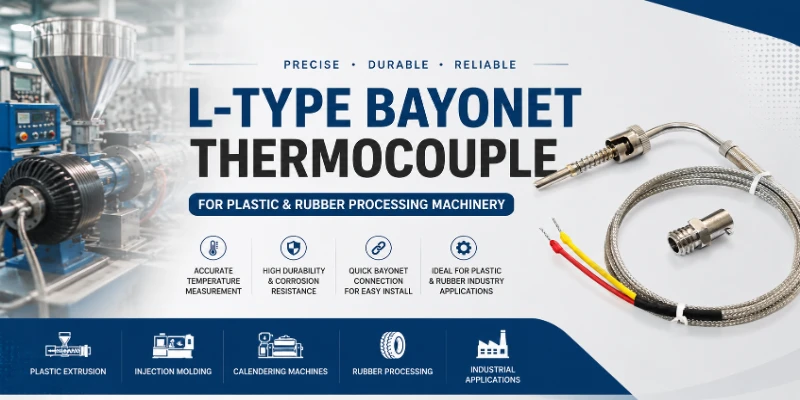
L-Type Bayonet Thermocouple: India’s Definitive Guide for Plastic, Rubber & Extrusion Machinery
India’s plastics and rubber processing industry is one of the fastest-growing manufacturing sectors in the country — with major processing hubs in Gujarat (Ahmedabad, Rajkot, Vadodara, Vapi), Maharashtra (Pune, Nashik, Nagpur), Tamil Nadu (Chennai, Coimbatore), Haryana (Faridabad, Gurugram), and UP (Noida, Greater Noida). Every injection molding machine, blow molding line, rubber extruder, and thermoforming press in these hubs runs on one simple reality: if barrel temperature isn’t controlled precisely, you’re making scrap.
The temperature sensor at the heart of that control — the one most often installed wrong, specified too loosely, or replaced too late when it starts drifting — is the bayonet-style thermocouple. And the L-Type variant, with its right-angle-exit cable design, is the version that fits the tight, congested spaces of modern plastic and rubber processing machinery most effectively.
This is the definitive guide to L-Type Bayonet Thermocouples for Indian industry: what they are, why the L-type design matters, where they’re used, and how to buy the right one the first time.
What Is an L-Type Bayonet Thermocouple?
A bayonet thermocouple is a temperature sensor that mounts via a bayonet locking mechanism — a cylindrical male body with pins that engage into L-shaped slots in a female receptor, secured by a spring that keeps the assembly under constant compression. This design provides:
- Rapid installation and removal — a quarter-turn engagement locks and releases the sensor in seconds
- Positive spring-loaded seating — the spring maintains constant contact pressure between the sensor tip and the measurement surface, regardless of vibration or thermal expansion
- Tool-free sensor swaps — no wrenches, no terminal screws, no rewiring; critical for maintenance speed on multi-zone processing machinery
The “L-Type” refers to the cable exit angle: instead of the cable exiting inline (straight along the sensor axis), it exits at a 90-degree (right-angle) bend. This single geometric difference — often overlooked in specifications — is what makes L-Type the correct choice for:
- Machines where inline cable exit would put the cable directly into a tight space between components
- Horizontal barrel zones where a straight-exit cable would hang downward into moving equipment
- Control panel wiring where cable management requires the cable to leave the sensor parallel to the machine surface rather than projecting outward
- OEM machine designs where the sensor pocket geometry specifically requires a side-exit cable to clear adjacent components
Bayonet Mounting: The Engineering Behind Spring-Loaded Contact
The fundamental problem bayonet thermocouples solve is one most plant engineers discover empirically: a loose thermocouple reads lower than the actual process temperature. Here’s why:
When a standard threaded or compression-fit thermocouple works loose — from machine vibration, thermal cycling, or imprecise installation — a microscopic air gap forms between the sensor tip and the barrel wall. Air is a poor thermal conductor. The sensor tip, now slightly isolated from the barrel surface, reads a cooler temperature than the barrel actually is. The temperature controller responds by pushing the heater harder — overheating the plastic inside the barrel while the external surface reads “normal.” The result is thermal degradation, burnt material, and scrap — all while the controller display shows what looks like a controlled process.
The bayonet mechanism directly addresses this failure mode:
- The cylindrical male body seats into the sensor well
- The spring inside the locking cap maintains constant forward pressure on the tip against the measurement surface
- As the barrel heats and expands, the spring automatically compensates, keeping the tip seated
- Even under continuous machine vibration, the spring prevents tip loosening and air-gap formation
No air gap. No false low reading. No undetected barrel overheating.
L-Type vs Standard (Inline) Bayonet: Which to Specify
| Factor | L-Type (Right-Angle Exit) | Inline (Straight Exit) |
|---|---|---|
| Cable exits at | 90° to sensor axis | Inline with sensor axis |
| Best for | Tight spaces, horizontal barrels, congested panel wiring, side-exit OEM designs | Open layouts where cable can project outward from the process connection point |
| Cable management | Easier in tight machine bays | Simpler in open installations |
| Typical machine types | Modern injection molders, compact extruders, rubber machinery | Older or open-layout equipment |
When in doubt for plastic and rubber machinery: specify L-Type. Modern processing machines are designed with compact component layouts that assume a side-exit cable, and an inline cable from a standard bayonet often has to be forced into an awkward bend near the sensor — which stresses the cable at the exit point and creates the premature cable failure it was trying to avoid.
Where L-Type Bayonet Thermocouples Are Used Across India
Plastic Processing — Injection Molding
Hubs: Ahmedabad, Rajkot, Vadodara (Gujarat) | Pune, Nashik, Mumbai, Aurangabad (Maharashtra) | Noida, Greater Noida, Faridabad (NCR) | Ludhiana (Punjab) | Chennai, Coimbatore (Tamil Nadu)
Each heating zone on an injection molding machine — typically 3 to 12 zones across barrel, nozzle, and hot runner — needs a bayonet thermocouple maintaining accurate, continuous barrel temperature contact. The L-Type cable exit keeps wiring clean and accessible in the often-cramped space between zones.
Plastic Processing — Extrusion Lines
Hubs: Ahmedabad, Surat (Gujarat) | Pune, Nashik (Maharashtra) | Hyderabad (Telangana) | Bengaluru (Karnataka) | Chennai (Tamil Nadu)
Extruder barrel zone control, die temperature monitoring, and screen pack pressure/temperature sensing all benefit from the bayonet’s vibration-resistant, spring-loaded contact and the L-Type’s space-efficient cable management.
Rubber Processing and Vulcanization
Hubs: Ballabhgarh/Faridabad (Haryana) | Vadodara, Ahmedabad (Gujarat) | Pune (Maharashtra) | Chennai (Tamil Nadu) | Kottayam (Kerala)
Rubber processing involves elevated barrel and die temperatures alongside significant machine vibration from the extruder and internal mixer. Bayonet thermocouples are the standard sensor type for rubber barrel monitoring; the spring-loaded contact prevents the sensor lift that rubber’s high-pressure resistance to flow would otherwise cause by transmitting back-pressure to a loosely-seated sensor.
Blow Molding Machinery
Parison, die head, and accumulator temperature zones on blow molding equipment — used across India’s packaging, automotive, and consumer goods sectors — use bayonet thermocouples for the same reason as injection molding: vibration, thermal cycling, and the need for fast zone-by-zone sensor replacement without complex rewiring.
Thermoforming and Compression Molding
Platen and die heater temperature monitoring, where the sensor is typically positioned against a flat or curved heating surface with the spring maintaining contact through the press cycle — exactly the contact-maintenance problem the bayonet spring mechanism was designed for.
OEM Machine Manufacturing
Machine builders across India — particularly in Gujarat and Pune — specify bayonet thermocouples as OEM-supplied sensors on new equipment because they allow end-users to replace sensors quickly without specialist support or rewiring expertise.
Full Specification Guidance: What to Confirm When Ordering
For any L-Type bayonet thermocouple order, confirm these parameters:
| Parameter | What to Specify | Why It Matters |
|---|---|---|
| Thermocouple type | K (for 0–600°C+ barrel range) or J (for lower-range, lower-cost option) | Must match your controller’s calibration curve |
| Tip OD and length | Must match your machine’s sensor well bore and depth exactly | Wrong dimensions = poor contact or wrong insertion depth |
| Spring length and pre-load | Must match the distance between the sensor well rim and the seating surface | Determines whether spring is actually in compression during installation |
| Cable exit direction (L-Type angle) | Confirm 90° exit and direction relative to machine orientation | Ensures cable doesn’t conflict with adjacent components |
| Cable length | From sensor to junction box or temperature controller | Custom lengths available from Aavad |
| Cable insulation | Fiberglass/SS for high-ambient-temperature environments; PVC only for cool panel areas | Fiberglass handles heat; PVC degrades near warm machinery |
| Thermocouple connector or bare leads | Depends on your machine’s wiring harness design | Connector allows plug-in replacement; bare leads need terminal connection |
India Coverage: Where Aavad Supplies L-Type Bayonet Thermocouples
Aavad Instrument supplies L-Type Bayonet Thermocouples PAN India from Ahmedabad, Gujarat:
Gujarat: Ahmedabad, Rajkot, Vadodara, Surat, Ankleshwar, Vapi, Jamnagar, Morbi, Gandhinagar, Mehsana, Bhavnagar, Junagadh
Maharashtra: Pune, Nashik, Mumbai, Nagpur, Aurangabad, Kolhapur, Solapur
Delhi NCR: Noida, Greater Noida, Faridabad, Gurgaon, Ghaziabad, Delhi
Tamil Nadu: Chennai, Coimbatore, Tiruppur, Salem, Hosur
Karnataka: Bengaluru, Mysuru, Hubballi, Belagavi, Tumakuru
Telangana & AP: Hyderabad, Sangareddy, Visakhapatnam, Vijayawada
Punjab & Haryana: Ludhiana, Chandigarh, Panipat, Faridabad, Ballabhgarh
Rajasthan: Jaipur, Bhiwadi, Neemrana, Alwar, Jodhpur
Uttar Pradesh: Noida, Greater Noida, Lucknow, Kanpur, Agra
Kerala: Kochi, Kottayam, Thrissur, Kozhikode
Why Aavad Is India’s #1 L-Type Bayonet Thermocouple Manufacturer
Aavad Instrument Pvt. Ltd., Chandkheda, Ahmedabad, Gujarat:
- ISO 9001:2015 certified manufacturing | NABL-accredited calibration laboratory
- 15+ years of thermocouple manufacturing experience
- 38M+ installations | 2,900+ customers | 12+ countries
- Deployed at: Sintex, PepsiCo, Kohler, Saint-Gobain, BHEL, L&T, and hundreds of plastic, rubber, and packaging manufacturers across India
- Custom L-Type configurations: tip OD, tip length, spring length, cable length, cable type, connector style — all configurable via Build Your Products
- Fast delivery across all Indian states from the Ahmedabad manufacturing facility
Frequently Asked Questions
Q1. What is an L-Type bayonet thermocouple and why is the “L” significant?
An L-Type Bayonet Thermocouple uses the same spring-loaded bayonet mounting mechanism as a standard bayonet thermocouple, but with the cable exiting at a 90-degree right angle to the sensor body rather than inline with it. This right-angle exit design makes the sensor compatible with tight machine spaces, horizontal barrel zones, and OEM machine designs where an inline cable exit would conflict with adjacent components or require awkward cable bends immediately after the sensor.
Q2. Why does the spring-loaded contact in a bayonet thermocouple matter for measurement accuracy?
The spring maintains constant forward pressure on the thermocouple tip against the measurement surface, preventing the air gap that forms when a sensor tip lifts away from the barrel wall due to vibration or thermal expansion. An air gap causes the sensor to read lower than the actual barrel temperature — leading the controller to overheat the process in compensation. The spring-loaded bayonet contact eliminates this error source.
Q3. How do I specify the correct spring length for my machine’s sensor well?
The spring length should be sized so that the spring is in compression by approximately 10–15mm when the bayonet cap is locked — meaning the spring is actively pushing the tip forward rather than being fully extended or fully compressed. Measure the depth of your sensor well and the length of the sensor body below the bayonet cap, and specify accordingly. Aavad’s engineering team can assist with this calculation.
Q4. Can L-Type bayonet thermocouples be customized for my specific machine design?
Yes. Tip OD, tip length, spring length, cable exit angle, cable length, cable insulation type, thermocouple type (K or J), and termination style (bare leads or connector) are all configurable through Aavad’s Build Your Products service.
Q5. What thermocouple type — K or J — should I specify for plastic barrel monitoring?
K-Type covers a wider temperature range (0°C to 1,200°C) and is the correct choice for engineering plastics processed at higher barrel temperatures (above approximately 300°C–350°C). J-Type (0°C to 750°C rated, though practically more cost-effective for lower ranges) is suitable for commodity thermoplastics processed at lower barrel temperatures and where slightly lower cost per sensor matters across a high sensor count.
Q6. Does Aavad supply L-Type bayonet thermocouples to OEM machine manufacturers?
Yes. Aavad supplies both end-user replacement sensors and OEM-specified sensor packages to machine manufacturers across India, with consistent specifications across batches and NABL-accredited calibration available for quality-system documentation.
Q7. How quickly can an L-Type bayonet thermocouple be replaced on a production line?
The bayonet mechanism is designed for tool-free replacement in seconds: depress and turn the bayonet cap to release, withdraw the sensor, insert the replacement, and turn to lock. With no wiring task required (when connector-terminated sensors are specified), a complete sensor swap takes under 30 seconds — compared with several minutes for a hardwired terminal-block replacement.
Buy L-Type Bayonet Thermocouples from India’s #1 Manufacturer
View product details and related Bayonet Type Thermocouple specifications, or contact Aavad Instrument for a custom quote.
📞 +91 90996 22823 | ✉ hrg@aavadinstrument.com | ISO 9001:2015 | NABL Accredited | Ahmedabad, Gujarat