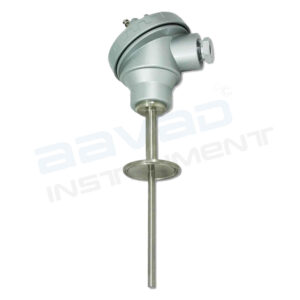
Description
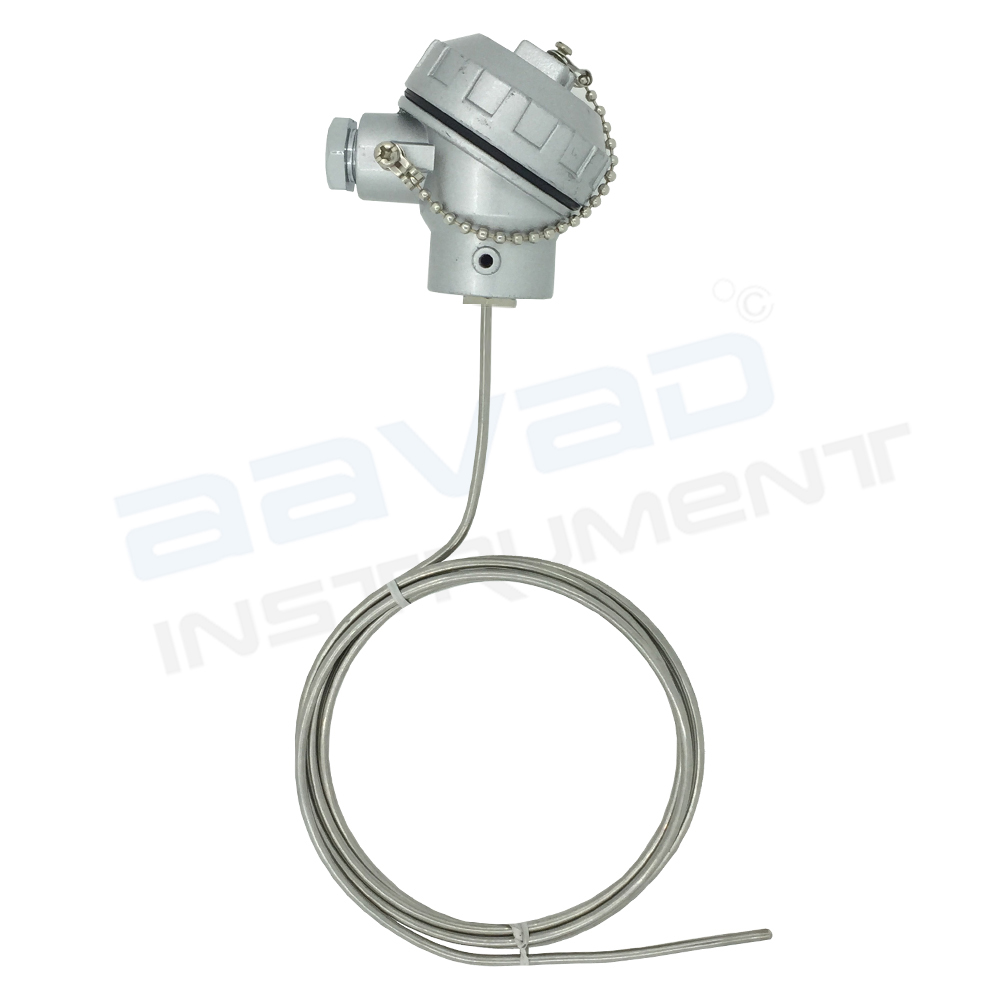
Mineral Insulated RTD Temperature Probe (Model APID-6×1500) is a long-length duplex PT100 RTD sensor engineered for accurate and reliable industrial temperature measurement in deep, remote, and difficult-to-access measurement points. Featuring a 1500 mm long, 6 mm OD SS316 stainless steel probe, two independent 3-wire PT100 sensing elements (3+3 wire), and Class A accuracy, this mineral insulated temperature sensor provides stable temperature measurement across a wide operating range of -50°C to +400°C. The compacted MgO mineral insulation provides excellent electrical insulation, thermal performance, and mechanical flexibility, making the probe suitable for routing and installation in deep tanks, large vessels, pipelines, reactors, engines, and industrial equipment where conventional short or rigid RTD probes are unsuitable.
Designed for demanding process and machinery monitoring applications, the duplex PT100 configuration provides two independent temperature signals from a single long-reach measurement point, supporting process control, indication, data logging, alarms, or redundant temperature monitoring without requiring an additional sensor tapping. The rugged IP67 die-cast aluminium terminal head provides protection against dust and moisture, while the corrosion-resistant SS316 sheath supports reliable operation in harsh industrial environments. Manufactured by Aavad Instrument, the Model APID-6×1500 mineral insulated RTD temperature probe is ideal for chemical plants, power generation, marine and stationary diesel engines, deep process vessels, and industrial automation systems requiring accurate long-reach PT100 temperature sensing.
Key Features
-
Extended 1500 mm Probe Geometry Long-reach design engineered specifically for deep immersion tracking inside tall processing reactors, bulk storage silos, and large-scale industrial fluid tanks.
-
Flexible Mineral Insulated Core Tightly compacted Magnesium Oxide (MgO) insulation provides excellent internal wiring stability while allowing the probe body to safely bend and route around tight physical machinery obstructions.
-
Dual Element Duplex Construction Integrates two entirely independent 3-wire Pt100 platinum circuits inside a single long sheath to achieve full dual-signal redundancy from a single, hard-to-access tapping point.
-
High-Precision Class A Compliance High-purity platinum element matches strict international DIN-IEC accuracy tolerances ($pm0.15^circtext{C}$ at $0^circtext{C}$) to guarantee tight, reliable thermal tracking over its full operating window.
-
Rugged IP67 Weatherproof Enclosure Heavy-duty die-cast aluminum connection head provides a complete dust-tight and waterproof seal against driving rain, heavy outdoor humidity, and low-pressure water sprays.
-
Corrosion-Resistant SS316 Sheath Marine-grade stainless steel body with a 6 mm outer diameter delivers outstanding physical strength, corrosion resistance, and structural defense inside aggressive process fluids.
Applications
-
Deep Tanks, Silos, and Large Reactor Vessels Direct continuous temperature profiling within deep chemical storage tanks, grain silos, and high-volume industrial fluid mixing vats.
-
Long Pipeline and Extended Duct Runs Precision thermal tracking of high-velocity liquid and gas process streams requiring deep center-stream probe immersion.
-
Marine and Stationary Diesel Engine Monitoring High-reliability tracking of cooling jackets, exhaust manifolds, and bearing temperatures in large-scale stationary generators and marine propulsion systems.
-
Power Plant Long-Reach Process Points Installation into massive utility boilers, deep steam recovery loops, and extended cooling water infrastructure pipelines.
-
Chemical Plant Infrastructure with Limited Access Deployment in complex processing installations where physical space constraints make creating secondary measurement ports highly expensive or difficult.
-
Applications Needing Redundant Signals Perfect for high-risk, deep-immersion industrial processes where independent primary control loop data and emergency safety trip monitoring must run from one point.
Datasheet
FAQs
1. What is a Mineral-Insulated RTD Temperature Probe?
A Mineral-Insulated RTD Temperature Probe is a PT100 Resistance Temperature Detector (RTD) in which the sensing element is enclosed inside a metal sheath filled with compacted Magnesium Oxide (MgO) insulation. This construction protects the sensing element from moisture, contamination, vibration, and mechanical damage while providing excellent thermal conductivity and flexibility. Aavad’s Model APID operates from -50°C to +400°C with Class A accuracy.
2. Why choose a Mineral-Insulated RTD Probe over a Standard Rigid RTD?
Mineral-insulated RTD probes are more flexible, vibration-resistant, and mechanically durable than conventional rigid RTDs. They can be routed through tight spaces, bends, long cable runs, engine compartments, and complex pipeline installations while maintaining accurate and reliable temperature measurement.
3. What is the standard length and configuration of Aavad’s Mineral-Insulated RTD Probe?
The standard Aavad Model APID_6X1500 features a 6 mm outer diameter (OD), 1500 mm long mineral-insulated probe in a duplex (3-wire + 3-wire) PT100 configuration. It also includes a die-cast aluminum IP67 protection head with a 1/2″ NPT cable entry connection for reliable industrial installation.
4. Can the Mineral-Insulated RTD Probe be cut or bent on-site?
Mineral-insulated RTD probes can generally be bent to suit installation routing, provided the recommended minimum bend radius is maintained. However, the probe should not be cut on-site, as this can damage the sealed MgO insulation and sensing element. Aavad Instrument manufactures custom probe lengths to meet specific application requirements.
5. Which industries typically use Mineral-Insulated RTD Temperature Probes?
Mineral-Insulated RTD Temperature Probes are widely used in chemical processing plants, power generation, pipeline temperature monitoring, engine manufacturing, petrochemical industries, OEM equipment, and industrial automation systems, where flexibility, durability, vibration resistance, and protection against moisture and contamination are essential.