Description
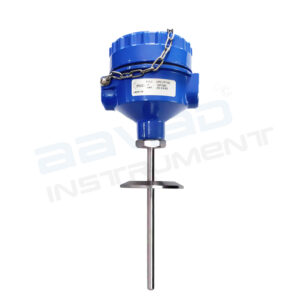
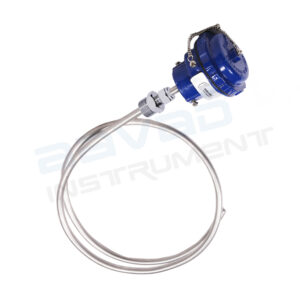
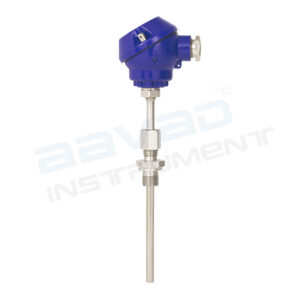
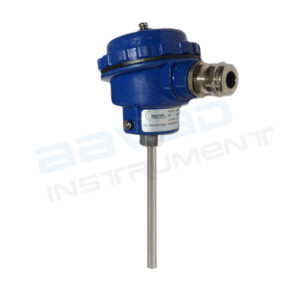
The Aavad RTD Sensor (Model APWS-6) is a general-purpose industrial RTD designed for reliable temperature measurement in non-hazardous process environments. It features a Class A PT100 sensing element, SS316 stainless steel construction, an adjustable 1/2″ BSP process connection, a 200 mm insertion length, and a durable IP65 weatherproof aluminium terminal head. Operating from -50°C to +400°C, it is suitable for continuous industrial service and is available in 2-wire, 3-wire, and 4-wire configurations for compatibility with temperature transmitters, PLC, DCS, SCADA, controllers, and process automation systems.
An RTD (Resistance Temperature Detector) Sensor is one of the most accurate and reliable temperature sensors used in industrial process measurement. It works by measuring the predictable change in the electrical resistance of a platinum sensing element as temperature changes. Because of their excellent accuracy, repeatability, and long-term stability, PT100 RTD sensors are widely used in chemical plants, pharmaceuticals, food processing, power generation, water treatment, HVAC, oil & gas, OEM equipment, and industrial automation systems.
🔧 Frequently Bought Together
| Requirement |
Recommended Product |
| Standard industrial process measurement |
RTD Temperature Sensor |
| Hazardous-area installations |
Flameproof RTD Sensor |
| Compact machinery and OEM equipment |
Miniature Head RTD Sensor |
| Hygienic food, dairy and pharmaceutical processes |
Sanitary RTD Sensor |
| Rotating equipment, motors and bearings |
Threaded RTD Sensor |
| Air ducts, ventilation and gas temperature |
Air & Gas RTD Sensor |
| High-pressure or corrosive processes |
RTD with Thermowell |
| Integrated 4–20 mA output |
RTD with Head Mounted Temperature Transmitter |
| Compact hazardous-area applications |
Compact Flameproof RTD Sensor |
| Calibration and validation applications |
PT100 Sensor with Calibration Certificate |
Additional information
| Weight |
0.3 kg |
| Dimensions |
40 × 15 × 15 cm |
Key Features
-
Premium Class A Pt100 Core Element Adheres to strict international calibration tolerances ($pm0.15^circtext{C}$ at $0^circtext{C}$) to guarantee exceptionally tight thermal tracking loops.
-
Sliding Adjustable 1/2″ BSP Fitting Integrated compression connector allows installation crews to adjust and lock the probe depth on-site to match varying pipeline diameters.
-
Standard 200 mm Industrial Insertion Reach Mid-length 6 mm OD probe design provides clean centerline fluid profiling while minimizing structural fluid drag.
-
Weatherproof IP65 Aluminum Head Rugged die-cast enclosure safely insulates internal terminal boards from humidity, driving rain, and facility wash-downs.
-
Broad -50°C to +400°C Operating Scale Handles demanding industrial applications, from sub-zero cooling utilities up to intense heat exchangers and boilers.
-
Flexible 2, 3, or 4-Wire Configurations Configurable across all major automation loops to properly compensate for distance-based lead wire electrical resistance.
-
Marine-Grade SS316 Protective Sheath Heavy-walled stainless steel body shields internal platinum elements from mechanical vibration and corrosive plant atmospheres.
-
Universal Automation Network Ready Seamlessly interfaces with head-mounted or panel-mounted temperature transmitters, PLCs, DCS architectures, and SCADA systems.
Applications
-
General Factory Process Automation Continuous, safe temperature regulation across factory manufacturing loops, steam headers, and water systems.
-
Chemical Blending and Storage Efficient thermal monitoring inside non-hazardous raw material storage tanks and secondary blending manifolds.
-
Water and Wastewater Utilities High-accuracy monitoring for massive facility cooling systems, filtration loops, and chemical dosing lines.
-
HVAC and Plant Utility Management Reliable core tracking across industrial air conditioning loops, boilers, chillers, and heat exchangers.
-
OEM Equipment and Machinery Skids Compact, dependable thermal instrumentation for automated manufacturing machinery, pump casings, and packaging lines.
Datasheet
FAQs
1. What is an RTD sensor?
An RTD (Resistance Temperature Detector) sensor is a temperature measurement device that determines temperature by measuring the change in electrical resistance of a metal sensing element, typically platinum. RTD sensors are widely used in industrial automation because they provide excellent accuracy, repeatability, and long-term stability for process temperature monitoring.
2. What types of RTD sensors does Aavad Instrument manufacture?
3. What is the difference between PT100 and PT1000 RTD sensors?
A PT100 sensor has a resistance of 100 Ω at 0°C, while a PT1000 sensor has 1000 Ω at 0°C. PT100 sensors are the most common choice for industrial process control, whereas PT1000 sensors are often selected where higher signal sensitivity or longer cable runs are required.
4. How do I choose the right RTD sensor for my application?
Selecting the correct RTD sensor depends on several factors, including the temperature range, installation environment, hazardous-area requirements, process connection, insertion length, terminal head type, thermowell requirements, wiring configuration, and compatibility with PLC, DCS, SCADA, or temperature transmitters. Aavad Instrument offers both standard and custom RTD solutions for a wide range of industrial applications.
5. Which industries commonly use RTD sensors?
RTD sensors are widely used in chemical plants, oil & gas facilities, power generation, pharmaceuticals, food & beverage processing, dairy, water treatment, HVAC, steel, cement, paper, textile, automotive, OEM machinery, boilers, furnaces, reactors, and industrial automation systems where accurate temperature monitoring is essential.
6. What wiring configurations are available for RTD sensors?
RTD sensors are commonly available in 2-wire, 3-wire, and 4-wire configurations. The appropriate wiring method depends on the required measurement accuracy, cable length, and instrumentation system. Three-wire RTDs are widely used in industrial process applications, while four-wire RTDs provide the highest measurement accuracy.
7. What is the difference between a weatherproof RTD and a flameproof RTD?
A Weatherproof RTD Sensor is designed for general industrial environments where protection against dust and moisture is required. A Flameproof RTD Sensor is intended for hazardous-area installations and is supplied with a flameproof enclosure suitable for use where applicable hazardous-area requirements must be met.
8. Can RTD sensors be supplied with different process connections and probe lengths?
Yes. RTD sensors can be manufactured with fixed or adjustable threaded connections, flanged connections, Tri-Clamp fittings, sanitary fittings, thermowells, spring-loaded assemblies, bayonet fittings, and custom process connections. Probe diameters, insertion lengths, cable lengths, and terminal head styles can also be customized to suit specific industrial applications.
9. Can RTD sensors be connected to PLC, DCS, SCADA, and temperature transmitters?
Yes. RTD sensors are commonly integrated with temperature transmitters, PLCs, DCS, SCADA systems, HMIs, data loggers, indicators, controllers, and industrial automation systems for continuous process monitoring, equipment protection, and temperature control.
10. Why choose Aavad Instrument for RTD temperature sensors?
Aavad Instrument manufactures a wide range of industrial RTD sensors for diverse process industries, offering standard and custom configurations, PT100 and PT1000 sensing elements, multiple terminal head options, simplex and duplex designs, weatherproof and flameproof constructions, sanitary solutions, thermowell assemblies, and application-specific RTD sensors designed to meet demanding industrial temperature measurement requirements.