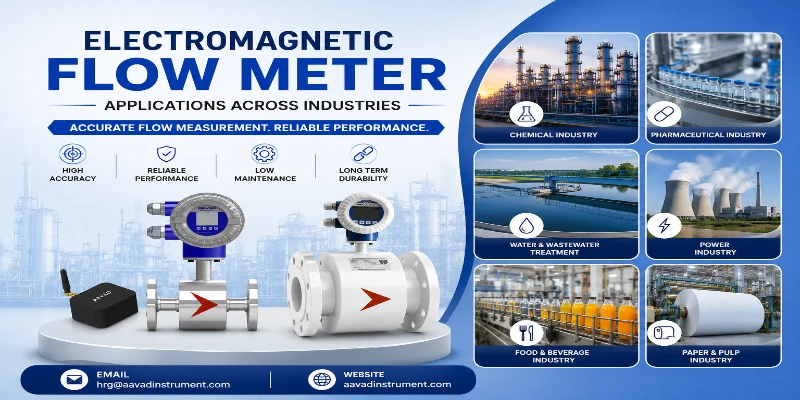
Electromagnetic Flow Meter Applications in All Industries: A Complete Industrial Flow Measurement Guide
Few flow measurement technologies are as widely deployed across as many industries as the electromagnetic flow meter. From municipal water utilities to pharmaceutical clean rooms, from power plant cooling towers to chemical dosing skids, the magmeter’s combination of accuracy, durability, and zero moving parts has made it close to a universal standard for conductive fluid measurement.
This guide covers how electromagnetic flow meters work, the full range of industries that rely on them, and how to choose the right specification for your application.
How Electromagnetic Flow Meters Work
Electromagnetic flow meters operate on Faraday’s Law of Electromagnetic Induction. A magnetic field is generated across the pipe’s cross-section; as a conductive fluid passes through this field, it generates a voltage proportional to its velocity. Electrodes mounted on the pipe wall detect this voltage, and the transmitter converts it to a calibrated flow rate.
Because the meter has no moving internal parts — no impeller, turbine, or restriction — it avoids mechanical wear, fouling, and the pressure drop associated with traditional flow meters.
Industry-by-Industry Applications
Chemical & Petrochemical Industry
- Raw material dosing and batch recipe control
- Cooling water and reactor jacket flow monitoring
- Effluent Treatment Plant (ETP) discharge measurement
- Acid/alkali transfer line monitoring with PTFE lining and SS 316L electrodes
Pharmaceutical & Biotech Industry
- Purified water and Water-for-Injection (WFI) system monitoring
- Clean-in-place (CIP) and sterilize-in-place (SIP) cycle flow verification
- Buffer and media preparation flow tracking in biotech manufacturing
- Validated, repeatable flow data supporting GMP documentation
Power Generation & Energy
- Boiler feed water measurement
- Cooling tower and condenser water circuits
- Ash slurry and effluent flow monitoring
- DM (demineralized) water plant flow tracking
Water & Wastewater Utilities
- Bulk water supply and distribution metering
- Water Treatment Plant (WTP) inlet/outlet monitoring
- Sewage Treatment Plant (STP) flow measurement
- Groundwater extraction monitoring for CGWA compliance
Food & Beverage Industry
- CIP system flow verification in hygienic processing lines
- Process water and ingredient liquid dosing
- Effluent discharge monitoring
Textile & Dyeing Industry
- Dye bath water dosing and process water monitoring
- Effluent flow measurement for treatment plant compliance
Pulp & Paper Industry
- Process water, white water, and stock flow measurement
- Chemical dosing (bleaching agents, additives) flow control
Mining & Mineral Processing
- Slurry flow measurement in abrasive, particulate-laden streams
- Process water circuit monitoring
Ceramics & Tiles
- Slurry and glaze preparation flow monitoring
- Cooling water circuit measurement
Steel & Metal Processing
- Cooling water and quenching circuit flow measurement
- Process water and effluent monitoring
Why Electromagnetic Flow Meters Work Across So Many Industries
| Property | Industrial Benefit |
|---|---|
| No moving parts | Virtually no wear, even with abrasive slurries |
| No pressure drop | Reduces pumping energy cost across the process |
| Wide accuracy range (±0.5% typical) | Suitable for both bulk metering and precision dosing |
| PTFE lining options | Chemically compatible with acids, alkalis, and most process fluids |
| SS 316L electrode options | Corrosion-resistant for aggressive and hygienic applications alike |
| Multiple output types (4-20mA, RS-485, Pulse) | Easy integration with virtually any DCS/PLC/SCADA system |
| IP68-rated housings | Suitable for outdoor, washdown, and wet-area installations |
| Telemetry/IoT options | Enables remote monitoring, regulatory compliance, and alerting |
Important Limitation: Fluid Conductivity
Electromagnetic flow meters require the measured fluid to have a minimum electrical conductivity, typically around 10 µS/cm or higher. This makes them excellent for water, aqueous chemicals, slurries, and most industrial process liquids — but unsuitable for non-conductive fluids such as hydrocarbons, oils, and some organic solvents. Always confirm your fluid’s conductivity before specifying a magmeter; for non-conductive fluids, alternative technologies such as Coriolis, ultrasonic, or vortex flow meters are typically more appropriate.
How to Select the Right Electromagnetic Flow Meter
- Confirm fluid conductivity — magmeters need a minimum conductivity to function correctly.
- Match lining material to fluid chemistry — PTFE is the most versatile and widely used option.
- Select electrode material — SS 316L is standard for most industrial and hygienic applications.
- Define accuracy requirements — ±0.5% of reading is typical for industrial process and dosing applications.
- Choose the right process connection — flanged (e.g., ASA 150) to match your existing pipeline standard.
- Decide on output/communication needs — 4-20mA for simple analog integration, RS-485/Modbus for digital communication, pulse for totalizing applications.
- Check housing protection rating — IP68 for outdoor or frequently washed-down installations.
- Consider telemetry requirements — necessary for regulatory reporting (e.g., CGWA) or remote/unmanned sites.
- Verify calibration traceability — look for NABL-accredited calibration certification for audit and validation purposes.
Aavad Instrument’s Electromagnetic Flow Meter Range
Aavad Instrument Pvt. Ltd., an ISO 9001:2015 certified manufacturer based in Ahmedabad, Gujarat, offers a complete electromagnetic flow meter portfolio suited to virtually every industry covered in this guide:
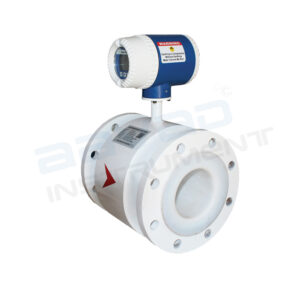
- Electromagnetic Flow Meter (Model AMAG-I) — PTFE lining, SS 316L electrodes, ±0.5% accuracy, 4-20mA/RS-485/Pulse output, IP68 housing, empty pipe detection, and optional IoT telemetry.
- Digital Flow Meter, Magnetic Flowmeter, and Magnetic Water Flow Meter with SS Body for sector-specific configurations.
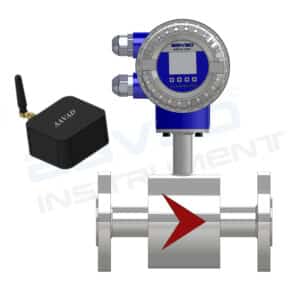
- Telemetry System add-on for remote monitoring and regulatory compliance.
- Full Electromagnetic Flow Meter Manufacturer category for the complete product range.
With 15+ years of experience, 38+ million successful installations, an in-house NABL-accredited calibration lab, and clients spanning ONGC, BHEL, Indian Oil, Torrent Pharma, Aditya Birla Group, and Saint-Gobain, Aavad Instrument supplies electromagnetic flow meters across India’s chemical, pharmaceutical, power, water utility, and process manufacturing sectors.
Frequently Asked Questions
Q1. What is the working principle of an electromagnetic flow meter? It works on Faraday’s Law of Electromagnetic Induction — a conductive fluid passing through a magnetic field generates a voltage proportional to its flow velocity, which electrodes detect and the transmitter converts into a flow rate reading.
Q2. Which industries use electromagnetic flow meters the most? Chemical, petrochemical, pharmaceutical, power generation, water and wastewater utilities, food and beverage, textile, pulp and paper, and mining industries are among the heaviest users of electromagnetic flow meters.
Q3. Can electromagnetic flow meters measure oil or fuel flow? Generally no. Electromagnetic flow meters require a minimum fluid conductivity to operate, and most oils, fuels, and hydrocarbons have conductivity too low for accurate measurement. Other technologies like Coriolis or ultrasonic meters are typically used for these fluids.
Q4. How accurate are industrial electromagnetic flow meters? Most industrial-grade magmeters achieve accuracy around ±0.5% of reading with ±1% repeatability, which is suitable for both bulk metering and process dosing applications.
Q5. Do electromagnetic flow meters need regular maintenance? They require minimal maintenance due to the absence of moving parts. Routine checks typically focus on electrode condition (in scaling/coating-prone fluids) and periodic recalibration through a NABL-accredited lab as per your quality system schedule.
Talk to an Application Engineer
Not sure which electromagnetic flow meter configuration fits your industry and fluid? Aavad Instrument’s team can help you specify the right lining, electrode material, accuracy class, and output signal. Request a quote or browse the complete flow meter range.