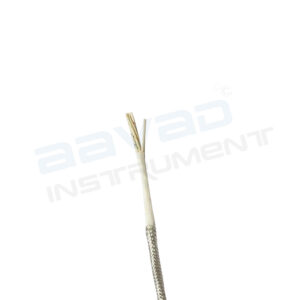
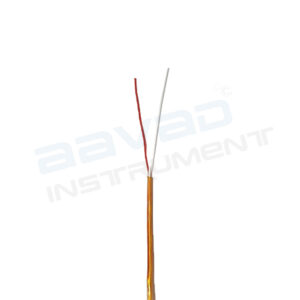
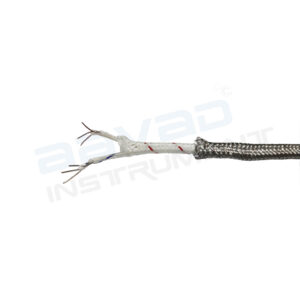
Description
The S-Type PVC/PVC Thermocouple Compensating Cable is designed for economical transmission of S-Type thermocouple signals between the sensing point and temperature measurement instruments. Unlike extension-grade cables manufactured from the same noble-metal alloys as the thermocouple, compensating cables use specially selected substitute conductors that closely reproduce the thermoelectric characteristics of the S-Type thermocouple over a defined ambient temperature range. This significantly reduces installation costs while providing reliable signal transmission for industrial instrumentation systems operating within the cable’s specified temperature limits.
Manufactured in a 2-core, 24 SWG construction, the cable features PVC insulation and PVC outer sheath, providing good electrical insulation, flexibility, and mechanical protection for indoor industrial environments. Designed for ambient temperatures up to 105°C, it is suitable for connecting S-Type thermocouples to temperature controllers, PLCs, DCS systems, indicators, recorders, and industrial automation equipment.
Key Features
-
Economical Noble-Metal Signal Extension Specially matched substitute alloys eliminate the extreme cost of running genuine platinum-rhodium wire back to control instrumentation.
-
Dual PVC/PVC Insulation Layers Flame-inhibiting, moisture-resistant PVC on both individual core conductors and the outer protective sheath.
-
105°C Continuous Ambient Rating Engineered to withstand warm control rooms, conduit trays, and ambient machinery temperatures up to 105°C.
-
Compact 24 SWG Conductor Sizing Standardized 24 SWG gauge provides easy terminal strip termination and optimal signal transmission without excessive bulk.
-
Smooth Outer Sheath for Conduit Pulling Tough PVC jacket resists industrial oils, mild acids, ambient moisture, and mechanical abrasion during installation.
-
High Measurement Accuracy Precise alloy composition maintains strict linearity with Type S thermocouple tables within the ambient junction range.
Applications
-
Steel Processing & Foundry Plants Extension signal runs from molten metal bath temperature sensors back to central monitoring equipment.
-
Glass & Ceramic Manufacturing Kilns Connecting high-temperature annealing furnace sensors to digital temperature controllers and recorders.
-
Heat Treatment & Furnace Automation Routing low-voltage signals through factory cable trays in thermal processing facilities.
-
General Industrial Power & Petrochemical Plants Reliable, cost-controlled sensor interconnects for high-temperature process monitoring.
Datasheet
FAQs
1. What is an S-Type PVC/PVC Compensating Cable?
An S-Type PVC/PVC Compensating Cable is designed to transmit the millivolt (mV) signal from an S-Type thermocouple to temperature controllers, PLCs, indicators, recorders, and other measuring instruments using specially selected compensating conductors that closely approximate the thermoelectric characteristics of the thermocouple within a specified ambient temperature range.
2. Why is a Compensating Cable used with S-Type Thermocouples?
S-Type Thermocouples use Platinum-Rhodium conductors, which are comparatively expensive. An S-Type Compensating Cable provides a more economical solution for transmitting thermocouple signals over suitable ambient temperature ranges while maintaining reliable measurement performance.
3. Why are S-Type Thermocouples used?
S-Type Thermocouples are widely used for high-temperature industrial processes requiring excellent measurement accuracy, outstanding long-term stability, and superior oxidation resistance. They are commonly used in furnaces, kilns, heat treatment, glass manufacturing, ceramic processing, and laboratory applications.
4. Why choose Aavad Instrument’s S-Type PVC/PVC Compensating Cable?
Aavad Instrument’s S-Type PVC/PVC Compensating Cable delivers reliable thermocouple signal transmission, cost-effective installation, durable PVC insulation, and customizable configurations to ensure dependable performance in demanding industrial temperature measurement and process control applications.