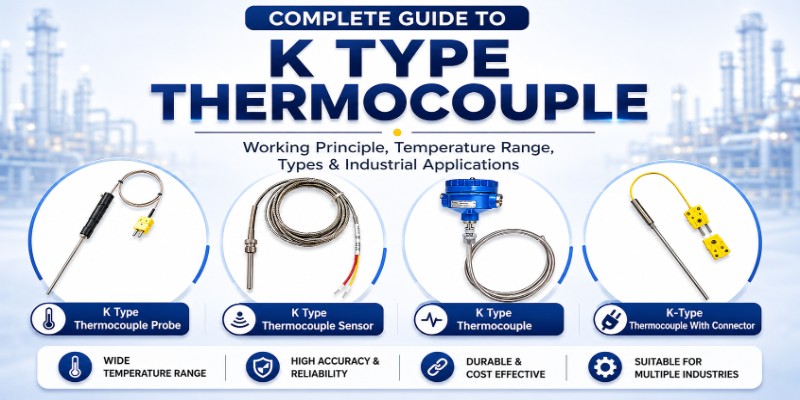
K Type Thermocouple: Complete Guide to Working Principle, Temperature Range, Types & Industrial Applications | Aavad Instrument
Table of Contents
- What Is a K Type Thermocouple?
- K Type Thermocouple Working Principle (Seebeck Effect)
- K Type Thermocouple Temperature Range
- K Type Thermocouple Materials: Chromel & Alumel Explained
- Types of K Type Thermocouple — Probe, Sensor, Head Type & More
- K Type Thermocouple vs J Type, T Type, R Type: Full Comparison
- K Type Thermocouple Accuracy & Tolerance
- K Type Thermocouple Applications by Industry
- How to Select the Right K Type Thermocouple for Your Process
- K Type Thermocouple Installation & Wiring Guide
- Common Problems & Troubleshooting Tips
- K Type Thermocouple Price in India
- Why Choose Aavad Instrument as Your K Type Thermocouple Manufacturer?
- FAQs
- Conclusion
1. What Is a K Type Thermocouple?
A K type thermocouple is the world’s most widely used temperature sensor, accounting for over 90% of all industrial thermocouple installations globally. It is made by joining two dissimilar metal alloys — Chromel (nickel-chromium) as the positive leg and Alumel (nickel-aluminum) as the negative leg — at one end to form a measuring junction.
When this junction experiences a temperature change, it generates a small but measurable electromotive force (EMF), or voltage, that corresponds precisely to the temperature being measured. This signal is then read by a temperature indicator, data logger, or process controller to display or control the temperature.
Why is the K Type thermocouple so popular?
- Covers the widest temperature range of any base-metal thermocouple: –270°C to +1,372°C
- Highly cost-effective compared to noble-metal thermocouples (Type R, S, B)
- Excellent performance in oxidizing and inert atmospheres
- Fast response time due to mineral insulation and small-diameter sheath options
- Available in multiple form factors: bare wire, probe, sensor assembly, head type, mineral insulated (MI)
At Aavad Instrument Pvt. Ltd. — an ISO 9001:2015 and NABL-certified manufacturer based in Ahmedabad, Gujarat — we design and manufacture K type thermocouples for India’s most demanding industrial environments, from steel furnaces to pharmaceutical cleanrooms.
2. K Type Thermocouple Working Principle (Seebeck Effect)
The K type thermocouple working principle is based on the Seebeck Effect, discovered by physicist Thomas Johann Seebeck in 1821.
How the Seebeck Effect works:
When two different conductive metals — in this case Chromel (+) and Alumel (−) — are joined at two points (the “hot junction” and the “cold junction” or reference junction), and these two junctions are maintained at different temperatures, a net electromotive force (EMF) is generated in the circuit.
The formula:
EMF = S × (T_hot – T_cold)
Where:
- S = Seebeck coefficient (~41 µV/°C for Type K)
- T_hot = temperature at the measuring junction
- T_cold = temperature at the reference junction (usually 0°C or ambient)
In simple terms:
- The hot junction is placed at the point where temperature needs to be measured (e.g., inside a furnace).
- The cold junction (reference junction) is at a known, stable temperature.
- The voltage difference between the two junctions is measured and converted to a temperature reading using standardized IEC 60584 K type thermocouple tables.
- Modern temperature transmitters and displays perform this conversion automatically, also applying Cold Junction Compensation (CJC).
Key insight: The K type thermocouple does NOT measure absolute temperature — it measures the difference in temperature between two junctions. This is why proper cold junction compensation is critical for accuracy.
3. K Type Thermocouple Temperature Range
| Parameter | Specification |
|---|---|
| Operating Range (continuous) | –200°C to +1,260°C |
| Short-term peak (in air) | Up to 1,372°C |
| Cryogenic applications | –270°C (with special insulation) |
| Recommended for oxidizing atmosphere | 0°C to 1,260°C |
| Recommended for inert atmosphere | –200°C to 1,260°C |
| Not recommended | Reducing, sulphurous, or vacuum atmospheres above 500°C without protection tube |
Temperature Range by Sheath Material (Aavad Instrument):
| Sheath Material | Max Temperature |
|---|---|
| SS 304 | Up to 850°C |
| SS 316 | Up to 900°C |
| Inconel 600 | Up to 1,150°C |
| Ceramic (Al₂O₃) | Up to 1,300°C |
| Silicon Carbide (SiC) | Up to 1,600°C (with K type wire) |
Pro Tip: For temperatures above 1,260°C in continuous service, consider upgrading to a Type R or Type S (Platinum-Rhodium) thermocouple from Aavad Instrument’s range, which supports up to 1,600°C.
4. K Type Thermocouple Materials: Chromel & Alumel Explained
The exceptional performance of the K type thermocouple comes from the unique properties of its two alloy legs:
Chromel (Positive Leg, +)
- Composition: ~90% Nickel + ~10% Chromium
- Color code (IEC): Green
- Color code (ANSI): Yellow
- Properties: Non-magnetic, high oxidation resistance, high thermoelectric output
Alumel (Negative Leg, −)
- Composition: ~95% Nickel + ~2% Manganese + ~2% Aluminum + ~1% Silicon
- Color code (IEC): White
- Color code (ANSI): Red
- Properties: Magnetic, good thermal stability, low thermoelectric sensitivity to stray magnetic fields
Why This Combination Excels:
- Together they produce approximately 41 µV/°C, one of the highest sensitivity values among base-metal thermocouples
- Chromel’s oxidation resistance protects the sensor in air and oxidizing atmospheres
- The combination is inherently stable across a wide temperature range
- Both alloys are abundant and affordable, making K type thermocouples the most cost-effective choice for industrial use
At Aavad Instrument, we source high-purity Chromel and Alumel alloys and use compacted MgO (Magnesium Oxide) insulation in our Mineral Insulated (MI) K type thermocouples, ensuring minimal signal drift and long service life.
5. Types of K Type Thermocouple — Probe, Sensor, Head Type & More
Aavad Instrument manufactures K type thermocouples in multiple form factors to suit every industrial application:
5.1 K Type Thermocouple Probe
The K type thermocouple probe is the most versatile form factor, consisting of a metallic sheath (SS, Inconel, or ceramic) with the thermocouple wire inside, connected to a lead wire or flying leads. It is ideal for:
- Direct immersion in liquids, gases, or semi-solids
- Surface temperature measurement
- Laboratory and research applications
- Food processing and pharmaceutical applications (hygienic probe designs available)
- OEM integration into equipment and machinery
Aavad Probe Specifications:
- Sheath OD: 1.5 mm to 12 mm
- Sheath length: Custom (up to 3,000 mm standard; longer on request)
- Tip style: Grounded, ungrounded, or exposed junction
- End fitting: Bare, with plug, terminal head, or connector
- IP protection: Up to IP67
5.2 K Type Thermocouple Sensor
A K type thermocouple sensor typically refers to a complete measurement assembly — probe + connection head or transmitter — ready for direct process installation. Aavad’s sensor assemblies include:
- Wire-wound mineral insulated sensor for high-vibration environments
- Flexible thermocouple sensors for tight or curved installation spaces
- Quick-response thermocouple sensors with thin-sheath design for fast process control
- Duplex (twin-element) sensors for redundancy in critical processes
5.3 Head Type K Type Thermocouple
The head type K type thermocouple is the standard industrial configuration featuring:
- A thermocouple element (MI cable or insert) inside a thermowell or protection tube
- A die-cast aluminium or stainless steel connection head (IP65/IP67/Flameproof Ex d)
- A ceramic or nickel-plated terminal block inside the head for signal wiring
- Process connection in BSP, NPT, or flanged format
Aavad’s Model AKFS-10 is our flagship head type K thermocouple with:
- SS 316 sheath, 8mm OD
- MgO insulation
- Die-cast aluminium flameproof head (IP67)
- Operating range: 0 to 850°C
- BSP ½” process connection
5.4 Mineral Insulated (MI) K Type Thermocouple
MI thermocouples use compacted magnesium oxide powder as insulation between the thermocouple wires and the metal sheath. Benefits:
- Highly flexible and bendable
- Excellent vibration resistance
- Fast response time
- Available from 0.5 mm to 12 mm OD
- Can be cut and re-terminated on-site
5.5 K Type Thermocouple with Flameproof / Explosion-Proof Head
For hazardous area installations (Zone 1, Zone 2, Zone 21, Zone 22), Aavad manufactures ATEX/IECEx-compatible flameproof thermocouple heads with:
- Ex d IIC T6 certification compliance
- Flameproof aluminium or cast iron head
- Heavy-duty conduit cable entry (¾” ET)
- Suitable for petrochemical, oil & gas, and chemical plant environments
5.6 Surface Mount K Type Thermocouple
For measuring surface temperatures of pipes, tanks, and equipment:
- Flat pad or bolt-on surface contact design
- Spring-loaded tip for consistent contact pressure
- Available with Teflon or fibreglass-insulated lead wire
6. K Type Thermocouple vs J Type, T Type, R Type: Full Comparison
| Feature | K Type | J Type | T Type | R/S Type |
|---|---|---|---|---|
| Materials | Chromel/Alumel | Iron/Constantan | Copper/Constantan | Platinum-Rhodium |
| Temp Range | –270°C to 1372°C | –210°C to 1200°C | –270°C to 400°C | 0°C to 1600°C |
| Sensitivity | ~41 µV/°C | ~51 µV/°C | ~43 µV/°C | ~10 µV/°C |
| Atmosphere | Oxidizing/Inert | Reducing/Inert | Mild only | Oxidizing |
| Cost | Low | Low | Low | Very High |
| Best For | General industrial | Reducing atmospheres | Cryogenic/food | High-temp precision |
| Durability | Excellent | Moderate (J oxidizes) | Limited above 300°C | Excellent |
| Availability | Very high | High | Moderate | Limited |
Verdict: For most industrial applications in India — furnaces, kilns, chemical processing, power plants, food & pharma — the K type thermocouple is the best all-round choice, offering the widest temperature range at the lowest cost.
7. K Type Thermocouple Accuracy & Tolerance
Per IEC 60584-2 and ASTM E230 standards, K type thermocouple accuracy classes are:
| Accuracy Class | Temperature Range | Tolerance |
|---|---|---|
| Class 1 (Special Tolerance) | –40°C to 1,000°C | ±1.5°C or ±0.4% (whichever is greater) |
| Class 2 (Standard Tolerance) | –40°C to 1,200°C | ±2.5°C or ±0.75% (whichever is greater) |
| Class 3 | –200°C to 40°C | ±2.5°C or ±1.5% |
Aavad Instrument manufactures K type thermocouples to Class 1 and Class 2 tolerances, calibrated in our NABL-accredited laboratory (NABL registration ensures traceability to national and international standards).
Factors affecting accuracy:
- Thermocouple wire purity and homogeneity
- Sheath material and sealing quality
- Cold junction compensation accuracy
- Installation conditions (immersion depth, thermal shunting)
- Extension lead wire grade and matching
8. K Type Thermocouple Applications by Industry
8.1 Steel & Metal Industry
K type thermocouples monitor temperatures in:
- Induction furnaces (up to 1,200°C)
- Heat treatment ovens (annealing, tempering, normalizing)
- Rolling mill exit temperatures
- Ladle and tundish temperature measurement (with ceramic protection tubes)
- Quenching bath temperature control
8.2 Chemical & Petrochemical Industry
- Reactor temperature monitoring
- Distillation column temperature profiling
- Heat exchanger inlet/outlet measurement
- Flameproof versions for hazardous area classification
- Acid-resistant sheath materials (Hastelloy, Inconel) for corrosive media
8.3 Power Generation
- Gas turbine exhaust temperature measurement
- Boiler flue gas temperature monitoring
- Transformer oil temperature
- Generator bearing temperature
- Steam pipe temperature measurement
8.4 Pharmaceutical & Food Processing
- Autoclave/sterilizer temperature validation
- Fermentation temperature control
- Freeze-dryer shelf temperature
- Pasteurization line monitoring
- FDA-compliant hygienic probe designs
8.5 Glass & Ceramics Industry
- Furnace and kiln temperature control (up to 1,260°C)
- Annealing lehr temperature monitoring
- Ceramic firing temperature control
8.6 Plastics & Rubber Industry
- Extruder barrel and die temperature control
- Injection moulding machine monitoring
- Rubber vulcanization temperature
8.7 HVAC & Building Automation
- Duct air temperature measurement
- Chiller/cooling tower monitoring
- Boiler room temperature control
8.8 Automotive & Aerospace
- Engine exhaust gas temperature (EGT) measurement
- Brake system temperature monitoring
- Turbine inlet temperature
- Crash-test and thermal simulation
9. How to Select the Right K Type Thermocouple for Your Process
Use this 6-step checklist when specifying a K type thermocouple:
Step 1 — Define Your Temperature Range Confirm the minimum and maximum process temperatures. If continuously above 1,100°C, consider ceramic-sheathed MI or noble-metal thermocouples.
Step 2 — Identify the Process Atmosphere
- Oxidizing (air, O₂): K type is ideal
- Reducing (H₂, CO): K type suffers “green rot” degradation above 650°C; use J type or protect with appropriate sheath
- Vacuum: Noble metal types preferred above 500°C
- Sulphurous gases: Requires special sheath (Inconel or ceramic)
Step 3 — Choose the Sheath Material
- SS 316: General duty, up to 900°C
- Inconel 600: High-temperature and corrosion-resistant, up to 1,150°C
- Ceramic (alumina): Chemically inert, up to 1,600°C
Step 4 — Determine the Probe Dimensions
- Length: Minimum immersion depth should be 10× the sheath OD for accurate reading
- OD: Smaller OD (1.5–3 mm) = faster response; larger OD (6–12 mm) = longer life
Step 5 — Select the Connection Style
- Bare leads: For direct panel connection or transmitter
- Connector (miniature or standard): For quick-disconnect applications
- Connection head: For permanent industrial installation
- Transmitter head mount: For 4–20 mA output directly to PLC/DCS
Step 6 — Consider the Installation Environment
- Hazardous area: Specify flameproof (Ex d) or intrinsically safe (Ex i) head
- High vibration: Specify MI design with armoured extension lead
- Hygienic/cleanroom: Specify electropolished SS, PTFE-insulated leads, and sanitary process fittings
Need help selecting? Contact Aavad Instrument’s engineering team at hrg@aavadinstrument.com or call +91 90996 22823. We provide free application consultation.
10. K Type Thermocouple Installation & Wiring Guide
Installation Best Practices:
1. Immersion Depth Install the thermocouple so that the hot junction (tip) is at the centre of the process medium, with a minimum immersion depth of at least 10× the sheath diameter. Shallow immersion causes under-reading due to conduction heat loss to the cooler outside.
2. Avoid Thermal Gradients Do not install thermocouples near uninsulated vessel walls, flanges, or nozzles where heat conduction can create false readings.
3. Flow Direction For pipe installation, insert the thermocouple against the flow direction where possible, or at a 45° angle using an adjustable compression fitting.
4. Extension Wires Use K type extension grade wire (green/white per IEC, or yellow per ANSI) from the thermocouple head to the indicator. Never use copper wire — it introduces EMF errors. Extension wire must match the thermocouple type exactly.
5. Shielding & Earthing In electrically noisy environments, use shielded extension cable and earth (ground) the shield at one end only (at the control panel end) to avoid ground loops.
K Type Thermocouple Wiring (Color Codes):
| Standard | Positive (+) | Negative (–) | Overall |
|---|---|---|---|
| IEC 60584 | Green | White | Green |
| ANSI/ASTM | Yellow | Red | Yellow |
| BS (UK, old) | Brown | Blue | Brown |
| DIN (Germany) | Green | Red | Green |
Important: Always connect to the correct polarity. Reversed connections will cause the instrument to read in the wrong direction from ambient temperature.
11. Common Problems & Troubleshooting Tips
| Problem | Likely Cause | Solution |
|---|---|---|
| Reading too low | Insufficient immersion depth | Re-install with correct immersion |
| Reading drifts over time | Thermocouple contamination or “green rot” | Replace element; use protection tube |
| Noisy/fluctuating reading | Electrical interference | Use shielded extension cable |
| Open circuit / no reading | Wire break or connection failure | Check connections; replace element |
| Reading reversed | Polarity swapped | Swap + and – connections |
| Reading correct at start, drifts high | Calibration drift in reducing atmosphere | Replace with appropriate type or sheath |
| Sluggish response | Sheath OD too large, or grease/scale on tip | Use smaller OD; clean or replace tip |
Note on “Green Rot”: K type thermocouples exposed to low-oxygen or reducing atmospheres above 700°C suffer selective oxidation of chromium in the Chromel leg, causing a green oxide layer (the name “green rot”). This creates significant measurement errors. In such atmospheres, specify Aavad’s Inconel-sheathed K type thermocouples or switch to Type N, which is specifically designed to resist this phenomenon.
12. K Type Thermocouple Price in India
The price of a K type thermocouple in India depends on several factors:
| Factor | Impact on Price |
|---|---|
| Sheath material (SS vs Inconel vs Ceramic) | Moderate to High |
| Sheath OD and length | Moderate |
| Form factor (bare wire vs probe vs head type) | Significant |
| Accuracy class (Class 1 vs Class 2) | Low to Moderate |
| Flameproof/ATEX certification | High |
| NABL calibration certificate | Low |
| Quantity | Volume discounts available |
Typical price range:
- Basic K type thermocouple wire probe: ₹350 – ₹800 per piece
- Standard head type K thermocouple (SS 316): ₹1,200 – ₹3,500
- Flameproof (Ex d) K type thermocouple: ₹4,000 – ₹12,000
- Ceramic-sheathed K type (high temp): ₹2,500 – ₹8,000
Get an accurate quote for your exact specifications from Aavad Instrument — we offer competitive pricing with NABL-certified quality. Call +91 90996 22823 or email hrg@aavadinstrument.com.
13. Why Choose Aavad Instrument as Your K Type Thermocouple Manufacturer?
13.1 NABL-Accredited Calibration Lab
Every K type thermocouple manufactured at Aavad Instrument can be supplied with a NABL (National Accreditation Board for Testing and Calibration Laboratories) calibration certificate, ensuring full traceability to international standards. This is critical for ISO-certified plants, pharmaceutical GMP compliance, and government tender requirements.
13.2 ISO 9001:2015 Certified Manufacturing
Our entire manufacturing process — from raw material procurement to final inspection and dispatch — follows ISO 9001:2015 quality management standards.
13.3 15+ Years of Industry Experience
With over 15 years of experience and 38 million+ successful installations across India and 12+ countries, Aavad Instrument has the expertise to solve even the most complex temperature measurement challenges.
13.4 Complete Customisation
No two industrial processes are identical. Aavad Instrument offers:
- Custom sheath lengths from 100 mm to 6,000 mm
- Any sheath material: SS304, SS316, Inconel 600, Hastelloy, ceramic, SiC
- Any process connection: BSP, NPT, flanged, compression, sanitary clamp
- Any head type: Aluminium IP67, stainless IP67, flameproof Ex d, watertight
- Custom accuracy class and NABL calibration
- Dual-element (duplex) for redundancy
- Integrated temperature transmitter (4–20 mA / HART / FOUNDATION Fieldbus)
13.5 Trusted by India’s Leading Industries
Aavad Instrument’s thermocouples are trusted by:
- BHEL, ONGC, HAL, BARC, NALCO (Public sector/defence)
- Indian Oil, Bharat Petroleum, NPCIL (Energy)
- Torrent Pharma, Piramal Glass, Saint-Gobain (Pharma & glass)
- Aditya Birla Group, L&T, SINTEX (Conglomerate)
- PepsiCo, Kohler (FMCG & industrial)
13.6 Fast Turnaround & Pan-India Delivery
- Standard models dispatched within 3–5 working days
- Custom/special models within 7–15 working days
- Pan-India delivery; export to UAE, USA, Germany, Indonesia, Bahrain, Kuwait, Saudi Arabia
13.7 End-to-End Support
- Free technical consultation and application engineering support
- On-site installation assistance available
- After-sales calibration and recertification service
- Datasheet and 2D drawing available for every model
14. Frequently Asked Questions (FAQs)
Q1. What is a K type thermocouple used for? A K type thermocouple is used to measure temperatures ranging from –270°C to +1,372°C in industrial processes such as furnaces, kilns, heat treatment systems, power plants, chemical reactors, and food processing equipment. It is the most commonly used thermocouple type worldwide due to its wide temperature range and cost-effectiveness.
Q2. What is the temperature range of a K type thermocouple? The standard operating temperature range of a K type thermocouple is –200°C to +1,260°C for continuous use, with a short-term peak capability of up to 1,372°C. Special low-temperature versions can operate down to –270°C.
Q3. What are K type thermocouples made of? K type thermocouples are made of two dissimilar alloys: Chromel (90% nickel, 10% chromium) as the positive leg and Alumel (95% nickel with manganese, aluminum, and silicon) as the negative leg. These are often referred to as Chromel/Alumel thermocouples.
Q4. How accurate is a K type thermocouple? Per IEC 60584-2, a Class 1 K type thermocouple has an accuracy of ±1.5°C or ±0.4% (whichever is greater) over the range –40°C to 1,000°C. Class 2 accuracy is ±2.5°C or ±0.75%. Aavad Instrument supplies both classes with NABL calibration.
Q5. What colour is a K type thermocouple? Under IEC 60584-3 standard: Positive leg (Chromel) = Green; Negative leg (Alumel) = White; Overall cable = Green. Under ANSI/ASTM: Positive = Yellow; Negative = Red; Overall = Yellow.
Q6. Can a K type thermocouple be used in a reducing atmosphere? K type thermocouples are not recommended for use in reducing, sulphurous, or low-oxygen atmospheres above 650–700°C due to a phenomenon called “green rot” (selective chromium oxidation in the Chromel leg). For such environments, use a Type N thermocouple or a K type with a protective ceramic sheath.
Q7. What is the difference between a K type thermocouple probe and sensor? A thermocouple probe refers specifically to the sensing element — the sheathed thermocouple wire with a measuring junction at the tip. A thermocouple sensor is a broader term that includes the probe plus any connection accessories (head, connector, transmitter). In practice the terms are often used interchangeably.
Q8. What is the output of a K type thermocouple at 500°C? At 500°C (with a 0°C cold junction), a K type thermocouple produces approximately 20.64 mV, as per IEC 60584-1 reference tables.
Q9. How do I connect a K type thermocouple to a PLC or controller? Connect the positive (green, IEC) lead to the thermocouple+ input terminal and negative (white, IEC) lead to the thermocouple− terminal on the PLC analog input card or temperature controller. Select “K type” as the input type in the configuration. Use K type extension cable for all runs from the thermocouple head to the panel. Never use copper wire.
Q10. Who is the best K type thermocouple manufacturer in India? Aavad Instrument Pvt. Ltd., based in Ahmedabad, Gujarat, is one of India’s leading NABL-accredited, ISO 9001:2015 certified K type thermocouple manufacturers. With 15+ years of experience, 2,900+ satisfied customers, and clients including BHEL, ONGC, and Aditya Birla Group, Aavad Instrument delivers world-class temperature measurement solutions at competitive prices.
15. Conclusion
The K type thermocouple remains the gold standard for industrial temperature measurement — no other base-metal thermocouple matches its combination of wide temperature range, reliability, versatility, and affordability. Whether you need a simple K type thermocouple probe for a food processing line, a flameproof head type sensor for a petrochemical plant, or a high-temperature ceramic-sheathed assembly for a ceramic kiln, the right K type thermocouple from a trusted manufacturer will give you years of accurate, trouble-free performance.
Aavad Instrument Pvt. Ltd. brings together NABL-accredited calibration, ISO-certified manufacturing, 15+ years of application expertise, and true customisation capability to deliver K type thermocouples that meet your exact process requirements — on time and at the right price.
📞 Ready to Order or Need a Custom Quote?
Aavad Instrument Pvt. Ltd. Sangath Mall-1, 216-217, Opp. Vishwakarma Engineering College, Chandkheda, Ahmedabad, Gujarat – 380005
📱 +91 90996 22823 📧 hrg@aavadinstrument.com 🌐 www.aavadinstrument.com
👉 Get a Quote for K Type Thermocouple 👉 Browse K Type Thermocouple Products
- Link “K Type Thermocouple Probe” → https://aavadinstrument.com/product/k-type-thermocouple-probe/
- Link “K Type Thermocouple Sensor” → https://aavadinstrument.com/product/k-type-thermocouple-sensor/
- Link “Head Type Thermocouple” →Head Type Thermocouple Manufacturer – Aavad Instrument Pvt. Ltd.
- Link “Get a Quote” → Contact Us Aavad Instrument Pvt. Ltd. | Ahmedabad, Gujarat