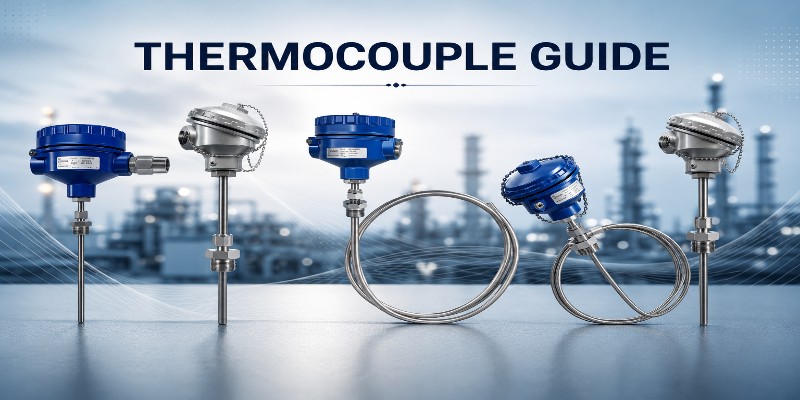
A thermocouple is a temperature sensor that generates a millivolt signal from two joined dissimilar metal wires via the Seebeck effect — no external power required, accurate from -270°C to over 1,700°C depending on type.
Key Takeaways:
- Type K is the default choice for most industrial work (-200°C to 1,260°C) — widest common range, lowest cost, works in oxidizing/inert atmospheres.
- Type N outperforms Type K above 300–500°C in marginal-oxygen atmospheres, resisting the “green rot” oxidation failure that degrades Type K over time.
- Type T is the only base-metal type built for cryogenic accuracy, stable down to -200°C for cold-chain and refrigeration duty.
- Selection order matters: confirm temperature range first, atmosphere second, accuracy class third — picking by habit is the #1 cause of premature sensor failure.
What a Thermocouple Measures — and How
A thermocouple has two junctions. The hot (measuring) junction is the welded tip placed at the process point. The cold (reference) junction is where the wires terminate at the instrument. The temperature difference between them produces a non-linear millivolt signal (roughly 0–50+ mV depending on type and range) that the transmitter or PLC input card converts to temperature — provided it applies correct cold-junction compensation (CJC).
Field-experience note: the single most common thermocouple “fault” reported to Aavad’s service team isn’t a bad sensor — it’s a consistent, uniform offset across the whole reading range caused by misconfigured CJC. That’s a wiring/configuration issue, not a sensor defect, and it’s diagnosed in minutes if you know to check it first.
Base Metal vs Noble Metal Thermocouples
Thermocouple types fall into two broad families:
- Base metal types (K, J, T, E, N) — built from common metals and alloys (nickel-chromium, iron, copper, constantan, nicrosil). These cover the vast majority — roughly 90% — of industrial thermocouple installations, handle most work up to around 1,260°C, and are priced as commodity items.
- Noble metal types (S, R, B) — built from platinum and platinum-rhodium alloys, used where base metals would melt or degrade, generally above 1,400°C. They’re also used as lab calibration references for their stability. Expect a significant cost premium — often 10 to 50 times a comparable base-metal assembly — so these are only worth it when the process temperature genuinely forces you there.
Practical rule of thumb: if your continuous process temperature stays below roughly 1,200°C, start with a base-metal type. Only move to a noble-metal type when temperature or atmosphere genuinely rules base metals out.
Thermocouple Types Compared: K vs. J vs. T vs. N
These four base-metal types cover the overwhelming majority of industrial applications and make up Aavad’s core thermocouple range.
| Type | Materials | Typical Range | Best For | Key Notes |
|---|---|---|---|---|
| K | Nickel-Chromium / Nickel-Alumel | ~-200°C to 1,260°C (continuous ~1,100°C) | General-purpose industrial use, furnaces, ovens | The industry workhorse — widest common range, good in oxidizing/inert atmospheres, cost-effective |
| J | Iron / Constantan | ~-210°C to 760°C | Older equipment, vacuum or reducing atmospheres, moderate-temp process | Shorter lifespan at high temperature than K; the iron leg oxidizes over time in open air at high temp |
| T | Copper / Constantan | ~-200°C to 350°C | Cryogenic and low-temperature applications | Very stable at low temperature; the go-to choice for sub-zero and refrigeration duty |
| N | Nicrosil / Nisil | ~-200°C to 1,300°C (continuous ~1,200°C) | High-temperature service where K-type stability issues appear | Better long-term stability than K in the 300–500°C band; more resistant to the “green rot” oxidation problem that affects Type K in marginal-oxygen atmospheres |
Aavad’s Thermocouple Range
Aavad Instrument manufactures head-type thermocouples across all four core types, plus weatherproof and flameproof constructions for demanding installation environments:
- K-Type Thermocouple — the general-purpose, widest-range option and the most commonly ordered type across process industries; available in flameproof construction for hazardous-area installations.
- J-Type Thermocouple — suited to moderate-temperature and legacy equipment applications where a J-type input is already standardized.
- T-Type Thermocouple — built for stable, accurate readings at low and sub-zero temperatures, common in cold-chain, refrigeration, and cryogenic-adjacent process duty.
- N-Type Thermocouple — an Inconel-sheathed construction for high-temperature applications that need better long-term stability than a standard K-type, particularly where marginal-oxygen atmospheres would otherwise cause premature K-type drift.
- Weatherproof K-Type Thermocouple — a sealed, weatherproof head construction for outdoor and washdown-exposed installations where a standard head assembly would risk moisture ingress.
Browse the complete head type thermocouple range for full specifications and custom-length options.
Thermocouple vs RTD: Which Should You Use?
| Factor | Thermocouple | RTD |
|---|---|---|
| Temperature range | Very wide — cryogenic to 1,700°C+ (type-dependent) | Generally narrower, typically up to ~600–850°C |
| Accuracy | Good, but lower than RTD | Higher accuracy and better long-term stability |
| Response time | Fast | Slightly slower (construction-dependent) |
| Signal | Self-generated millivolt (no excitation needed) | Requires excitation current to measure resistance |
| Cost | Lower, especially base-metal types | Higher, but often justified by accuracy needs |
| Best for | High-temperature, fast-response, rugged/vibration-prone applications | Precision process control at moderate temperatures |
If your process runs hot, fast-cycling, or in a harsh mechanical environment, a thermocouple is usually the right call. If you need tighter accuracy at moderate temperatures — say, in pharma or precision chemical process control — an RTD is typically worth the extra cost.
How to Choose the Right Thermocouple Type
Work through these three variables in order — temperature first, atmosphere second, accuracy third — rather than picking a type by habit or catalog familiarity:
- Temperature range first. Rule out any type whose range doesn’t comfortably cover your process, with margin. Don’t run a type at the edge of its rated range if you can avoid it.
- Atmosphere compatibility second. Reducing, oxidizing, sulfurous, or vacuum atmospheres each favor different types — a Type K, for example, is prone to a stability-degrading oxidation issue in marginal-oxygen atmospheres where a Type N would hold up better.
- Accuracy class third. Confirm the required tolerance against the type’s standard or special-limits-of-error accuracy class — don’t assume every application needs the tightest available class, since that’s often where cost is added unnecessarily.
- Construction and installation environment. Confirm sheath material, head style (weatherproof, flameproof, standard), and connection type against where and how the sensor will actually be mounted — a correct sensor type in the wrong housing still fails early in outdoor or hazardous locations.
- Compatibility with your transmitter/input card. Confirm the receiving temperature transmitter or PLC input card is configured for the same type — a mismatched type configuration will silently produce a wrong-but-plausible temperature reading rather than an obvious fault.
- Releted blogs-K Type Thermocouple Guide ,Type K vs Type N Thermocouple: Green Rot Guide | Aavad,Type N Thermocouple: Working Principle, Benefits & Uses,Type T Thermocouples for Freezers, Labs & Cold Chain,J Type Thermocouples for Food Processing & Packaging
Where Thermocouples Are Used
- Furnaces, kilns, and heat-treatment processes
- Power generation — boilers, turbines, exhaust gas monitoring
- Oil, gas, and petrochemical processing
- Steel, cement, and heavy process industries
- Food processing and cold-chain/refrigeration (T-type)
- Chemical and pharmaceutical manufacturing
- HVAC, foundries, and general industrial process control
Common Thermocouple Problems (and What Causes Them)
- Drifting or unstable readings — often cold-junction compensation error, or a Type K in a marginal-oxygen atmosphere suffering oxidation (“green rot”)
- Sudden open-circuit failure — physical wire break at the junction, often from vibration fatigue or mechanical stress at the sheath
- Consistent offset error across the whole range — almost always a cold-junction compensation or wiring/polarity issue, not a sensor fault
- Slow response — usually a construction/sheath thickness issue rather than a type issue; a heavier sheath protects the junction but adds thermal mass
- Reading a plausible but wrong temperature — a mismatched type configuration on the transmitter or PLC input card (e.g., a K-type sensor read against a J-type curve)
Why Choose Aavad Instrument as Your Thermocouple Manufacturer
- ISO 9001:2015 certified manufacturing with NABL-accredited calibration support
- Full type range — K, J, T, and N type thermocouples, in standard, weatherproof, and flameproof head constructions, from a single thermocouple manufacturer
- Custom configuration — sheath material, length, head style, and connection type built to your exact process rather than a fixed catalog spec
- Full temperature-loop portfolio — pair directly with Aavad’s temperature transmitters, thermowells, and thermocouple connectors for a complete, single-vendor measurement assembly
- Proven industrial track record — long-standing supply relationships with BHEL, ONGC, NPCIL, Indian Oil, BPCL, L&T, and other major industrial and public-sector accounts
If you’re specifying thermocouples for a new project or replacing failed sensors on an existing line, get a quote from Aavad’s engineering team — share your process temperature, atmosphere, and installation environment, and they’ll recommend the right type and construction rather than just selling a catalog part number.
Frequently Asked Questions (FAQ)
1. What is a thermocouple and how does it work?
A thermocouple is a temperature sensor made from two dissimilar metal wires joined at a measuring junction. A temperature difference between the measuring junction and reference junction generates a thermoelectric voltage through the Seebeck effect, which the measuring instrument converts into temperature.
2. What is the difference between K-type and J-type thermocouples?
Type K provides a wider temperature range and is commonly used for general industrial applications, while Type J has a lower upper-temperature capability and is often selected for moderate-temperature or legacy equipment. Type K uses Nickel-Chromium/Nickel-Alumel, while Type J uses Iron/Constantan.
3. How do I choose the right thermocouple type?
Start with temperature range, then evaluate process atmosphere, followed by accuracy requirements. After selecting the sensing type, specify the sheath, junction, probe dimensions, head construction and instrument compatibility according to the installation environment.
4. Why should I choose an N-type thermocouple instead of a K-type?
Type N can provide better long-term stability than Type K in certain demanding high-temperature conditions, including environments where Type K can experience oxidation-related stability problems. The final choice should be based on the actual temperature and atmosphere.
5. What is cold-junction compensation in a thermocouple?
Cold-junction compensation corrects the thermocouple measurement for the actual temperature at the instrument connection point. Incorrect CJC configuration can cause a consistent temperature offset even when the thermocouple itself is operating correctly.
Have a specific process condition to spec a thermocouple for? Contact Aavad Instrument’s engineering team with your temperature range, atmosphere, and installation details for a free recommendation.